





Medieval art continues to resurface as a foil for the art of subsequent generations. In the quattrocento, Vasari coined the term “gothic” to decry the “barbarousness” of such pre-Renaissance styles. By the mid-19th century, however, revivalists looked to it for inspiration, an egress from the calcified obsequiousness of neoclassicism and the depredations of industrialization. The latter had torn up the old social fabric, killed hundreds of thousands during the Napoleonic wars, and displaced millions from the countryside to the cities. Yet what emerged was a radically new interaction between old forms and new ideologies. William Morris, the socialist founder of the Arts and Crafts movement, believed medieval art embodied artisanal brilliance and collaboration. By contrast, Augustus Pugin, a monarchist architect of Westminster Palace, hoped it would usher in “a return to the faith and the social structures of the Middle Ages.”
Malo Chapuy is the latest avatar of medieval revivalism. Born in 1995 in northeastern France, he studied philosophy before turning to art history at the Sorbonne, and then to studio art at the École des Beaux-Arts in Paris. At art school, Chapuy resisted pressure from his advisor to “paint like Rothko,” gravitating to late 13th- and early 14th-century art. He obsessed over ancient techniques, probing manuals by famous conservationists and counterfeiters. He learned how to not only paint like the Old Masters but also make his surfaces look faded and cracked. For his thesis exhibition in 2022, he produced an illuminated manuscript, several small paintings in egg tempera, and a tapestry of faux stained glass made from Covid-19 face shields.
Malo Chapuy: The Nativity, 2025.
Courtesy mor Charpentier, Bogota
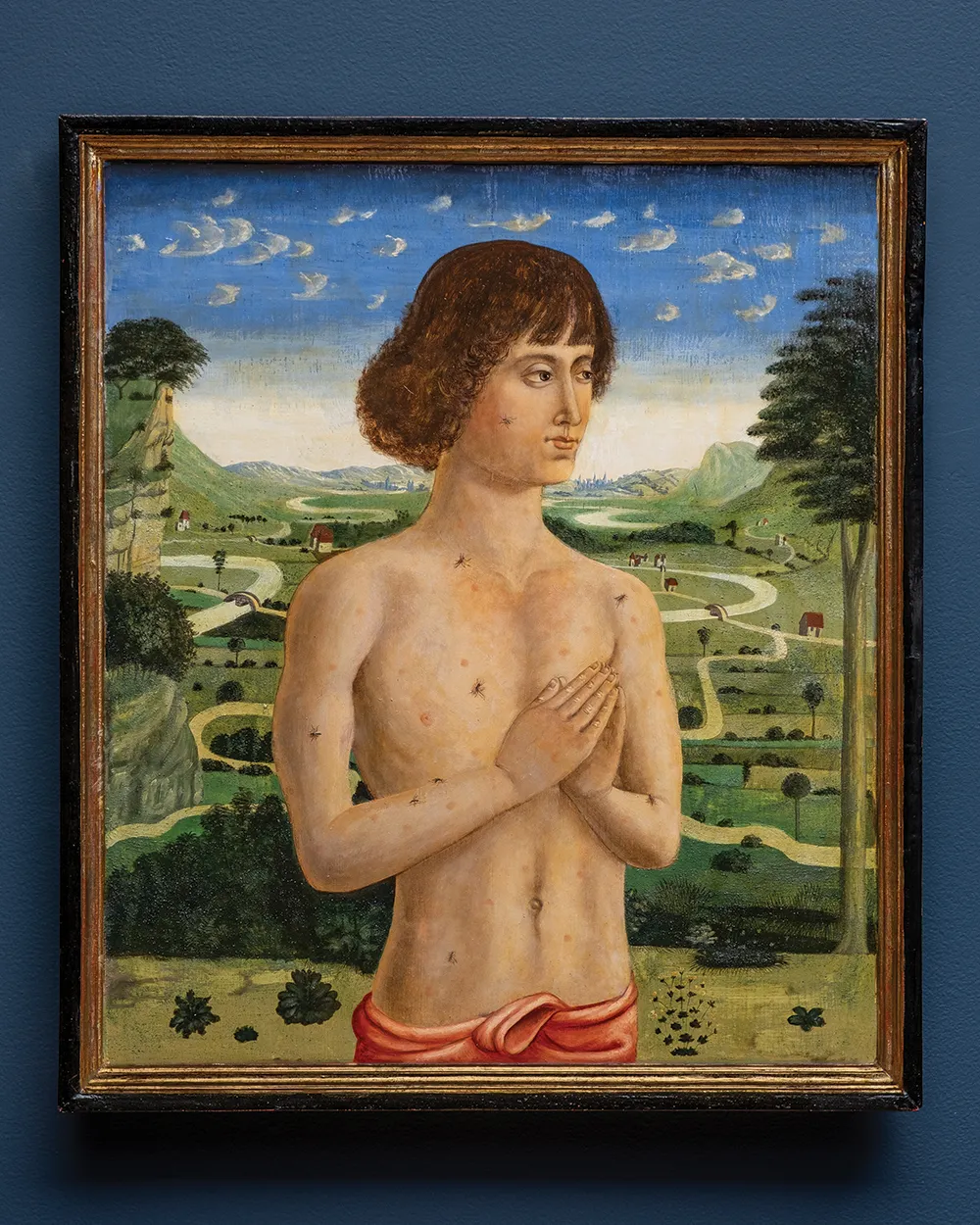
Today he paints religious scenes, altarpieces, and early Renaissance-style portraits that look like museum artifacts save for the proliferation of wind turbines, water towers, astronauts, and spaceships. Since graduating, Chapuy has seen his work included in the 2024 Lyon Biennale and in the thematic group show “Gothiques” at the Louvre-Lens last year. When we met, he had just returned from Bogota, where his gallery, Mor Charpentier, had organized a solo show of recent work.
Chapuy isn’t his gallery’s only medieval revivalist. Sacha Cambier de Montravel, a Belgian artist also born in 1995, whose studio is located across the courtyard from Chapuy’s, contributed dark diptychs and triptychs evocative of Hieronymus Bosch to the “Gothiques” exhibition. These appeared alongside works by their contemporaries Alison Flora and Emilie Pitoiset. Clearly, there is a movement—a new neogothic revival—to which Chapuy belongs.


Malo Chapuy: Scene of Pilgrimage, 2025.
Courtesy mor Charpentier, Bogota
Big tech, after all, has created a new click-based serfdom, as Yanis Varoufakis asserts in Technofeudalism, replacing capitalist markets and profit with platforms and rents. But Chapuy’s skewering of techno-feudalist fantasies shuns the digital in favor of tactile materiality, just as his 19th-century counterparts resisted industrialization. Although he denies any specific political subtext, something is happening underneath the artificially aged surfaces of his work—a new synthesis of past forms and modern ideas that says as much about ambient apocalyptic fears as it does about desires for alternative futures. In one of his two paintings of Saint George (2024), the monstrous dragon of legend appears as a serpentine oil pipeline. Black viscera seeps from its flank, pierced by George’s lance, as the saint raises his sword to strike the fatal finishing blow. Here, the potent beauty and storytelling of medieval religious art, used to such great disciplinary effect under feudalism, is reimagined as indistinguishable from the dream of overcoming present ecological and political crises.
Despite its gilded surfaces, Chapuy’s revivalism is no Panglossian golden-age thinking but an imaginative activation of alternative pasts and futures.


