








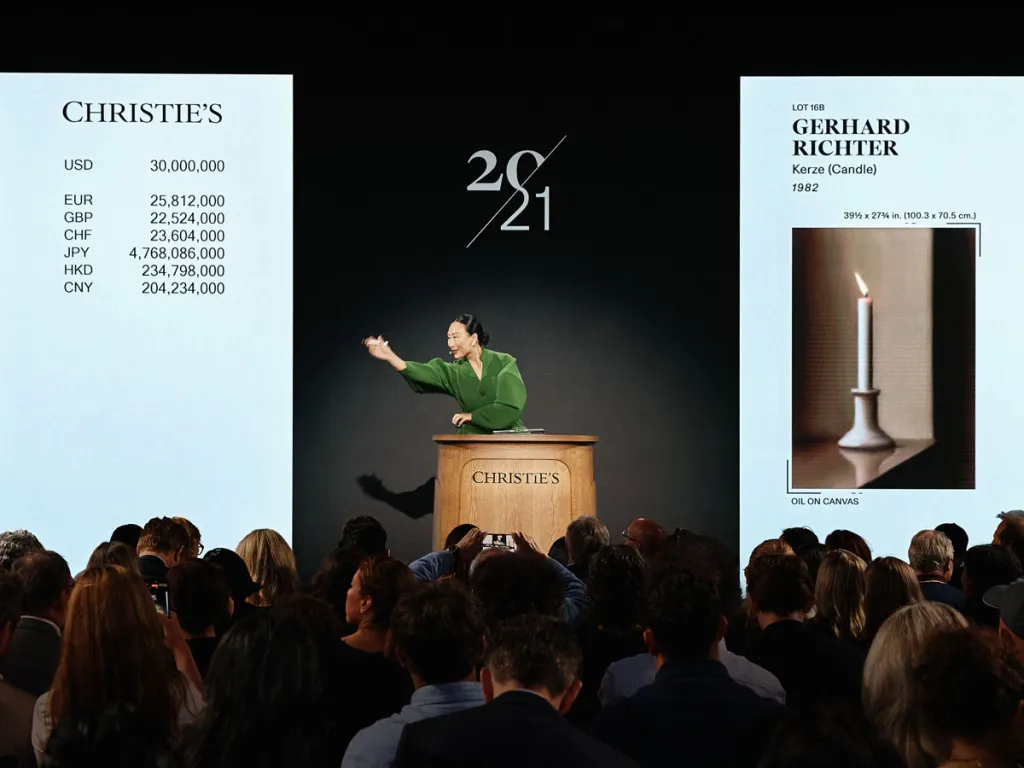
Led by a $35.1 million Gerhard Richter canvas, Christie’s New York notched a $162.7 million across a trio of evening sales of postwar and contemporary art that just barely meet expectations at its crowded Rockefeller Center salesroom on Wednesday night.
The auction was expected to bring in between $129 million and $191 million on 42 lots (after a Kerry James Marshall was withdrawn); the hammer total, before the house’s fees, came to $133.6 million, just a few million above the low estimate. Wednesday night saw the highest total for an equivalent sale in five years; last year’s equivalent sale notched $96.4 million with fees on 39 lots.
Just one work, an Ed Ruscha canvas estimated at up to $5.5 million, failed to sell. Auctioneer Yü-Ge Wang effortlessly shifted from English to Mandarin, German, and French as she took bids, mainly from Christie’s staffers who bid on behalf on clients talking by phone.
Revered art dealer Marian Goodman’s collection of eight Richter paintings was estimated to fetch in the region of $65 million; all were guaranteed to sell, either by the house or a third-party bid. The group hammered at $66 million, and with the house’s fees, the sale totaled $78.8 million. Friedrich Petzel described Goodman, who died in January, to the New Yorker in 2004 as “the queen of us all,” and dealers as varied as Jeffrey Deitch and David Zwirner described her as a model.
There was much excitement for this octad of Richters in the salesroom, which saw heavy bidding for them, minus $35.1 million Kerze (Candle) painting. Coming in second for the night was the artist’s 1995 painting Mohn (Poppy), measuring six feet high and exhibited only twice, at the Museé d’Art Contemporain de Nîmes and at Goodman’s gallery, both in 1996. Estimated at $14 to $18 million, it hammered at $16.9 million to sell for $20.1 million with fees.
Donald Judd, Untitled (1969).
Christie's
Those pieces came as the first half of a combined “Marian’s Richters & 21st Century Evening Sale” that also included market stalwarts like Jean-Michel Basquiat, Cecily Brown, Peter Doig, Keith Haring, Richard Prince, Ed Ruscha, and Andy Warhol.
Starting off the sale, at 7 p.m., were 12 works by canonical Minimalist artists from the estate of Henry S. McNeil, an ARTnews Top 200 collector from Philadelphia who died in 2025. The group was estimated to sell for between $21 million and $31 million, and hammered collectively for $21 million; all were guaranteed to sell, either by the house or with a bid placed by a third party.
The group was led by a 1969 Donald Judd stack that sold for $12.8 million, making it the night’s third-priciest lot. The sale landed at the end of an auction season that saw results ranging from respectable to blockbuster at the big three auction houses’s New York locations, confirming that at least the top end of the art market has emerged from a slump, even as broader economic indicators remain shaky amid global conflict, inflation fears, and rising energy prices.
The season kicked off last Thursday with a solid $433.1 million Sotheby’s modern and contemporary art sale, including what was at that time the second-priciest Mark Rothko ever sold. Next came a $1.1 billion night at Christie’s on Monday, including three record-smashing pieces, a $181.2 million Jackson Pollock, a $107.6 million Constantin Brâncuși, and a $98.4 million Rothko. Tuesday night saw an above-estimate $115.2 million modern and contemporary sale at Phillips and a “solid but subdued” $303.9 million modern art sale at Sotheby’s.


Gerhard Richter, Mohn (Poppy), 1995.
Christie's
“A noted shift this season from a few years ago was that most of the excitement and bidding wars were in the blue-chip classics segment instead of 21st-century contemporary [works],” New York dealer Evan Beard told ARTnews after Wednesday night’s sale. “There wasn’t much speculative capital in the room tonight. A sign of a healthy, rational art market.” Beard called the sale “well-managed.”
New York dealer and adviser Cristin Tierney weighed in, telling ARTnews, “Looking at Goodman’s Richters’ and the McNeil collection of Minimalist works, the byword is provenance, provenance, provenance—the auction market cannot get enough of it.”
Filling out the top 10 were works by four other works by Richter along with pieces by Doig, Basquiat, Brown, and Haring. Doig’s landscape painting Target (2000) was estimated at $6 million to $10 million. The unnamed seller bought it at Christie’s London in 2007 for $1.8 million. Target hammered below estimate at $5.8 million to sell for $7.2 million with fees, well below his record of $39.9 million achieved in 2021, also at Christie’s New York.
Another Richter from Goodman’s collection, Abstraktes Bild (2008), was estimated at $4 million to $6 million and hammered at $4.1 million to sell for $5.1 million with fees.

Peter Doig, Target, 2000.
Christie's
Brown’s seven-foot-wide semi-abstract painting Bedlam Vacation (2005) was estimated at $5 million to $7 million and covered by a third-party guarantee. It hammered at $4.8 million, selling squarely within the estimate, with fees for $5.9 million, or more than halfway toward her $9.8 million record set last November. The unnamed consignor of Bedlam Vacation bought it in the same salesroom in 2018 for just $2.1 million.
Haring’s 1984 canvas Untitled (June 1st a Milano) was tagged at $4 million to $6 million. It hammered at its low estimate to fetch just shy of $5 million with fees.

Cecily Brown, Bedlam Vacation (2005).
Christie's
Wang ended the night auctioning off the final lot, Jeff Koons’s Silver Shoes (1990), a photograph showing the artist and his former wife engaged in sex. Estimated at $400,000 to $600,000, it sold for just $254,000 with fees, but that was enough to inspire Wang to thank the bidder for giving the night “a happy ending,” to a round of laughs from the dwindling crowd in the sale room.


