






The Old Stone Mill in Newport, Rhode Island, is an odd little building. Eight thick stone legs support a circular tower pierced by arched openings. There aren’t exactly windows, nor is there a roof. Stand in the middle and look up and all you see is sky.
The structure, which sits in Touro Park in the city’s center, is often called a 17th-century windmill, though its exact origins have inspired theories and debate for generations, which have cycled between calling it the Newport Tower, the Touro Tower, and even the Viking Tower. Whatever it once was, today it looks like a ruin dropped into the middle of an otherwise orderly New England town.
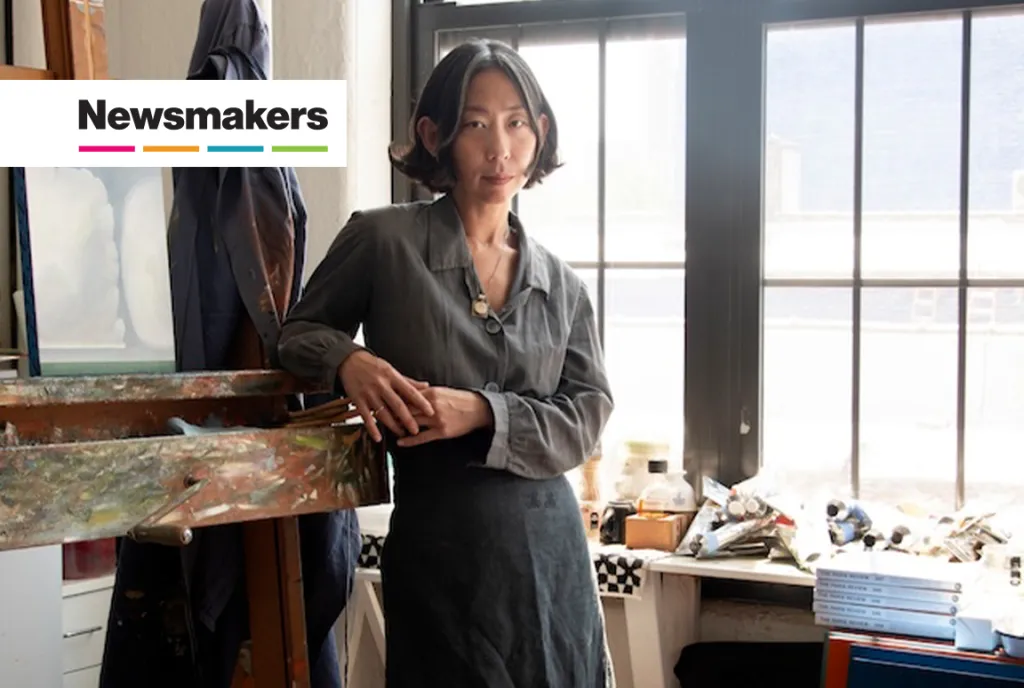
Na Kim, the renowned book designed and painter, had never been to Newport when curator and longtime Vogue writer Dodie Kazanjian invited her to make a project for Art&Newport, the organization Kazanjian founded in 2017 to bring contemporary art into the city’s historic buildings and landscapes.
It was unusually good timing: Kim, best known for her paintings of faces, had recently begun painting clouds. Her portraits, including those shown at White Columns and Nicola Vassell Gallery in New York, live in the slippery space between figuration and abstraction. Faces interested her because they are instantly recognizable and constantly changing. Clouds, she discovered, act in much the same way.
For “Portraits,” on view through August 10, Kim has placed a group of small cloud paintings in weatherproof frames around a central column inside the mill. Visitors can circle them, looking from painted clouds to real ones above, depending on the day. A second, horizontal cloud painting is installed across the street at the Redwood Library & Athenaeum.
The exhibition is the first half of Art&Newport’s summer program, which will continue later this month with Austin Eddy’s Hope Deferred, an installation of 107 bird sculptures at the Norman Bird Sanctuary in nearby Middletown. Later this year, in September, Nicola Vassell will host Kim’s second solo show with the gallery, “Blue,” which will similarly show the artist’s current interest of blurring landscape and portraiture.
ARTnews spoke with Kim, who in addition to her painting practice is art director of The Paris Review and creative director of Farrar, Straus and Giroux, about painting clouds, taking art outside the white cube, and what happens when a picture of the sky is placed directly beneath the real thing.
ARTnews: You had never been to Newport before this project. What happened when you first saw the Old Stone Mill?
Na Kim: Dodie and I had first talked about doing an Art&Newport project, but we hadn’t decided on the space. Because I had actually never been to Newport before, we went up together to visit a couple of different spots, like the Vanderbilt mansion and all these other places. But there was something I immediately connected with when I saw the Mill. You can stand in there and see the clouds above it. I had never seen anything like that, and I thought this would be the one opportunity to install a show like this. That’s why we said we should try to go for the Old Stone Mill.
Were the paintings made specifically for the space?
I’ve been working on these paintings since the beginning of this year, and I’m still working on them. I do serialized work, so I try to paint every day. I started these before we found the space, then made some after we found it, and I’m continuing to make more for my September show [at Nicola Vassell].
What can a painting of a cloud do in a place where the viewer can also look up and see the actual sky?
For me, at least, the more I paint these, the more I look at them, the more I notice actual clouds in the sky. Being able to pause and see a cloud for what it is in that moment feels quite special. If you look at the sky, it’s constantly moving and disappearing. I guess it’s a way to somehow have the viewer be a little more present. And obviously, when you think about Newport, you think about the ocean and the sea and these beautiful horizon lines. In a way, these are in response to that as well.
The Old Stone Mill itself has this strange, slightly mysterious history. Did that become part of the appeal?
I think it’s safe to say it’s at least mid-17th century, but the history behind it feels a little mysterious. People can’t seem to place exactly when it was built. They have so many names for it, too. I call it the Old Stone Mill, but it’s also called the Newport Tower, the Touro Tower, the Viking Tower. It’s kind of cool that it’s just standing there in the center of the town. And all the little windows and pockets in it are so specific. As we were installing the show, I was inside looking at all the different stones used to build it. It’s just very cool.
Na Kim, DodieTad, 2026
There’s a push and pull in your work between representation and abstraction. What appeals to you about clouds as a subject?
That’s something that appeals to me about having clouds as a subject. It’s something that we all know and can’t really know at the same time. If you ask someone to draw a cloud, they’ll draw a cloud. We all see something, but it’s never exact. There’s kind of an uncanny quality to them.
Before I was painting clouds, I was painting these portraits of faces. I think they’re very similar in that way. You can know a person’s face, but it’s never the same. Whatever I think of your face is probably not what somebody else sees when they look at your face, and the same thing happens when you look at yourself. There are these micro-expressions that constantly change how we’re perceived and what we’re seeing. That creates a lot of room for exploration, even if you’re exploring the same subject over and over again. There are variations and little nuances. I think they’re figurative works, but they’re not exactly representational. It’s more like the idea of a face or a cloud. I like how open-ended that is. You can go in any direction with it. That’s one of the joys of painting.
There’s also something strange about faces in that we know them extraordinarily well without necessarily being able to explain what we’re seeing. We know Robert Redford doesn’t look like Brad Pitt, but try explaining the differences to someone and the words get lost.
It’s like this weird, nonverbal, constantly shifting thing that we all know so well. It just leaves room for endless exploration, and I find that very exciting, to keep digging further and further into the same thing.
Dodie Kazanjian has spent nearly a decade bringing contemporary art into places people might otherwise think of as historic or preservation sites. What does contemporary art add to a place like Newport?
For one thing, I think it brings new audiences to these places and spaces and allows people to appreciate why they need to be preserved and why they need to be there. In reverse, I think it does a lot for the art as well, to see it in that context, outside of a gallery. You see this Old Stone Mill, you pass by it every day, and then maybe you pause. You see how transformative it can be for art. I think that’s pretty beautiful.
Does taking the work outside a traditional gallery space, especially the white cube, change the way people approach it?
It totally puts the work in a new context. I like that it sometimes, or often, makes it more approachable. It becomes just a part of the world.


The Old Stone Mill in Newport, Rhode Island.
Photo Ajay Suresh
Did being outdoors, with the changing light and the sky above you, make you think differently about the paintings themselves?
Oh my God, absolutely. To have the work outside is kind of a dream with these cloud paintings. I feel like it helped me, and maybe it will make people appreciate the work more, too—just to see it out there for what it is. I thought, when else can I have these in the open air like this? They’re not large works. They’re very small, about 9 by 12 inches. There’s a quiet to that space, too, that really holds them in a nice way.
You’ve called these paintings “portraits.” Why?
I titled the show “Portraits” because that’s kind of what they are. I like being able to contextualize clouds or landscapes in that way, so they don’t have to be seen in one specific way.
The installation also seems to change how someone physically looks at the work. You can look at a painting, then look through the opening at the real sky, then walk around the mill. How did you think about that movement?
All those arches show different sides of the column. The paintings are installed on a very small column in the center of the mill, and you can walk around it, so you get a 360-degree view. The mill actually wasn’t open to people going inside before. They opened it for this installation. I think that’s nice, too, that people get to go inside there.
There’s a lot happening at once: the paintings, the architecture, the history of the space, the changing sky. What do you hope people take away from it?
I think they should just stop and look up sometimes. It might just be a cloud, but all of these things are always around us. It’s worth it just to stop and look up sometimes.


