






Land Art of 1960s and 1970s America was chiefly the preserve of men intervening in the landscape in often bombastic ways: blowing up parts of the Nevada desert with dynamite (Michael Heizer) or planting hundreds of stainless-steel poles at high altitude in New Mexico in a bid to conduct lightning flashes (Walter De Maria). Nancy Holt, therefore, was an anomaly among them, a woman who had studied biology at Tufts University, Massachusetts and came to making large-scale art works that often dealt with cosmic, as well as earthly, matters via concrete poetry.
This month, Holt (1938-2014) is the subject of her first major show in the UK, at Goodwood Art Foundation just outside Chichester, West Sussex. It follows other exhibitions of her work at the Whitworth in Manchester in 2013 and at London’s Parafin Gallery in 2015 and 2020—but this is the first to include the artist’s outdoor works.
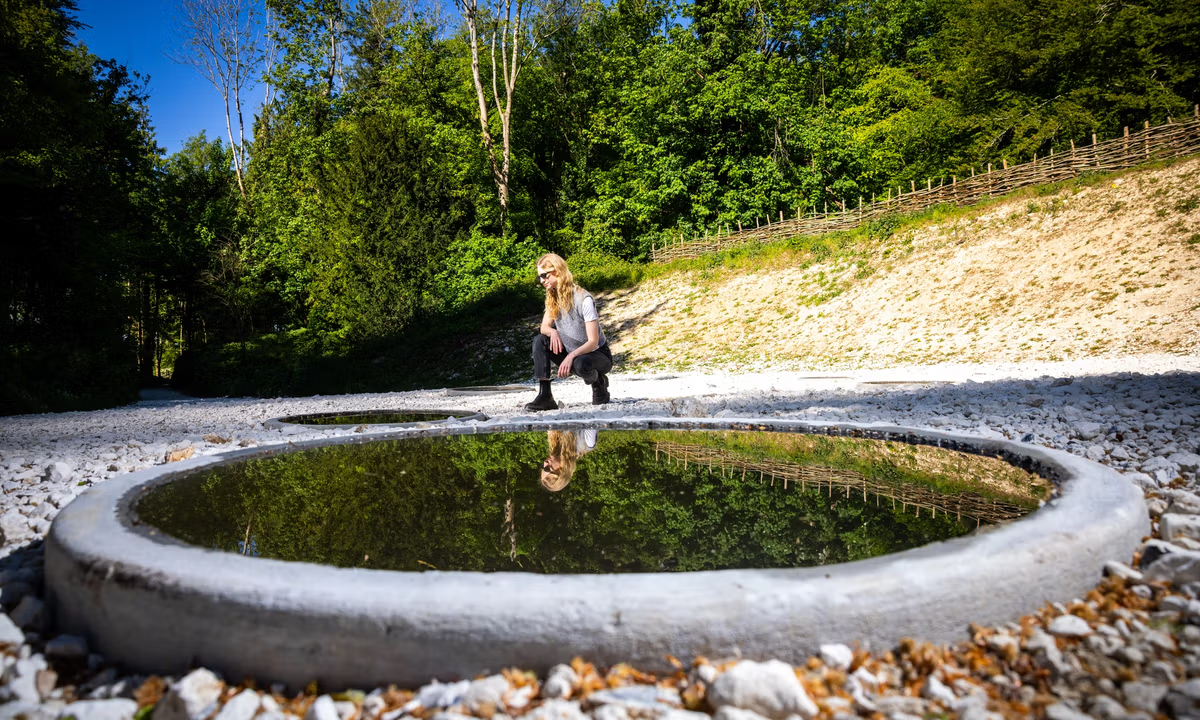
Among the pieces on show is the first posthumous installation of Hydra’s Head, an earthwork formed of six pools of water positioned according to the Hydra constellation. Last installed on the banks of the Niagara River in 1974, it is presented within Goodwood’s chalk quarry—precisely situated following instructions left by Holt, according to the curator of the exhibition, Ann Gallagher, who knew the artist during the last ten years of her life. Another work, Ventilation System (1985-92), consisting of lengths of ventilation tubing containing air, begins inside Goodwood’s gallery and extends beyond the building into the landscape.
Holt’s Ventilation System (1985-92) © Holt/Smithson Foundation /Licensed by Artists Rights Society, NewYork. Photo:Ciaran McCrickard/PA Media Assignments
Gallagher and the Goodwood Art Foundation worked closely with the Holt/Smithson Foundation to secure all loans. The latter organisation was founded by Holt in 2018, dedicated to preserving and extending the creative legacies of her and her late husband and fellow artist, Robert Smithson, who famously created Spiral Jetty on the edge of the Great Salt Lake in 1970. He tragically died in a plane crash three years later, aged just 35. The Holt/Smithson Foundation—planned to terminate in 2038, 100 years after both artists were born—oversees all research, exhibitions, publications and events and also manages both artists’ collections.
In terms of the outdoor works, Gallagher says she could only consider pieces that Holt had installed temporarily during her lifetime or those the artist had indicated in her archives she wanted to reactivate, given the correct circumstances.
Off limits due to its permanent siting elsewhere is Sun Tunnels (1973-76), the most recognisable of Holt’s large-scale outdoor works, which the artist installed on 40 acres of land she purchased in the Utah desert, close to the Nevada border, in 1974. Holt first visited that part of the US in 1968 with Smithson and the couple’s friend and fellow artist Michael Heizer. Of her first trip to the Nevada desert, Holt said she was “just knocked out” by the landscape, particularly the sky and the sun. “It was a very special experience where I felt that my inside and the outside were identical, somehow. I had been carrying this landscape within me, and suddenly there it was, without. When I came back to [New York], I was never the same person again.”

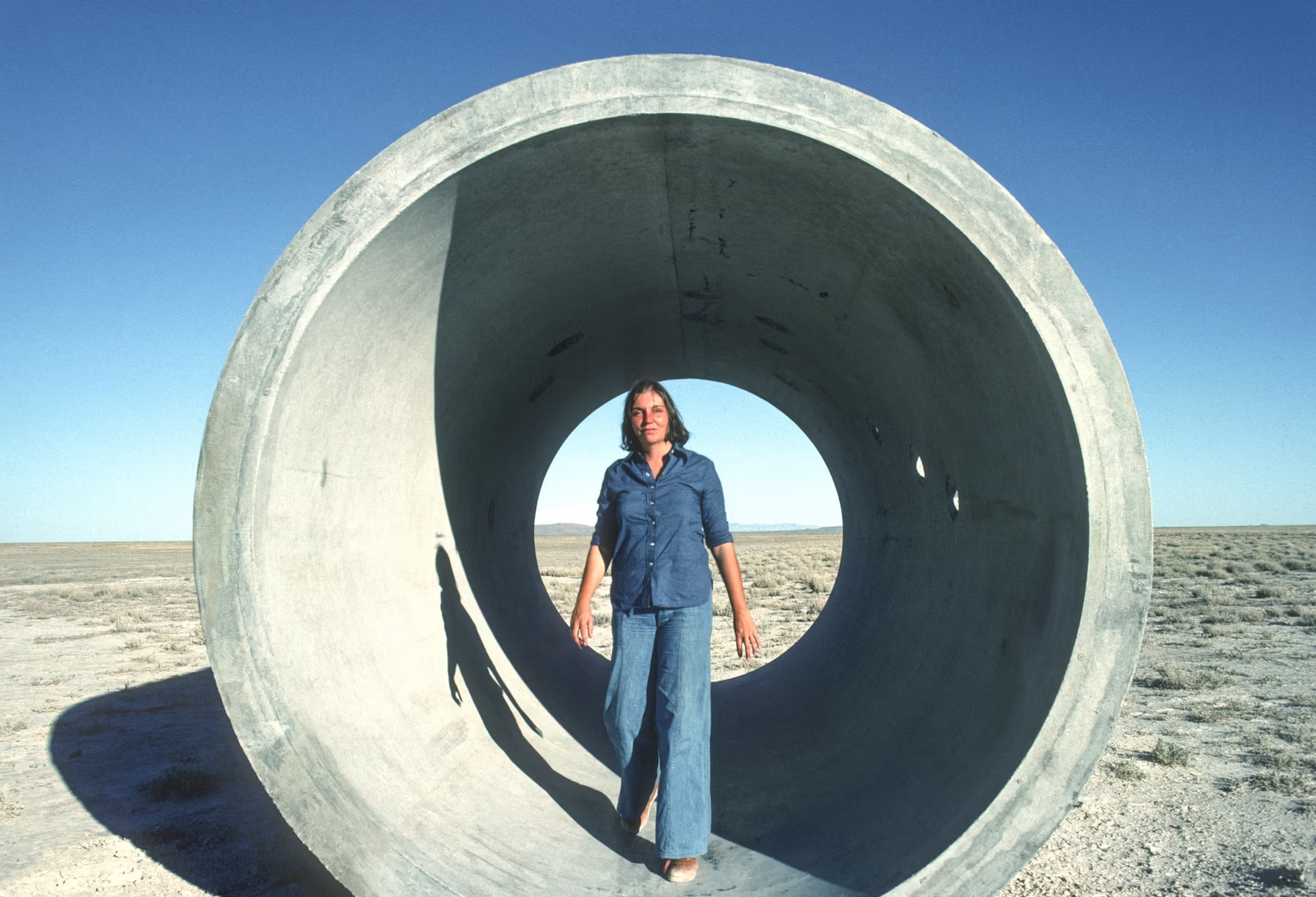
Holt inside Sun Tunnels in Utah in 1976 Photo: Ardele Lister. Artwork: © Holt Smithson Foundation and Dia Art Foundation
Now owned by the Dia Art Foundation (the organisation’s first outdoor work by a woman), Sun Tunnels, which consists of four enormous concrete cylinders arranged in an X formation to frame the rising and setting sun during the summer and winter solstices, is represented in the Sussex exhibition by a film of the work’s making. It is being shown alongside drawings and photography—an essential medium for Holt, who said it enabled her “vision to be fixed”. Sun Tunnels, too, is formed of apertures of sorts.
In 1969, Holt and Smithson took a trip through England and Wales, visiting ancient sites and landscapes that resonated with their practices including the Cerne Abbas Giant chalk figure and Stonehenge (Sun Tunnels is said to be directly influenced by the latter monument). Holt’s series of photographs of trail markers in Dartmoor National Park and of Old Sarum Ruins form part of the display at Goodwood.
Language, too, played a crucial part in the development of Holt’s practice. In the 1960s, she worked as a sub editor at Harper’s Bazaar magazine, an experience that immersed her in structured systems and influenced her early concrete poetry, which Holt would exchange by post with the Minimalist artists Sol LeWitt and Carl Andre. Several examples of Holt’s concrete poetry including MoonSunStarEarthSkyWater—from which the Goodwood exhibition takes its title—are on show. Another, Making Waves (1972), is a “slightly tongue-in-cheek diagram”, Gallagher says, of Holt’s different “selves” over a 24-hour period: artist, feminist and mystic. Unlike many of her female peers working in the 1960s and 70s, Holt resisted the label of “feminist artist”, wanting recognition for her art, not her politics.
Despite this, Gallagher says there is “no question” that Holt considered herself a feminist, though the term has taken on different meanings since the artist first started making work in the 1960s. Perhaps today, one label does not have to eclipse the other, and Holt can be recognised both for her ground-breaking art and the path she forged for other women in the now expanded field of Land Art.
• Nancy Holt: MoonSunStarEarthSkyWater, Goodwood Art Foundation, Chichester, 2 May-1 November


