






Fresh off her first institutional exhibition, artist Natasha Toney is set to unveil an ambitious immersive installation during the Venice Biennale at the Ateneo Veneto di Scienze, Lettere ed Arti, a 16th-century building in San Marco.
Jointly commissioned by Berlin’s LAS Art Foundation and Helsinki’s Amos Rex contemporary art museum, The Phantom Combatants and the Metabolism of Disobedient Organs, as the installation is called, combines video, sound, light, and sculptural elements to reimagine the story of Len Karamoy, a combatant in Permesta, a CIA-supported political movement that fought against the Indonesian government from 1957 to 1961 in North Sulawesi.
The 37-year-old artist has gained international attention for her darkly humorous videos and installations that explore Indigenous identity and cosmologies, ecology, futurism, and the line between history and myth. Tontey often blends the aesthetics of B-movies, horror films, and low-budget television, with DIY special effects and advanced imaging techniques.
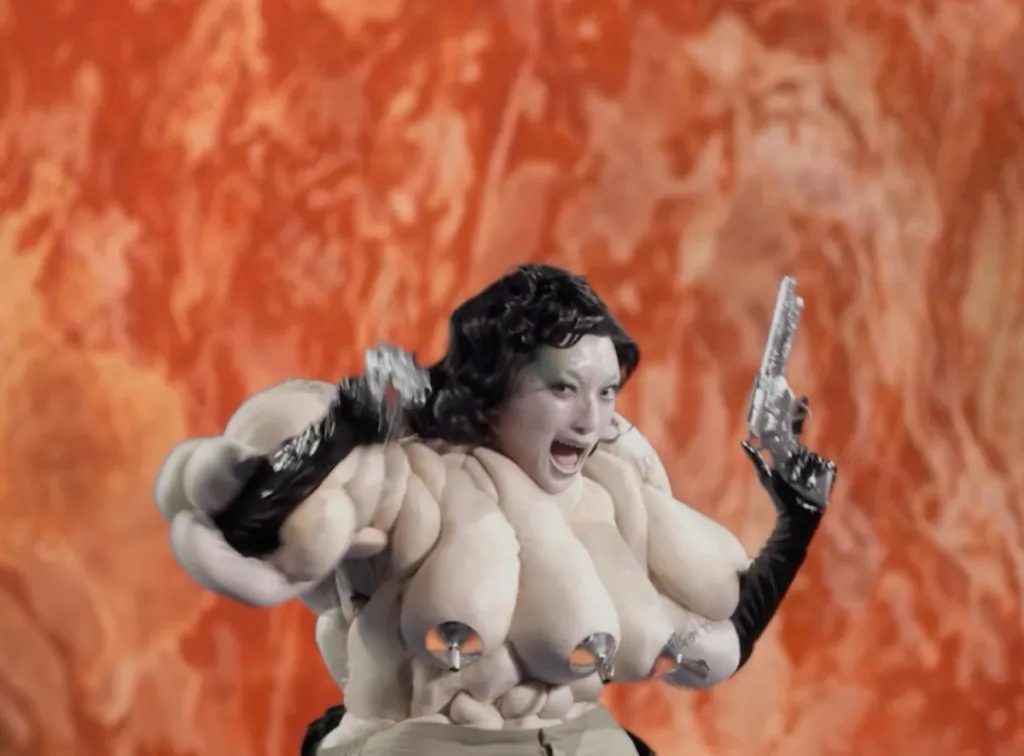
In Phantom Combatants, Tontey transforms Karamoy from a singular historical figure into a mythic presence multiplied through a chorus of young troops, according to a press release. Tontey’s Karamoy becomes literally larger than life, with three breasts and exaggerated muscles, a physical manifestation of her will toward self-determination. Both Tontey and Karamoy are Minahasan, a North Sulawesi Indigenous group.
Much of the video employs LiDAR remote sensing, quantum ghost imaging, 3D modeling photogrammetry, and thermal cameras, as means of reappropriating contemporary forms of surveillance and control.
Natasha Tontey, The Phantom Combatants and the Metabolism of Disobedient Organs, 2026. Video still.
Commissioned by LAS Art Foundation and Amos Rex. © 2026 Natasha Tontey. Courtesy the artist.
“Through this project, I try to listen to the quieter tones of history—the minor keys where fragments of memory, mourning and ritual continue to resonate,” Tontey said in a statement. “These subdued frequencies, often drowned out by louder narratives, are where I find gestures of survival, care and imagination that persist in spite of violence.”
In a joint statement, Bettina Kames, CEO of LAS, and Kieran Long, CEO of Amos Rex, billed the work Tontey’s “most ambitious” to date, and said it “speaks to the extraordinary times we are living in, marked by uncertainty amid shifting political and technological landscapes.”
Tontey arrives in Venice one year after the close of her first major institutional exhibition, “Primate Visions Macaque Macabre,” which ran at Jakarta’s Museum MACAN from 2024 to 2025. That show garnered her a profile in Artnet News and a rave review in Artforum, in which critic Hung Duong praised Tontey’s disruption of “the preconceived hierarchy in the human-primate relationship,” which “prompt[s] us to envision more equal forms of interspecies relation.” In that show’s immersive installation and accompanying film, Tontey explored human-macaque relationships with a mix of humor and horror to destabilize settled notions of human supremacy.
Though Tontey does not currently work with gallery representation, she is quickly becoming a regular on the biennial circuit. Her work will appear in both the 59th Carnegie International in Pittsburgh, opening this week, as well as the Biennale de l’Image en Mouvement in Tunis later this year. She has also shown at the 2025 Istanbul Biennial, the 2025 Mercosul Biennial in Brazil, and the 2022 Singapore Biennale.
Tontey’s Venice presentation opens May 5, with an artist talk ahead of a public opening. It will run through October 25, before traveling to Amos Rex in 2027.


