








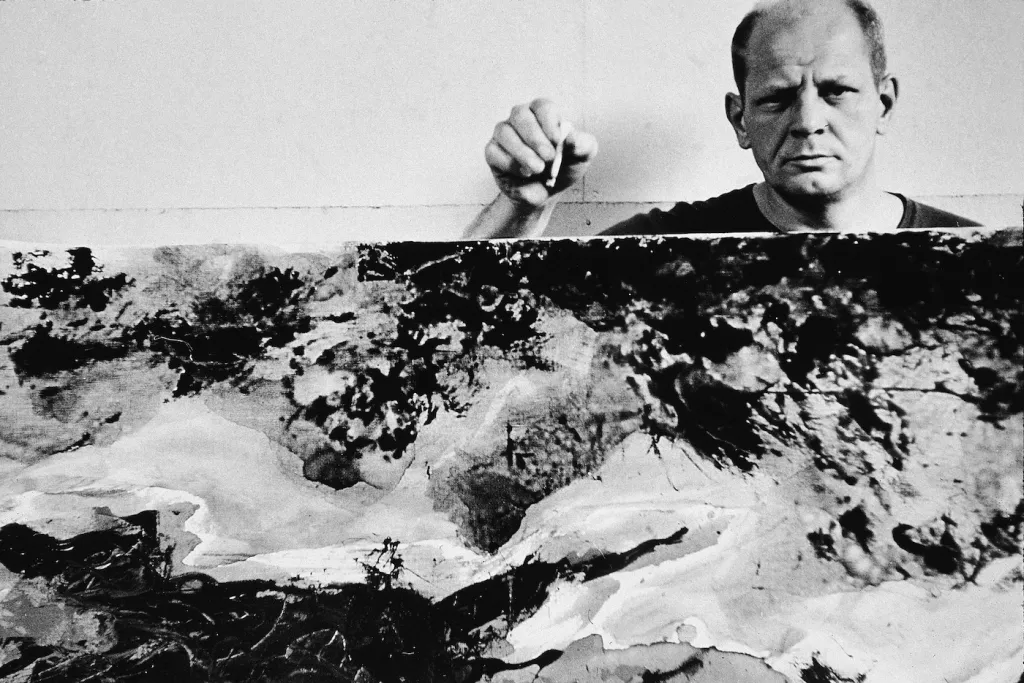
Leaving aside the so-called drip paintings that made Jackson Pollock (1912–1956) the face of Abstract Expressionism, an argument could be made that, overall, he wasn’t a particularly good artist. The period between 1947 and 1950, when Pollock produced his breakthrough abstractions, was bookended by years of kludgy attempts to, essentially, out-Picasso Picasso, a desire driven by kill-the-father ambition. According to his wife, the painter Lee Krasner, Pollock once shouted, “God damn it, that guy missed nothing!” while throwing a catalog of Picasso’s work across a room.
Whatever his doubts about measuring up to Picasso, Pollock was instrumental in bringing a uniquely American form of modernist art out from under Europe’s shadow. The audacity of works such as Lucifer, Autumn Rhythm (Number 30), and Lavender Mist made them as indelible—if not as easy to individuate—as anything produced by the Spaniard. But Pollock could not put aside his crippling insecurities, which may account for the inconsistency of his output.
Pollock was an alcoholic, possibly closeted (though evidence of the latter is contestable), and like most drunks given to outbursts and dissolute behavior. One such incident—urinating into the fireplace of New York art doyenne Peggy Guggenheim—was likely made up by Guggenheim herself. Another—getting behind the wheel in no condition to drive—ended his life.
With the news that, earlier this month, Pollock’s auction record was reset at $181.2 million, with the sale of the monumental drip painting Number 7A, 1948 at Christie’s, take a closer look at Pollock’s life and career below.


