








The National Trust for Historic Preservation, a private nonprofit based in Washington, D.C., has released its annual list of “America’s 11 Most Endangered Historic Places,” which includes sites that have been targeted by the second Trump administration.
Published each year since 1988, this year’s list was framed around the 250th anniversary of the founding of the United States and “our nation’s founding and the self-evident truth that all people are created equal,” according to a press release. Each selected site receives a one-time grant of $25,000 to “protect these historic places and enable their stories of equality to be shared for generations,” per a release.
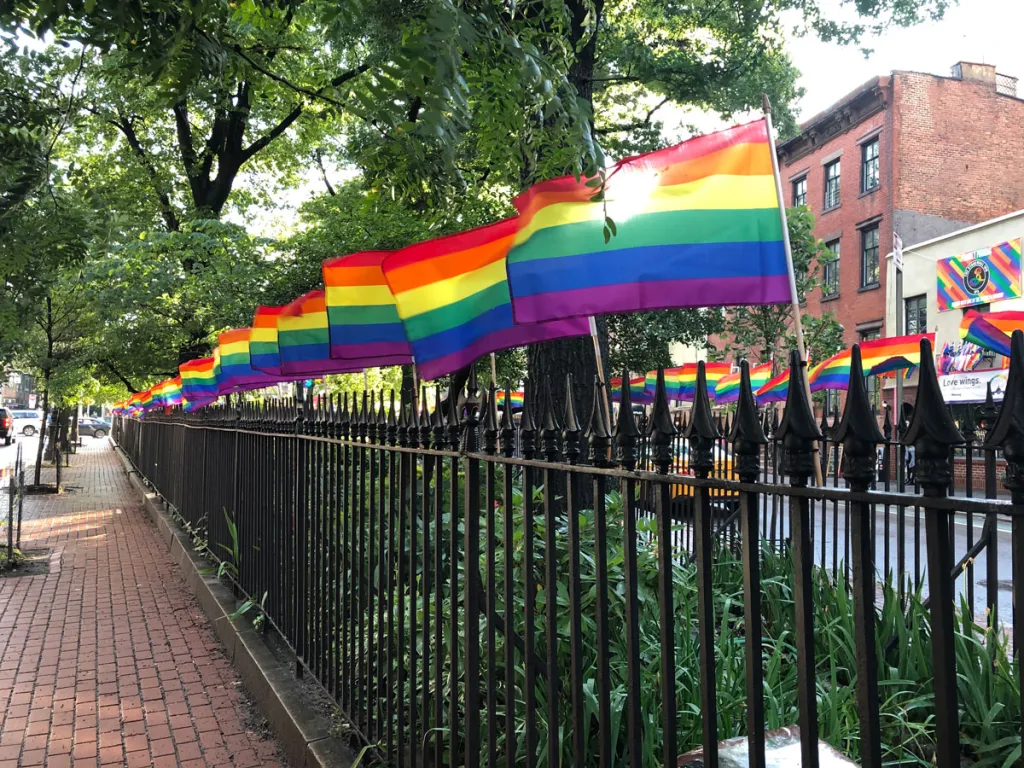
Among those selected are two sites that have drawn the ire of the Trump administration, the Stonewall National Monument in New York, often considered the birthplace of the gay right’s movement, and the President’s House Site in Philadelphia, which served as the presidential home prior to the capital’s relocation to Washington.
In January, the National Parks Service (NPS) removed placards from the President’s House Site that acknowledged the history of the nine enslaved people who worked at the presidential home during the Washington administration. The removal, according to the Department of the Interior, was to align Independence National Historical Park with a March 2025 executive order that said the site had been subjected to “corrosive ideology.”
The City of Philadelphia soon filed a suit, claiming that any changes to the site must be agreed upon between the city and NPS, which the city says did not occur. In February, a federal judge ruled that the signs must be temporarily restored, who wrote in a lengthy opinion that any visitor who “does not learn of the realities of founding-era slavery, receives a false account of this country’s history.”
The President’s House Site in Philadelphia has been subjected to changes by the Trump administration.
Photo Michael Bixler
February also brought news that the NPS had removed the Pride flag that had flown from a flagpole within the Stonewall National Monument, which was designated a national monument in 2016. The NPS replaced the Pride flag with a US flag. For this change, the NPS cited an Interior Department memo against “non-agency” flags being flown at national monuments. But that same week, New York City elected officials convened at Stonewall to re-raise the Pride flag.
Shortly afterward, a group of nonprofits filed a lawsuit against the Trump administration to restore the flag that NPS had removed as it is the only flag that can officially fly at the site. In its complaint, the nonprofits argued that the removal violated a federal law that allowed Confederate flags to fly at similar historic sites. In April, the federal government agreed to a settlement that would allow the Pride flag to permanently fly there.
“These historic places helped define, or redefine, the nation’s fundamental values of equal opportunity, religious freedom, self-governance and voting, immigration and citizenship, freedom of expression and assembly, and equal access to justice,” the release reads. “Preservation of these sites is key to telling the full American story.”


The interior of the Detroit Association of Women’s Clubs building, which was damaged by a pipe burst in 2024.
Photo Elonte Davis
The other sites on the list include ones with historical significance to various historically marginalized communities, including women, Black Americans, Japanese Americans, Mexican Americans, and Indigenous peoples; many of them are in need of funds to ensure their preservation long-term. The Women’s Rights National Historical Park in Seneca Falls, New York, a major site for women’s suffrage where the 1848 the Declaration of Sentiments signed, is currently experiencing a maintenance backlog of $10 million. The Detroit Association of Women’s Clubs, one of the first Black organizations in Detroit to own its building, which was damaged by a pipe burst in 2024.
The Ben Moore Hotel in Montgomery, which served as a gathering place for Black Americans during Jim Crow, is in need of significant restoration to protect it from development. The Tule Lake Segregation Center in Modoc County, California, is a national monument dedicated to the Japanese Americans who were held at this concentration camp as part of Japanese internment during World War II; only 37 of the site’s 1,100 acres are currently protected.
El Corazón Sagrado de la Iglesia de Jesús in Ruidosa, Texas, once served as “a place of refuge and prayer for Mexican and Mexican American farming communities on both sides of the international border along the nearby Rio Grande River,” according to the Trust. While its adobe structure was recently stabilized, after more than half a century of being vacant, a nonprofit friends group is seeking additional funding to transform it into a community hub. The Swansea Friends Meeting House in Somerset, Massachusetts, is the oldest surviving Quaker meeting house in the state; it has been closed for several years and requires repairs in order to transform it into a community center.

Matachines de Ojinaga y Presidio perform at the annual community day celebration held at El Corazon Sagrado de la Iglesia de Jesus.
Photo Jessica Lutz for Friends of the Ruidosa Church
According to the National Trust, some of these sites have been partially protected but need additional funds in order to preserve them more fully and protect them from possible developments. The Angel Island Immigration Station in Tiburon, California, was once one of the busiest entry points for immigrants from Asia and the Pacific; while several buildings have been restored, others are in need of repairs. The Hanging Rock Revolutionary War Battlefield in Heath Springs, South Carolina, is considered a site that helped turn the war in the Patriots’ favor. Only parts of it are currently protected, and “and the area is anticipating population growth and increasing development pressures,” per the Trust.
The Greater Chaco Cultural Landscape, which spans New Mexico, Colorado, Arizona, and Utah, is the ancestral homelands of the Pueblo and Hopi. Though it is a UNESCO World Heritage site, it does not have current federal protections and recent laws could subject it to oil and gas development. Permanent protects, the Trust says, could transform it into “a national model for Indigenous-led stewardship, intertribal collaboration, and public education grounded in respect and consent.”
Pueblo Bonito in the Chaco Culture National Historical Park, New Mexico.
Photo Avi Farber
In a statement, Carol Quillen, the National Trust’s president and CEO, said, “Even as the American people prepare to commemorate the nation’s 250th anniversary, consequential historic places are at risk, some through intentional erasure, others from short-sighted development plans, and still others from deterioration or neglect. This year, we honor our Declaration of Independence and the living power of its aspirations by highlighting at-risk sites where the fight for equality happened and by recognizing the heroes whose commitment, resilience, and moral courage can inspire us today to continue to build a more perfect union.”


