







An Egyptian archaeological mission working at Saqqara has uncovered the tomb of Sekhentiu-Ptah, a high-ranking official of Egypt’s Old Kingdom (ca. 2700–ca. 2200 BCE). In a separate discovery, the archaeologists also found a network of burial shafts containing human remains and funerary objects from later periods.
Heritage Daily reported the news following an announcement by Egypt’s Ministry of Tourism and Antiquities.
The finds were made during the mission’s first excavation season in an area west of the Bubasteion necropolis in Saqqara. Taken together, they point to the ancient cemetery’s use over centuries.
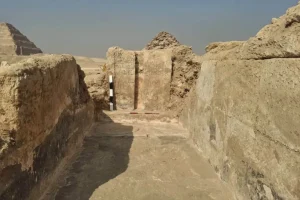
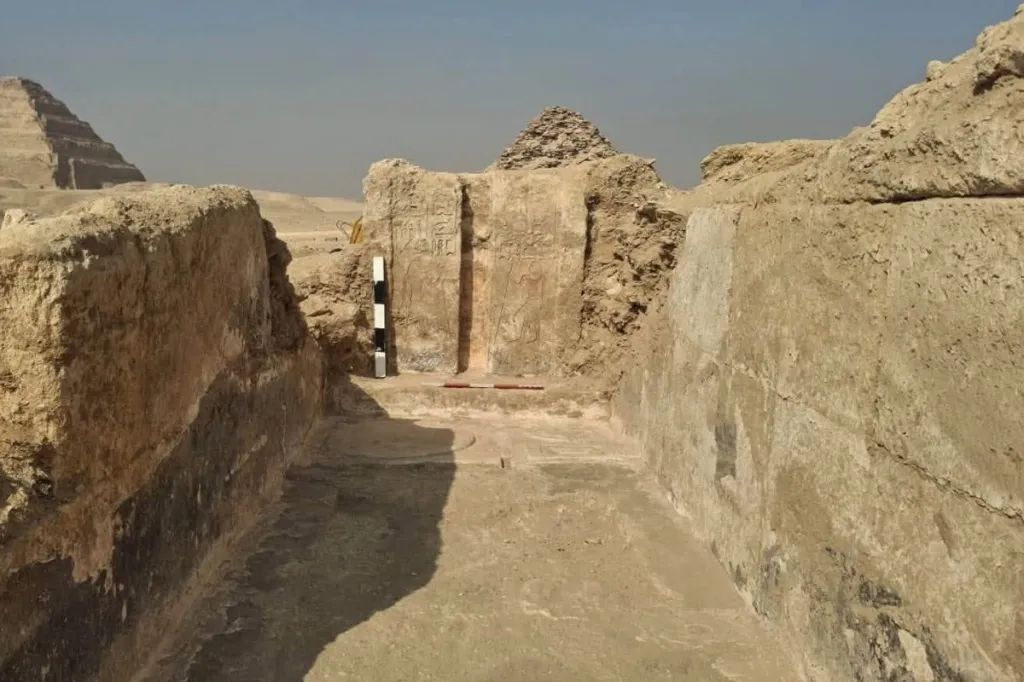
According to the mission, Sekhentiu-Ptah’s tomb contained the remains of a funerary chapel with its false door still in its original position. Alabaster objects arranged in front of it included an offering table, an offering implement, a purification basin, a vessel, and a mat.
Mohamed Abdel Badi, head of the Egyptian Antiquities Sector, described the discovery of these objects as particularly important. Because they were still in their original positions, they provide researchers with a clearer understanding of Old Kingdom burial practices.
In addition to Sekhentiu-Ptah’s name, hieroglyphic inscriptions on the false door and funerary objects also recorded several of his titles. They included royal chamberlain, supervisor of the king’s works, supervisor of royal documents, keeper of royal secrets, priest of the goddess Maat, and supervisor of the library.
The tomb stands alongside a group of later burials containing human remains, painted funerary cartonnage, three sealed sarcophagi, and over 100 faience ushabti figurines. Preliminary explorations indicate these burials were looted in antiquity; passages linking them are thought to have been made by ancient robbers moving between the tombs.
Amr El-Tayeb, Director-General of the Saqqara Archaeological Area and head of the archaeological mission, said the surviving material will offer researchers insight into funerary practices, particularly those of Egypt’s Late Period (664–332 BCE).
Located 20 miles south of Cairo, the Saqqara archaeological site was the main necropolis for the ancient Egyptian city of Memphis, which was founded around 3100 BCE and abandoned in the 7th century CE. The latest discoveries add to growing evidence of its extraordinary longevity as a burial ground.


