







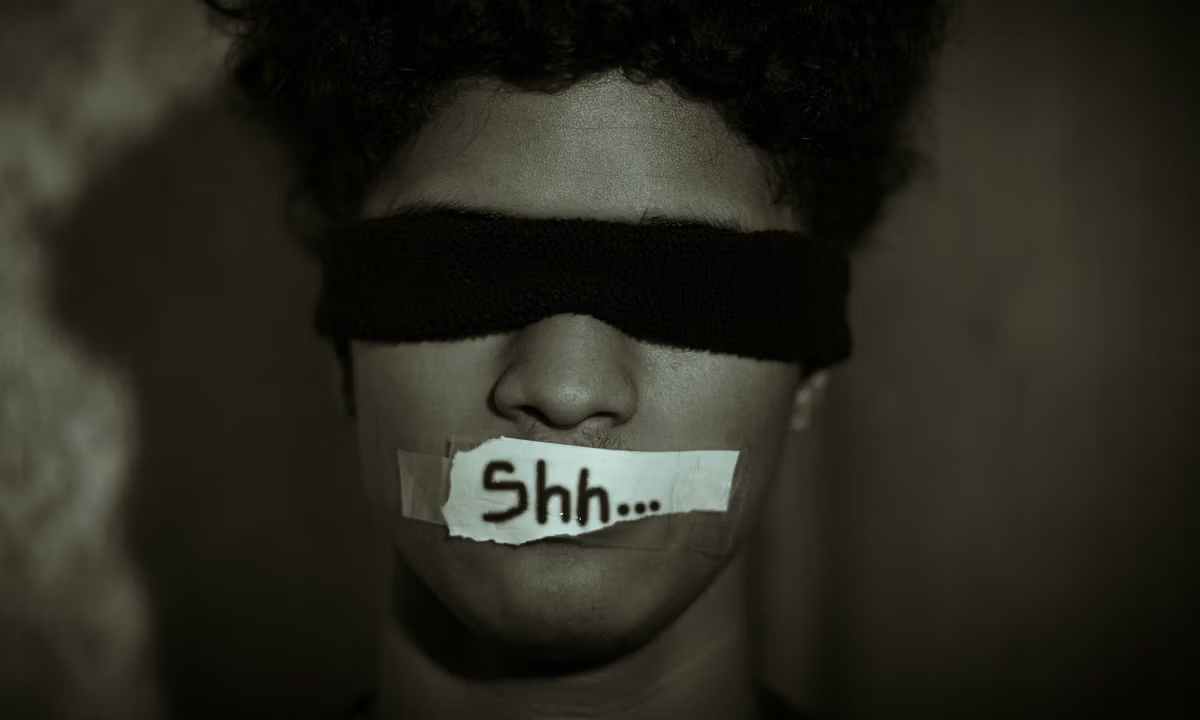
Few people realise how precarious freedom of expression is until it’s under threat. A new resource guide from the National Coalition of Artists Against Censorship (NCAC), “The Artist’s Guide to Defending Artistic Freedom”, outlines strategies for artists to advocate for themselves when institutions cancel shows, deinstall works or renegotiate contracts based on a work’s perceived likelihood to cause controversy.
There is certainly no shortage of recent examples of politically contentious works and exhibitions being shut down at institutions big and small across the US. In early 2024, the Indiana University at Bloomington’s Eskenazi Museum of Art came under fire for cancelling a retrospective devoted to the 87-year-old Palestinian artist Samia Halaby. Last year, the artist Amy Sherald called off her travelling survey exhibition’s planned stint at the Smithsonian’s National Portrait Gallery, alleging she had been pressured to remove the painting Trans Forming Liberty (2024); the gallery has disputed her claims of attempted censorship. Earlier this year, the University of North Texas in Denton abruptly shuttered a solo show by Victor Quiñonez at the the College of Visual Art & Design Gallery—which included works critical of the enforcement activities of US Immigration and Customs Enforcement—nine days after it opened.
As more topics are deemed too “controversial”, “complicated” or “challenging”, museums have more incentive to decide certain subjects are off limits—particularly if donor funding is at stake. The guide paints a grim picture of an unstable arts ecosystem where institutions do not feel they are in positions to take risks, so risk-taking artists stand to suffer.
“Over a year ago, an artist asked for a list of talking points she could use in defending an exhibition of her work, which was under threat of deinstallation,” Elizabeth Larison, the director of arts and culture advocacy at the NCAC tells The Art Newspaper. While in the past, Larison felt curators often acted as advocates against censorship, she says she has perceived a shift in the institutional climate this year.
“For example, there are curators on college campuses where state governments are enforcing overly broad interpretations of the executive orders targeting diversity, equity, inclusion and accessibility, and villainising queer and trans-inclusivity,” she says. “For many people working across the cultural sector, the equation is simple: if they resist publicly, they risk their livelihoods.”
Larison and members of her team, including Minji Lee and Svetlana Mintcheva, began writing the guide in 2025 and released it earlier this month. For artists whose works are challenged by safety concerns or potential threats to donor fundings, the guide recommends: “Remind the institution that side-stepping curatorial integrity and mission- centric decision-making can expose them to a greater loss of public trust [and] reputational damage.” Though the guide is written for artists, it also addresses museums workers, encouraging them to see themselves as providing platforms for work that not every visitor or donor will find agreeable.
“Even if curators or other institutional employees engage in behind-the-scenes resistance for artistic freedom, the absence of a public argument for artistic freedom is often filled by the work’s detractors,” Larison says. “Under these challenging circumstances, it can be less effective to let the artwork ‘speak for itself.’ Artists need to be able to advocate for their own work.”
The NCAC guide cites the concept of “the Streisand Effect”, which holds that the more a person or institution wants a controversy to disappear, the more widely it is likely to spread. The guide recommends artists harness this truism if an institution truly will not budge. It advises: “With censorship, attempts to avoid negative publicity tend to backfire. Censorship often causes even more negative attention and controversy for the organisation.”
The guide notes that censorship is not a neutral act, and museums are not neutral spaces. They are made up of individuals with individual interests and biases, some of which aren’t in the best interest of the artist.
“Everyone can do something to promote artistic freedom, but not everyone can do so publicly and safely,” Larison says. “This reality has been made evident this past year and has helped motivate our focus to complete and release this resource.”
The guide is free to access and download from the NCAC’s website, which also has a form for artists to reportinstances of possible suppression and misconduct. The NCAC also recommends that if a governmental organisation is behind the censorship, artists should involve the American Civil Liberties Union, the Foundation for Individual Rights and Expression or other First Amendment-based advocacy groups.
Larison adds: “Our hope is that this document will circulate between artist communities so that artists are better informed and feel more empowered and prepared to stand up for their work and its importance in our shared cultural ecosystem.”


