






Operating just outside of Vienna’s historic centre a century ago, the Wiener Werkstätte aspired to handcraft beautiful objects for 20th-century living. Active between 1903 and 1932, and founded by members of the Vienna Secession movement, this collective of artists and craftspeople brought creative freedom to utilitarian objects such as furniture, textiles, jewellery, toys and ceramics. Other European movements of the time, such as the German Bauhaus school, shared this goal but strove towards mass production; the Wiener Werkstätte championed the human touch.
In some ways, the group’s ethos resonates with the rapid-fire technological advancements of our current moment. “This was a group of artists and designers who were anxious about how industrialisation and machines were impacting society, quality of life and the value of craftsmanship,” says Kristina Parsons, the curator of a new exhibition about the workshop at the Jewish Museum in New York. “In response, the Wiener Werkstätte sought to bring art to the everyday aspects of modern life.”
The textile designer Felice Rix-Ueno’s plain-weave silk print Tarantella (1929) will be on view © MAK/Branislav Djordjevic
As this lesser-known collective has begun regaining attention in recent years, its female artists are getting a closer look. The Museum of Applied Arts in Vienna hosted an exhibition on the women of the Wiener Werkstätte in 2021, which inspired New York’s Jewish Museum to produce an alternative version, opening in July. A quarter of the roughly 200 women artists who worked with the guild were of Jewish descent, and they are the focus of an exhibition of more than 200 objects in various mediums, titled Modernity and Opulence: Women of the Wiener Werkstätte.
Makers and patrons
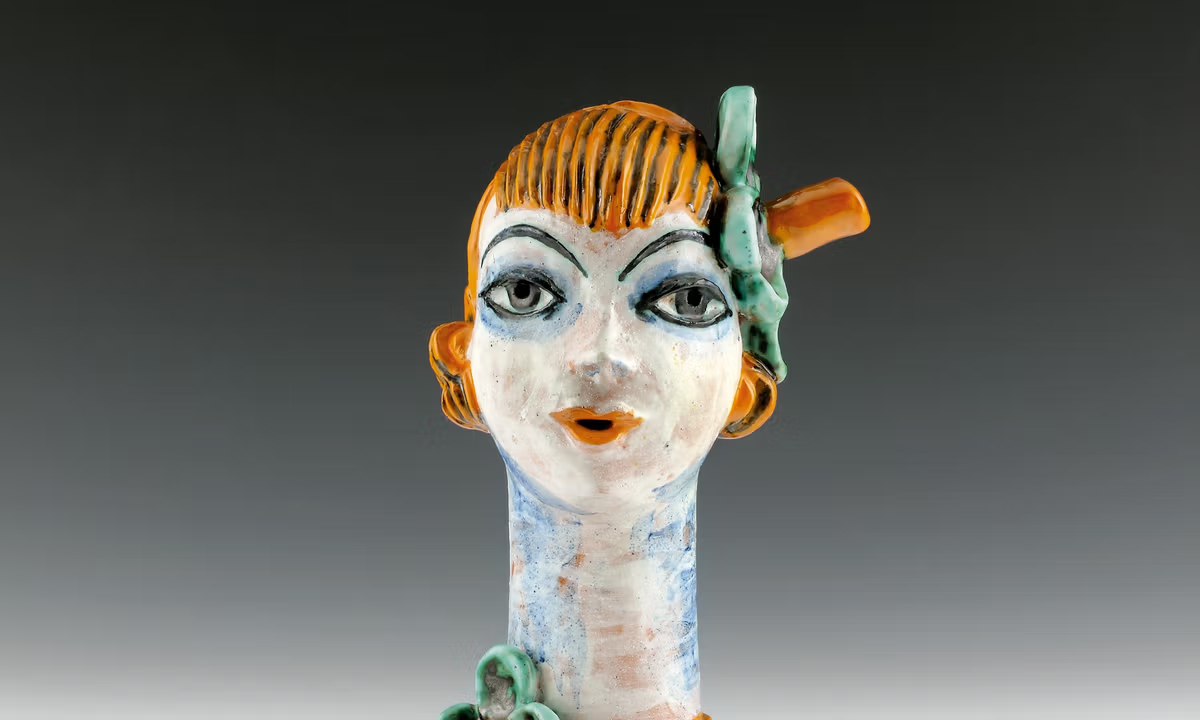
Of the 30 artists included in Modernity and Opulence, works by the ceramic artist Vally Wieselthier and the textile designer Felice Rix-Ueno are being given particular emphasis. The museum is also drawing from its own collections, which include several Jewish New Year greeting cards adorned with Wiener Werkstätte textiles. One exhibition section will highlight the group’s fashions, frequently immortalised in photographic and painted portraits of the era; another will feature the network of Jewish women who were active patrons of the Wiener Werkstätte, a facet explored by the Jewish Museum curatorial team. This includes the socialite and art patron Adele Bloch-Bauer (famously painted by Gustav Klimt), the journalist Berta Zuckerkandl, the artist Broncia Koller-Pinell, the gallerist Friederike Maria Beer-Monti and the women’s rights advocate Magda Mautner von Markhof.
Another group of Wiener Werkstätte women that Modernity and Opulence is hoping to bring attention to is those who worked with the collective and were later killed in the Holocaust or whose fates remain unknown. One such artist is Grete Neuwalder, who was killed, although some of her clay work survives. (It was believed to have been hidden in a Viennese chocolate shop and later shipped to the artist’s surviving family in New York.) A booklet accompanying the exhibition will include Neuwalder’s story along with the names of other Jewish women artists of the Wiener Werkstätte, in an effort to encourage future research.
“It is my hope that this exhibition will be an important platform to rediscover and reintroduce many once-known artists into our histories,” Parsons says, “so that they are celebrated and remembered.”
• Modernity and Opulence: Women of the Wiener Werkstätte, Jewish Museum, New York, 17 July-15 November


