






Fifty-nine antiquities looted from Italy, Iraq, and Indonesia, including 45 seized from the Metropolitan Museum of Art, have been returned to their countries of origin, the Manhattan District Attorney’s Office announced on Wednesday.
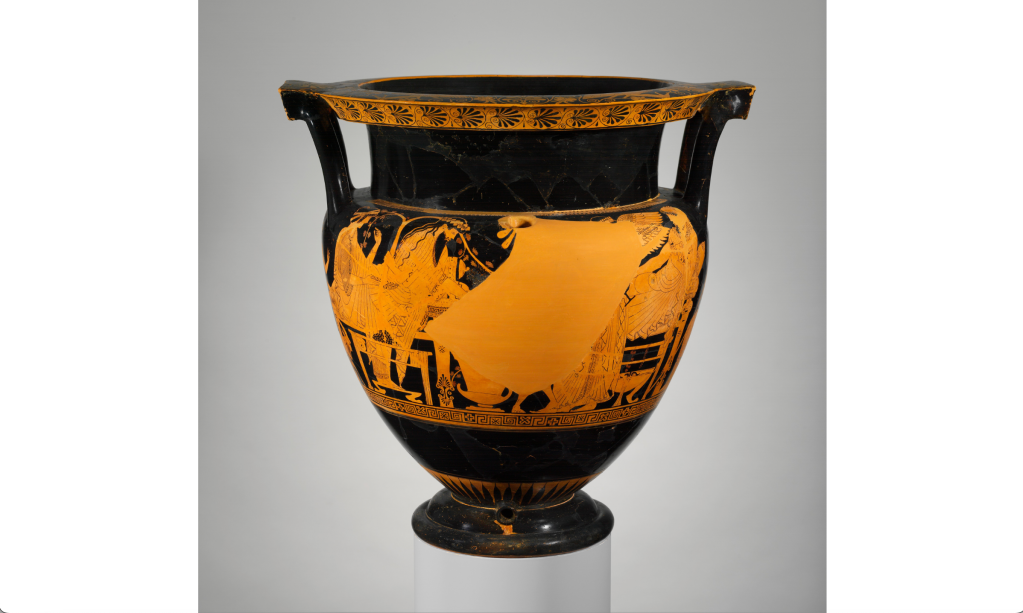
Among the objects seized from the Met and returned to Italy was a terracotta vase used for chilling and mixing wine and water, attributed to the famed Troilos Painter. One side depicts Dionysos, the Greek god of wine, and the hero Herakles on Mount Olympus; the reverse shows members of the Olympian pantheon, including Zeus, Athena, and Nike. According to New York investigators, the vase was smuggled out of Italy by Fritz Burki and consigned for sale at Christie’s London before entering the museum’s collection. Also seized from the Met was a marble fish plate from Magna Graecia, dating to around 400 B.C.E., which entered the museum through dealer Robert Hecht in 1984.
Nine antiquities collectively valued at nearly $300,000 were returned to Iraq. Among them were two of the earliest known sculptural depictions of the human figure in the round: the Sumerian Gypsum Male Worshipper and the Sumerian Gypsum Female Worshipper, both dating to Iraq’s Early Dynastic II period, circa 2750–2600 BCE.
“The return of these invaluable Iraqi antiquities reflects the strength of the partnership between the Republic of Iraq and the Manhattan District Attorney’s Office in protecting our shared cultural heritage,” said Dr. Duraid Abbas, deputy chief of mission of Iraq to the United States, at the handover ceremony in Manhattan.
Returning to Indonesia are two “carefully preserved and venerated” human skulls from the Dayak, a collective term for the more than 200 Indigenous groups native to Borneo.
As ethical standards evolve and repatriation laws tighten, ethnographic museums worldwide are increasingly removing human remains from public display. Once treated as collectible objects with a monetary value, these remains are increasingly understood as tangible links to revered ancestors and, in many cases, as integral to ancestral and ceremonial traditions that continue to be practiced today. In recent years, major museums, including the American Museum of Natural History, the Penn Museum, and the Met, have removed human remains from exhibition or returned them to descendant communities.
The Manhattan District Attorney’s Office, particular its Antiquities Trafficking Unit, led by Matthew Bogdanos, a former classics scholar, US Marine colonel, and current assistant district attorney in New York, has been at the forefront of increased efforts for restitution and repatriation. Earlier this year, the Vilcek Foundation awarded Bogdanos its prize for excellence in art history, which carried a $100,000 purse. Bogdanos declined the cash, which is instead being donated to nonprofits of his choosing.
Winanto Adi, consul general of the Republic of Indonesia in New York, said in a statement that it was “particularly meaningful that this handover of Indonesian cultural objects takes place during the year in which the United States commemorates the 250th anniversary of its independence.”
Adi added: “As Americans celebrate their nation’s remarkable history and enduring ideals, today’s ceremony also reminds us that every nation treasures the objects that tell the story of its civilization.”


