







The UK artist Conrad Shawcross has raised concerns about the possible closure of the Jodrell Bank Observatory which houses the UK’s largest telescope, in service for almost 70 years.
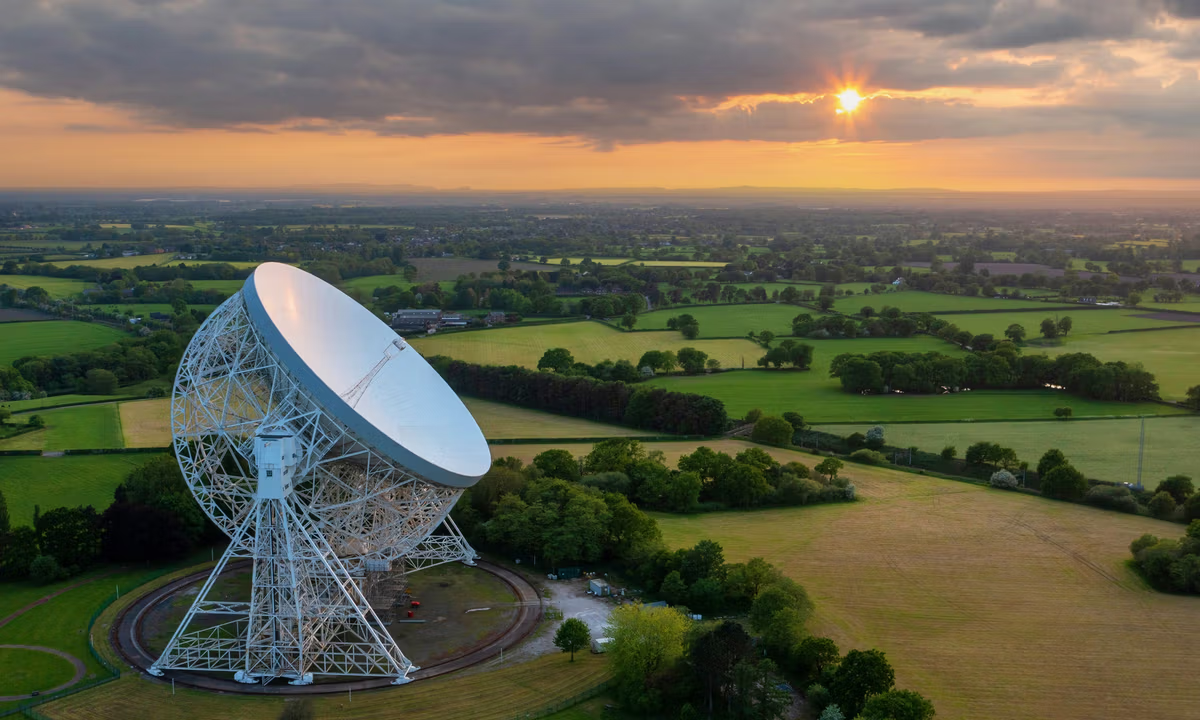
Jodrell Bank in Cheshire, a Unesco world heritage site, is home to the Lovell Telescope which launched in 1957 as the world’s then-largest steerable dish. The Lovell Telescope, once the largest radio telescope in the world, is the largest part of a seven-telescope system in England known as the e-Merlin network.
The arm’s-length body UK Research and Innovation (UKRI) confirmed earlier this month that it would cut its £2.8m annual grant to the Jodrell Bank Observatory when the current funding term comes to an end in March 2028.
“I am deeply concerned to hear that Jodrell Bank Observatory is currently facing closure following funding cuts. The Grade 1-listed observatory, which I would rate as one of the most exceptional structures in the UK, has been pivotal to the country’s study of distant galaxies and the wider universe since the 1960s but is also essential for the training and inspiring future generations of astronomers,” Shawcross tells The Art Newspaper.
Conrad Shawcross with Ringdown (2024)
Photo: Richard Ivey
Two works by Shawcross including the kinetic work Ringdown (2024), inspired by black holes merging in space, feature in a group exhibition called Curious Universe: Cosmic Titans (until 20 September) at the observatory site. Shawcross also highlights a petition calling for Jodrell Bank to be saved, which has garnered more than 13,000 signatures at time of publication.
In its budget statement, UKRI says that overall costs for its science and technology programme are “forecast to increase significantly” due to increases in energy and labour costs, unfavourable foreign exchange rates and the growth of its activities overall. The BBC reports that Jodrell Bank supports nearly 3000 scientists who use its research; 28 jobs could be lost if alternative funding cannot be found for the site.
According to Museums Journal, the on-site museum is not subject to closure, reporting that ”The University of Manchester, which owns and manages the entire site, has emphasised that the museum is funded separately to the scientific research programme at the observatory.”
In a statement, Sarah Sharples, the university’s vice president and dean of science and engineering, says: “The university’s focus now is on securing the future of Jodrell Bank and the e-Merlin network.”
In response to pushback, UKRI released a position statement factsheet on 31 July, stating that UKRI “do[es] not directly fund The University of Manchester’s Jodrell Bank site itself but support[s] specific research infrastructure and projects that are based at, or operate from the site“.
”Researchers have significant notice and access to alternative facilities around the world. e-MERLIN has played an important role in developing early career researchers and preparing scientists for future radio astronomy facilities,” the statement adds.


