





When New York City Mayor Zohran Mamdani took his oath at the start of this year, he vowed to tell a “new story of our city.” MoMA PS1, one of the city’s defining contemporary art institutions, has now endeavored to do the same with Greater New York, its quinquennial for artists who live and work in all five boroughs.
The occasion is a grand one, and not only because it’s the first Greater New York since the Covid-era 2021 edition. This one, the exhibition’s sixth, is being held during MoMA PS1’s 50th anniversary year, and in tribute to the institution’s might, the museum has relied entirely on its own curatorial staff instead of bringing on outside contributors to organize the show. Some 53 artists are showing at the exhibition this time.
What new story of our city is this edition of Greater New York telling? One having to do with vulnerability resulting from weakened infrastructure and failing systems of support. Whether that story is a sad one or a hopeful one has split ARTnews senior editors Maximilíano Durón and Alex Greenberger, who opened a Google Doc to discuss the show.
Maximilíano Durón: The last Greater New York was held in 2021, following a year-long delay due to the pandemic. The world was certainly in a different place then, and the work on view in the show was often introspective, with artists mining the archive or their own inner states for Surrealism-inflected works. This edition, held about four and a half years later, is about artists who are in and of the city, with their ties to their communities on fuller display.
Going through this new exhibition, I couldn’t get one quote I heard out of my head: “We always worry, how are we going to make it.” That line is delivered by taxi driver Salaheldin Elcharfa about 10 minutes into Kenneth Tam’s 2026 video I’M STAYING HOPEFUL AND STRONG (For Bilal and Salah), which is among the many works premiering at this edition of Greater New York. The film, also featuring Salaheldin’s brother and fellow taxi driver Bilal, is about the ongoing taxi medallion crisis, which has seen permits to drive yellow cabs plummet in value because of the rise of ride-sharing apps, often causing drivers to take on enormous amounts of debt and, in some cases, to declare bankruptcy. But in many ways, I feel like the line in Tam’s video speaks to the state of living in New York City at the moment.
There’s an underlying sense of precarity that’s in many ways buoyed by a sense of hope created by our recently elected mayor, Zohran Mamdani, whose participation in the 2021 hunger strike to address the taxi medallion crisis significantly raised his political profile. As we walked through Greater New York, I got the sense that this precarity is something that New Yorkers—both artists and non-artists—feel every day.
Kenneth Tam’s 2026 video installation I’M STAYING HOPEFUL AND STRONG (For Bilal and Salah).
Alex Greenberger/ARTnews
Alex Greenberger: So many of the works in this biennial—around half of them, I’d guess—involve fragile materials at risk of being destroyed. You can see this, for example, in Louis Osmosis’s works, which he views as responses to the monumental sculptures seen in New York City courtyards controlled by corporations and real estate companies. But where those sculptures are sleek, gleaming things, Osmosis’s pieces are deliberately cheap-looking: his are assemblages of tossed-out objects—old cash registers, pieces of disused signage, mannequin parts, used boxers, ribbons, and more—that are delicately balanced together. He revels in the flimsiness of his materials, exhibiting these sculptures alongside an installation composed of confetti placed on the floor, with each colorful swatch accompanied by a number scrawled in chalk.
In this show, that celebratory quality sometimes turns elegiac, as it does in I have eaten and made friends (The Devouring Hill), a new installation by Mekko Harjo (Quapaw) that turns an entire gallery into a space mimicking a Bushwick bar, replete with karaoke videos, a microphone, and, yes, more confetti. While Harjo’s work will periodically be activated by live performers during the show’s run, it’s notable that, when most people visit it during public viewing hours, the installation will be empty, bearing evidence of fun times without any partiers on hand. When we went, there were already empty Modelo cans lining the floors.
I take this as a sign that Harjo, like so many New Yorkers, knows that what is here today is often gone tomorrow. And it’s interesting, too, that this is a recurrent idea across so many pieces in this edition of Greater New York, even though the show lacks a thematic armature.


Mekko Harjo’s I have eaten and made friends (The Devouring Hill) (2026) at Greater New York.
Maximilíano Durón/ARTnews
Durón: The exhibition doesn’t have a curatorial thesis beyond the notion that New York City, per the introductory wall text, is “a historical condition, backdrop, muse, and foil”—whatever that means. But a throughline I observed was a focus on the hyper-local, especially on different parts of Queens, the borough that PS1 has called home for 50 years. Queens is a part of the city that can often feel invisible within the larger conception of New York, so it feels important to highlight the borough.
I’m specifically thinking of a knockout installation by Red Canary Song, a grassroots organization based in Flushing that supports Asian and migrant sex workers through mutual aid and aims to decriminalize sex work. Titled Touch the Heart (the literal translation of “dim sum” from the Cantonese), the installation is centered around Yin Q and Chong Gu’s Dim Sum Constellations (2026), consisting of four round tables with banquet chairs that recall the kind seen in dim sum restaurants in various Chinatowns, such as the one in downtown Flushing. Each is decorated differently: Table III: Body Care, Desire & Labor, for example, has a silicone breast pierced with acupuncture needles, cotton-filled condoms, tiger balm, fake money strung into G-strings, satin robes, and red lingerie. The tools of sex work are presented here not unlike the pick-and-choose experience of carts rolling by at a dim sum parlor. The artists see the two connected in a poetic way: like food, “touch, desire, and fantasy are all essential nourishments,” as Yin Q puts it in a wall label.
Red Canary Song formed in 2017 in response to the killing of Yang Song, a Chinese massage worker in Queens, during a police raid, and that history is embedded through the installation. Table I: Altar of Past & Future includes incense embedded in bowls of rice, candles, teacups, fruits, and ghost money that recall Chinese altars, while nearby is 8Lives, a suite of eight portraits on wooden cutting boards of the eight people, including six Asian women, killed in the Atlanta spa shootings in 2021. Those portraits are by an artist and massage worker using the pseudonym “Ellen.” There’s a lot of care in how this installation is exhibited; it’s one of the best things I’ve seen in New York in a minute.
Red Canary Song’s installation at Greater New York.
Maximilíano Durón/ARTnews
Greenberger: As you hinted earlier, the last edition of Greater New York, in 2021, had a relatively large number of dead artists—nearly a fifth of its 47 participants, to be exact. This time around, just one of the 53 artists is deceased, and that artist is the painter Jay Carrier (Wolf Clan, Onondaga/Tuscarora Nations), who died last year. How ironic, then, that this edition is even more haunted by death than the last one.
Often, the artists deal with mortality in a metaphorical way. André Magaña, for example, re-presents LED displays that have been outmoded by increasing temperatures; once used to display colorful ads, they are now browned like decomposing flesh. The Women’s History Museum collective has an installation featuring a mannequin seated in an apartment-like setting whose walls fall apart, revealing old photos of the city. Sophie Friedman-Pappas is showing Department 4 (2026), a scuffed kiln streaked with dried liquid that wouldn’t be out of place in the Silent Hill universe.
In isolation, each of these works is a salient statement about urban decay and all that goes missing when cities evolve. But there are too many works similar to them in this show, which struck me as needlessly dour. Yes, there’s a lot broken in this city, as Josh Kline recently pointed out in his widely read essay for October. Still, I found this exhibition’s preoccupation with loss to be out of step with our current moment, which is characterized by hard-won, Mamdani-fueled optimism.
It’s not as though there aren’t any works in this show that are upbeat: I’m thinking here of Piero Penizzotto’s delicious papier-mâché sculpture of women gossiping, a triumphant elevation of the everyday that recalls the work of the sculptor John Ahearn. But the curators have largely selected gloomy art that started to run together in my mind. Alongside these works, I would’ve wanted to see ones about survival and hope. It’s sad to me that Carrier’s contribution to this show, a gorgeous, 18-foot-long abstraction filled with prismatic blue forms, is one of the few works here that doesn’t strike me as downcast.
Works by Jay Carrier and the Metoac Collective at Greater New York.
Alex Greenberger/ARTnews
Durón: I have to disagree with you on the exhibition feeling dour, perhaps because I’m too much of an optimist. One interpretation of the works on view, as you suggest, is: this is the New York City of 2026—how terrible. But if you filter the show through the Mamdani lens, it doesn’t have a woe-is-me, everything-is-terrible sensibility. Instead, the show is saying these are the issues facing the city, many of them unnoticed. Let’s get to work.
Tam’s video pairs its protagonists’ complaints of the taxi medallion crisis—at various points, the Elcharfa brothers describe their “disappointment of [the] system”—as they perform different movements. But amid the chaos, it’s still possible to find optimism. At one point, Salaheldin Elcharfa says, “I’m staying hopeful and strong.”
Carrier’s painting might be a moment of levity, but undergirding the work is a real concern for how industry has polluted the Niagara region. It takes its name from a sign installed on a chemical tank by Robert Moses, the 20th century urban planner whose work permanently reshaped New York, often for the worse: “Niagara it’s Great to be Here.”
I found a parallel to Carrier’s painting in a 360-minute video by Tiffany Sia that’s shown on screens measuring no more than a few inches. The footage is mostly taken from the point of view of a camera positioned on a car’s dashboard—it essentially looks like someone just driving around. Sia is attempting to document, and perhaps even access, the Ashokan Reservoir, which is located about a 100 miles north of New York City and is responsible for about 40 percent of the city’s drinking water. It’s a futile attempt, since the public can’t enter the reservoir, which is policed by a special arm of the NYPD. Water is essential to life, and we must aim to protect our waterways. But, Sia seems to ask, is this really the way to go about it? The work doesn’t provide an easy answer, forcing us to find our own way to respond.
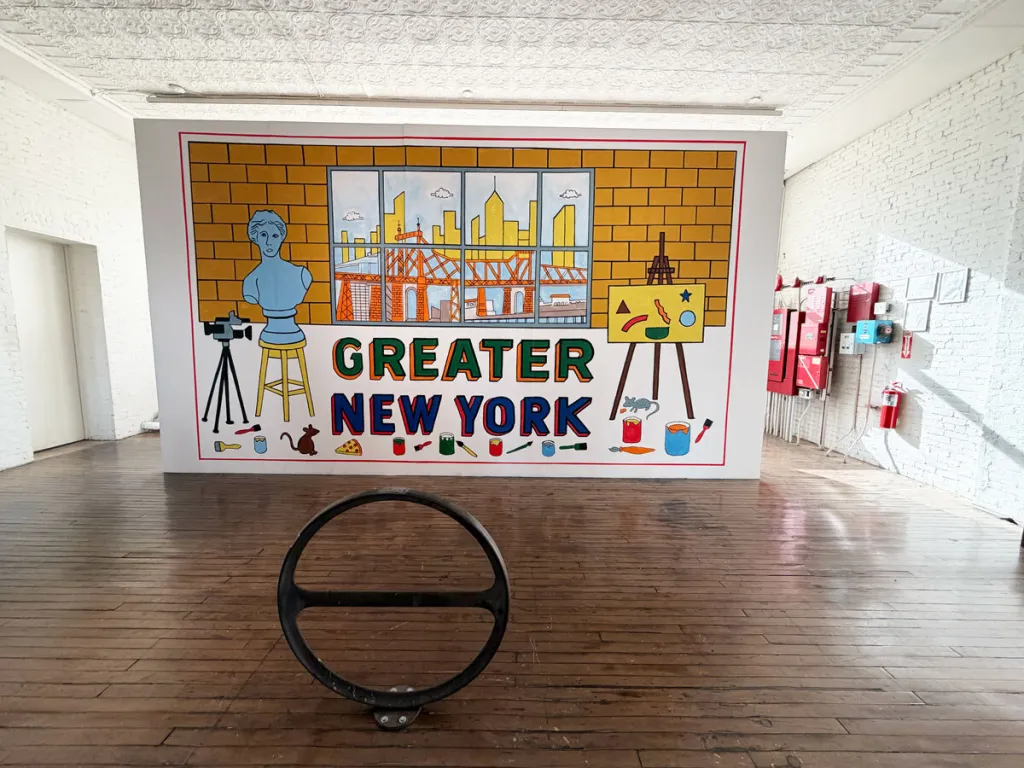
I also think the curators are smart to avoid trying to treat New York City through a lens that waxes nostalgic for an idealized version of the city that never actually existed. But I do think there’s still a focus on what makes New York beautiful. Look at the inclusion of the Cevallos Brothers, whose hand-painted signs make up so much of the visual fabric of Queens, specifically Jackson Heights and its many eateries, some of the best in the city. They’re uplifting a vernacular art form in a museum setting without giving themselves a pat on the back for including the work of so-called outsider artists, which many mainstream museums are quick to do. To me, this signals a declaration that this is the visual language that makes Jackson Heights the vibrant community that it is. Isn’t it beautiful? In addition to having some of their designs on view upstairs, their mural Greater New York (2026) welcomes visitors into PS1’s former public school building. It reminds me of Queens is the Future, a 2007 mural by Eve Biddle and Joshua Frankel that decorates a handball court at Jackson Heights’s I.S. 145. What a way to declare what this exhibition is all about.
An installation of Dean Majd’s photography at Greater New York.
Alex Greenberger/ARTnews
Greenberger: The show is equally engaged with the notion that New York is a city within a larger world—hardly a novel idea, but a compelling one, no less. Covey Gong looks to his home country of China for sculptures that utilize signage from a Shenzhen theme park. Dean Majd turns his camera on both Palestinians in the West Bank and New Yorkers, often finding places of intersection between those two communities: one photograph features Mahmoud Khalil, an Algerian Palestinian activist whom ICE detained last year after he participated in the Gaza Solidarity Encampment at Columbia University. Majd’s all-over photographic display even finds an echo in Farah Al Qasimi’s, which features lush pictures shot in the United States, the United Arab Emirates, and Kuwait, some of which come close to overlapping with each other.
Durón: Majd and Al Qasimi’s installations are powerful and eye-catching. If I recall correctly, the latter is installed almost directly above the former, which I think adds to that synchronicity you picked up on.
What I find interesting in thinking of these two together is Majd’s focus on the people who make up the Palestinian community in New York. Al Qasimi, on the other hand, turns her lens more toward the material culture of Arab communities in the US—one image shows a sliced watermelon that rests on a cutting board. The watermelon, of course, has been a symbol for the resilience and resistance of the Palestinian people for decades. In one corner of Al Qasimi’s display is a print-out of a racist Reddit comment about whether or not a mosque in Dearborn, Michigan, home to one of the country’s largest Arab communities, plays the Adhan (call to prayer) on a loudspeaker. Even in creating a work that uplifts this diasporic community, Al Qasimi recognizes the reality of life within it, including the anti-Muslim and Islamophobic hate that marks its members’ lived experiences.
Coumba Samba’s Panels (red) (black) (green), 2025, at Greater New York.
Maximilíano Durón/ARTnews
In between these two installations is another one of the exhibition’s most powerful works: Coumba Samba’s 2025 three-part work Panels (red) (black) (green). With its minimalist presentation of the titular three colors, along with borders of the wood panel representing white, the work immediately calls to mind Felix Gonzalez-Torres’s Forbidden Colors (1988). But Samba takes Gonzalez-Torres’s concept a step further, essentially asking visitors to question their own assumptions of what those colors represent. By themselves, the colors are those used in the Pan-African flag, but they are also among the most used in various configurations for the flags of Afghanistan, Kenya, Kuwait, and, yes, Palestine. Samba’s panels could easily be rearranged, suggesting a certain sense of unfixedness in the symbols we use to mark national identity.
Greenberger: As the artists in this show reach beyond the borders of New York, and even the US, I notice them returning once again to the concept of fragility. This is most obvious in one of the show’s finest works, María-Elena Pombo’s installation Tejiendo el guayabo (2018–26), in which spindly tangles of reddish yarn hang down from metal panels. Pombo made her yarn using water culled from a panoply of nations, from her native Venezuela to Australia, that she dyed using avocado pits and brown algae. Knotted, tangled, and limp, her yarn acts well as a metaphor for New York’s brittle patchwork of immigrant communities.
Pombo’s work stands in sharp contrast to my favorite work in the show, Coco Klockner’s Glottoplasty (2026), an installation that’s both sonically and conceptually loud. It’s composed of plastic storage drawers embedded with speakers that emit jarring rumbles and whirs. Occasionally, human voices can be heard, but before those voices even sound out a full word, they abruptly drop out. Abstracted beyond recognition, some of those half-words were spoken by Klockner while others were borrowed from trans oral history archives from across the US, a wall text tells us. But you don’t even need to read the label to know this work is about embodying ideas, sounds, and states of being that are hard to verbalize. Some other useful context: glottoplasty is a surgical procedure performed on the vocal cords that is often termed “voice feminization,” since it results in more highly pitched tones.
Klockner’s installation is a total face-melter, the kind of work that grabs you by the collar and refuses to let go. (And indeed, it can be heard—and even felt!—several galleries away, so powerful are its noises.) And I like that it is so the opposite of Pombo’s installation, which asserts its presence through extreme quietude and reserve. This Greater New York is decidedly low-key, but I wish it weren’t so afraid to occasionally turn up the volume, as Klockner’s work does.
Durón: It’s interesting you say that, as that was also one of your criticisms of this year’s Whitney Biennial. I think the critics who ask for in-your-face, easily legible works are looking for a type of art that isn’t common right now. The world has changed drastically since the first Trump administration, when so many of us naively thought that a Women’s March would effect real change. It didn’t. Then we saw the Biden administration target student protesters at universities, like Columbia, for trying to end the genocide in Gaza, followed by the re-election of Trump. That’s not to say that works like Pombo and Klockner’s works shouldn’t exist together—I think they should. But it does seem like we are in a moment in which these works of quietude are on the rise.
Red Canary Song’s installation at Greater New York.
Maximilíano Durón/ARTnews
Greenberger: You misunderstand me. My problem with the Whitney Biennial was that it refused to directly contend with real, pressing issues, which is not an issue in this edition of Greater New York. Workers’ rights, economic disparities, suppressed histories, legacies of dispossession, conflicts abroad: all are addressed here, often incisively. My issue is more with the curation, which leans heavily toward a kind of conceptual art that is largely colorless and typically sedate. I’ve got no issue with art that denies easy legibility, and in fact, I agree that we need it for the very reason you stated. But so many New York artists are not working in this way right now. I’d say this show is a selective vision of all our art scene has to offer, and a bit of a dull one at that.
Women’s History Museum’s installation at Greater New York.
Maximilíano Durón/ARTnews
Durón: A rebuttal to your rebuttal, if you will. I think that two sets of curators are showing these kinds of works is proof that this way of working just isn’t breaking through. Perhaps there could be more research done on their part, but as a point of reference, I made it to about 40 galleries in both Tribeca and Chelsea on Saturday, and I have to say it left me wanting. I’m not seeing that kind of work in the city’s galleries right now. It might also be that these curatorial teams just don’t share your specific taste.
Greenberger: I wish this Greater New York had more variety, and indeed, I think some of the best work in it recognizes the value of aesthetic diversity. I’m thinking here of Chart of Darkness (2025), a painting by Akira Ikezoe, who’s also a participant in the Whitney Biennial. Set against a bright yellow background, that work features rows of unlike objects: scissors, maracas, a satellite, a violin, a mask, half a pair of glasses, all set in close proximity. What binds all these objects? Nothing, or possibly everything. That work stuck out to me, not just for its rich hues but also for its humor and its grace, and I’ll be thinking about it for quite a while. What works left you thinking, Max?
Works by the Cevallos Brothers at Greater New York.
Maximilíano Durón/ARTnews
Durón: I’ll answer that in a second, but I’ll pause to note that I also loved Chart of Darkness. That row of doubled objects, which ranges from a pair of clocks (another Gonzalez-Torres reference, perhaps) to the wings of a butterfly to two sushi rolls to the little girls from The Shining: What’s not to love?
I’ll end with a work that might go unnoticed by many visitors to Greater New York. Installed in front of the Cevallos Brothers’s ground-floor mirror is a singular bike rack. Given PS1’s vestige as a former public school and the ubiquity of bike racks in the city, people might assume that that bike rack has always been there. For a second, I even had that thought until I learned that it’s actually a work by fields harrington, titled Unfree Free Time (2026). During the run of the show, a bike might actually be parked there. That bike’s owner is Gustavo, one of leaders of Los Deliveristas Unidos, the advocacy group that won the minimum wage of $21.44 for delivery drivers in New York in 2025. For each hour that Gustavo’s bike is parked in the museum, he’ll receive that wage, allowing him moments of rest in honor of his work. It’s a moment in which Gustavo can enjoy the quietude of New York, its hustle and bustle, or, even, as most New Yorkers know both at the same time.


