





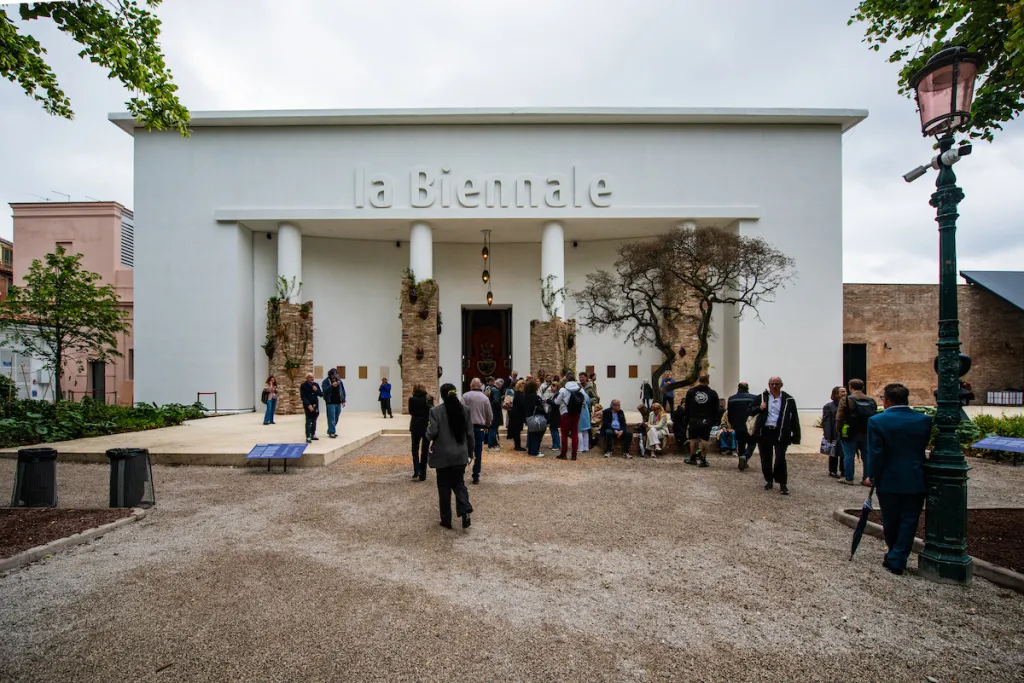
Nearly half of the artists in the main exhibition of the Venice Biennale said they did not want to be considered for the show’s top honors this year, marking yet another unprecedented development in an edition roiled by controversies of all kinds.
Fifty-two artists—just under half of the artists in the Koyo Kouoh–curated “In Minor Keys”—signed the statement published by e-flux on Saturday, which noted that they had done so “in solidarity with the resignation of the jury selected by Koyo Kouoh.” Those artists include such well-known names as Alfredo Jaar, Tuan Andrew Nguyen, Otobong Nkanga, and Walid Raad.
Published on the day when the Biennale typically holds its Golden Lion ceremony—something that did not happen this year because there was no jury to evaluate the artists—the statement was also signed by the artists who had done national pavilions for 16 countries. Among the national representatives who signed were France’s Yto Barrada, Lithuania’s Egle Budvytyte, and the Netherlands’s Dries Verhoeven.
Typically, these artists would have all been eligible for the Golden Lions, which are given by a jury both to artists in the main exhibition and national representatives. But instead of a jury determining who wins, the Biennale has planned what it has called Visitor Lions, which will be decided through a public vote. Those awards will be given out on the show’s closing day, on November 22, instead of during the exhibition’s public opening.
A Biennale spokesperson did not immediately respond to ARTnews’s request for comment.
The Biennale was plunged into controversy last month after the five-person jury named to judge the prizes issued a statement of its own, saying that it would not consider national representatives whose countries have been charged with crimes against humanity in the International Criminal Court. That would have knocked both Israel and Russia, two countries whose presence at the Biennale has been widely protested, out of contention.
Then, about a week after the jury was announced, its members collectively quit, without an explanation. Since then, multiple outlets, including the Italian news agency Adnkronos, have reported that Israel’s representative, Belu-Simion Fainaru, pressured the Biennale behind the scenes, alleging discrimination on the basis of race and antisemitism, and threatening to bring the show to court.
His pavilion, along with Russia’s, ultimately made it on view, though not without demonstrations nearby in the case of both shows. The organizers of Russia’s pavilion, however, have said their show will close following the Biennale’s preview days for the press.
In the run-up to the Biennale, politicians, artists, and activists alike had called on the show to drop Israel and Russia from the show. But the Biennale said it could not do so, claiming it did not have the right to exclude nations recognized as states in Italy, and said that the show “rejects any form of exclusion or censorship.”
Once the show opened, Biennale president Pietrangelo Buttafuoco said his exhibition was “not a court,” marking another attempt to claim the Biennale as a space of political neutrality. Some have questioned whether the Biennale really is a nonpartisan exhibition, pointing to the show’s history of making political statements, including in 2022, when Russia invaded Ukraine. That year, Russia’s artists closed their show, earning the Biennale’s stamp of approval.


