






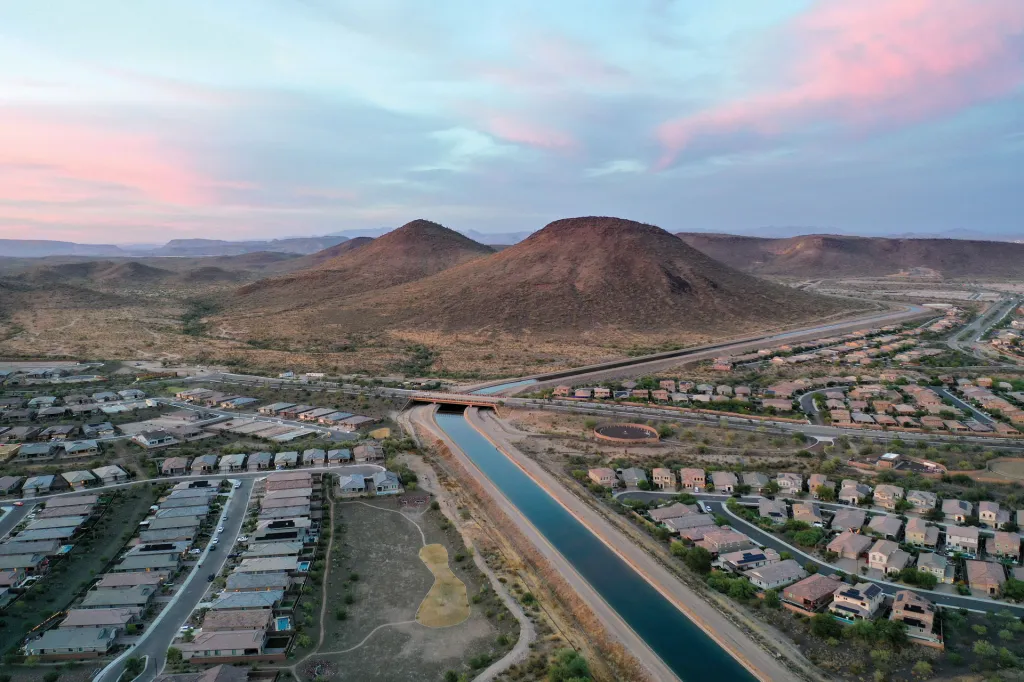
As the plane starts its final descent, the first thought you might have is: How can all of this be here? Another that may irk you, particularly if you’ve been keeping up with the news about the dwindling Colorado River, is: None of this should be here. If you’re like me, you will think some version of: Jesus Christ, that’s a lot of swimming pools.
It really is, too: 257,983, according to one survey. Developers build them in backyards as a way of charming new homeowners, but they’re also the easiest place to go if the air-conditioning cuts out in July, when the line between having fun and not dying is blurrier than one might hope.
Phoenix is home to 1.67 million people. In the summer the heat can reach triple digits by mid-morning, but in the winter you are all but guaranteed a string of sunny 70-degree days. Space is plentiful, the hiking sublime, and, in recent years, per that incontrovertible oracle of hipness The New York Times, the Phoenix suburb of Scottsdale has been challenging Nashville for the title of America’s bachelorette-party capital. All of which has made the city one of the fastest-growing in the United States, a transformation made possible by millions of kilowatt-hours of air-conditioning and millions of gallons of water slurped from the Colorado, Verde, and Salt Rivers. Dave Hickey had the innocence to call Phoenix “an ordinary city of the American West,” which is exactly what a Vegas guy would say. But I grew up here, and I’m still trying to describe the exact flavor of weirdness, of which ordinariness is merely one ingredient.
Over the course of 2025, having nothing in particular to keep me on the East Coast, I made four visits to Phoenix. All started the same way, with my brother picking me up from the airport and driving me to my mom’s house as we listen to yacht rock (if our listening ages were our actual ages, we’d both be retirees).
The streets near my mom’s place are lined with shaggy, seasonless palm trees. The first ones were planted in the 1870s; thousands more showed up in the 1920s and ’30s, a sign of the glinty Egyptomania of the era. If you were making a Phoenix movie today, you would include a shot of palms in the same way you’d throw in a shot of the Eiffel Tower for a movie about Paris. It’s an odd fate for plants that have never been native to the Sonoran Desert, drink obscene amounts of water relative to actual Sonoran flora, and provide no shade. They do, however, look good, in a jaunty-majestic sort of way, and in Phoenix, how X looks tends to outweigh how practical X might be.
On one visit, I came with my girlfriend, who was judging art by students of Phoenix College. Her co-panelist was the school’s most famous alum, Eric Fischl, and on our first night in town, the three of us had dinner. Eric was unceasingly pleasant and charming, and I was in agony—one of these days, I’m going to figure out how to act around people I deeply admire. You probably have your own list of artists whose work goes beyond mere humdrum excellence and grabs you with both fists; Fischl has been on mine ever since I walked into Skarstedt Gallery one afternoon and found Daddy’s Gone, Girl glowering at me.
Eric Fischl: Daddy’s Gone, Girl, 2016.
Courtesy Skarstedt, New York/©Eric Fischl/Artists Rights Society (ARS), New York
That painting, completed in 2016, shows a woman in lacy Emily Brontë black dipping her legs and some of her dress in a twinkling pool (suburban pools are to Fischl as haystacks are to Monet). Behind her, there’s a tumbler of something, probably not her first today. Also: a lawn that may or may not be real but looks like AstroTurf either way, and a pair of those skull-white lounge chairs no swanky hotel is without. The woman in black almost seems to reprimand the setting for its cheer, even as the setting reprimands the woman for her boozy gloom. A black dog paddles around in the water, too busy to worry what it’s supposed to be a symbol of. There is nothing at all lovable about Daddy’s Gone, Girl, and so I loved it immediately.
My girlfriend did a talk with Fischl at the Phoenix Art Museum, the site of a survey titled “Eric Fischl: Stories Told,” which opened in November and continues into June. The building opened in 1959 but got a new wing in the ’90s, courtesy of architects Tod Williams and Billie Tsien, who also designed one of my favorite New York places, the American Folk Art Museum. Like the duo’s work in Manhattan, the Phoenix wing feels grand but light, with glass and greenery tempering all the sandblasted concrete. The main difference between the two, alas, is that the Phoenix Art Museum still exists; the Folk Art Museum was ripped apart in 2014 to make way for more MoMA. Nobody really thinks of Phoenix as an architectural Oz, but it has one big thing going for it: There’s so much space that nobody needs to destroy the old to clear way for the new.


View of “Eric Fischl: Stories Told” at the Phoenix Art Museum.
Photo Brandon Sullivan
I took my mom to the talk and introduced her to Fischl. She teaches fourth graders, but for years she was a professor of political science at Phoenix College, so soon they were off and bantering. I overheard Fischl explaining that he was never any good at music because his childhood piano teacher had enormous breasts. His voice was low and calm, and I didn’t get the sense he was trying to shock, though he’s been accused of this many times since hitting it big in the ’80s—distracting bosoms are just another fact of existence, like the weather. If you’ve ever wondered if artists resemble their art, the answer, in my experience, is usually yes.
We celebrated Passover in my mom’s backyard, surrounded by palm trees: a table of Arizona Jews, honoring the Exodus from Egypt in the non-shade of faux-Egyptian foliage. The sun made the pool glow like a neon sign, which it sort of is.
I SPENT A SMALL BUT MEMORABLE PORTION of my Phoenix time at Taliesin West, the architecture school where Frank Lloyd Wright lived and worked for the last 22 years of his life. I had been before but somehow forgot about it. That’s telling, though: Taliesin West is spectacular in ways that melt into the general spectacle of Arizona. There are nine main buildings, mostly made from local desert rock, and they’re all gently sloped so as to echo the shape of the McDowell Mountains to the north. The designer George Nelson compared the complex to a “crustacean,” an odd thing to bring up when writing about the desert; but then, ambitious new buildings usually seem more bizarre at first than they really are. Where Nelson saw crazed disjunction, I see harmony: The walls are made from the same stuff as the ground, and the dusty red stairs to the main building rhyme with the peaks in the distance. In summer, the stone hallways stay surprisingly cool—Wright despised air-conditioning. That he didn’t live long enough to see what happened to Phoenix (or Taliesin West, now climate-controlled for year-round use) is probably for the best.
Frank Lloyd Wright’s Taliesin West.
Photo Jim Steinfeldt/Michael Ochs Archives via Getty
Still, as the name might suggest, Taliesin West is in many senses a figment of the eastern (or at any rate farther-east) imagination. Its parent campus is still going strong in Spring Green, Wisconsin, and its reputation over the years has been boosted by exhibitions at MoMA and breathless reviews in all the big city newspapers and magazines. In that sense, Wright’s creation resembles Arizona generally. Sleek, gray New York has a nice opposites-attract friendship with chunky, bright Arizona—witness Scottsdale Ferrari Art Week, brought to you by the founder of TEFAF New York and in March coming up on its second year.
Which takes us back to Eric Fischl. Raised in Arizona, educated at Phoenix College and ASU, he started painting meaty, sun-slapped bodies at a time when no career-minded East Coast artist was going within 100 miles of figuration. If you’re breaking with convention, you might as well go all the way and embrace bad taste—hence the abundance of Fischl canvases showing drunk dads, feral BBQs, and little kids contemplating naked women. After several years of producing work like this, Fischl found himself not just accepted but beloved by the New York crowd: praised by Hughes and Schjeldahl, collected by Steve Martin, displayed in the Whitney.
Critics writing about Fischl like to bring up Long Island, and not without reason (he also grew up there). To me, though, most of the paintings in “Stories Told” scream Phoenix suburbia. I feel it in the bright, hard colors, and the occasional palm trees and bungalows. But most of all I feel it in the way he handles water: It’s ubiquitous but still unnatural, seemingly teleported from light-years away. “None of this should be here” might as well be the caption for every painting in this exhibition, though with the implication: “But it is, so we might as well come to terms with it.”

Eric Fischl: Late America, 2016.
Courtesy Skarstedt, New York/©Eric Fischl/Artists Rights Society (ARS), New York
On a late afternoon in the fall, I wheeled my grandfather through the exhibition. We were both struck by an oil-on-linen canvas called Late America (2016). A little kid wrapped in a stars-and-stripes towel stares down at a pink, babyish grown-up passed out on the floor; behind them is a pool that nobody is enjoying. One of the first Fischls I ever saw, it’s still one of my favorites, if that’s the right word. An easy complaint would be that the painting is too on the nose, not quite like real life. But I was looking at Late America while pushing around a 90-year-old man and goofing off with my 8-year-old niece, all so that I could write this piece for the “American Art” issue of a magazine called Art in America. When I’m in Phoenix, real life doesn’t always feel like real life, either.


