







In AD 79, Mount Vesuvius erupted, sending a cloud of ash and hot gas sweeping through the ancient Roman town of Pompei. The writer Pliny the Younger—whose uncle, Pliny the Elder, died in the eruption—watched the catastrophe unfold from a vantage point across the Bay of Naples, later describing how inhabitants had tied pillows over their heads to protect themselves from falling debris and carried torches to find their way through the darkness.
In 2024, archeologists discovered the skeletons of two of the volcano’s victims, likely killed as they tried to reach the sea, just outside Pompeii’s southern gates. The first skeleton was of a young man, who is thought to have died in a pyroclastic surge—a rush of superheated gas and hot ash that can literally boil blood.
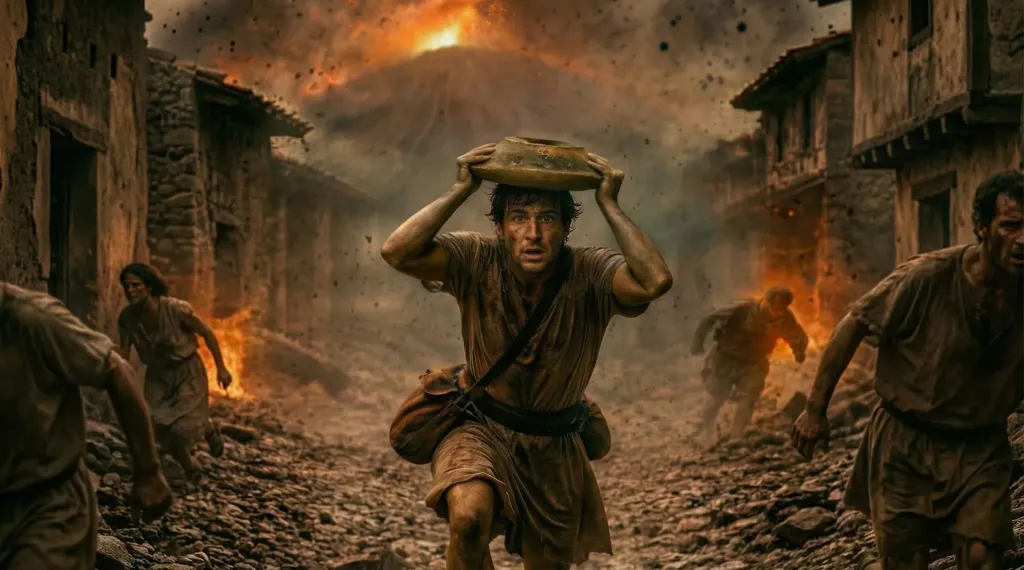
In an eerie echo of Pliny the Younger’s account, the second skeleton, that of a somewhat older man, was found with a terracotta bowl near his head. According to researchers, who published their findings on April 27 in the journal Scavi di Pompei, he may have tried to use the vessel as a defense against lapilli, or falling pebbles.
This man was also found with an oil lamp and 10 bronze coins, suggesting that he fled with money and a means to navigate the gloom, in addition to whatever he could find for protection. Now, the Pompeii Archaeological Park, in collaboration with the University of Padua, has created an image of his last moments using image-generation and image-editing tools.
“Italy has historically always made classical culture a key ingredient of innovation,” noted Italian culture minister Alessandro Giuli. “In Pompeii, artificial intelligence helps not only in the protection of the immense archaeological heritage, but also in the engaging and accessible narration of ancient life.”


