







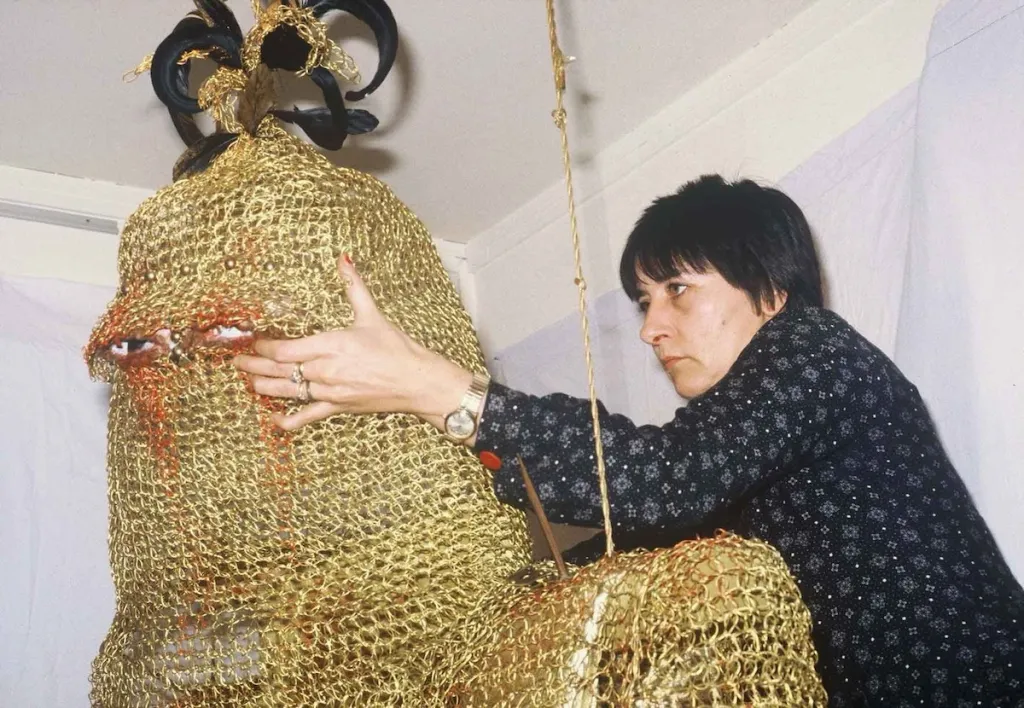
Raymonde Arcier, who brought attention to women’s work by way of an art practice based in fabric and textiles of different kinds, died in May at the age of 86. Her death was acknowledged by sources including curators and the magazine Textile/Art.
Arcier was born in 1939 in Bellac, France, and made her way as an office worker and self-taught artist who “from 1970 on, produced her most striking works, crocheting wool and cotton, and knitting metal—with each piece demanding up to a year’s work,” according to Centre Pompidou’s AWARE: Archives of Women Artists, Research & Exhibitions. “Through her appropriation of this female cultural apprenticeship, she wittily conjured up her social confinement, trying—to use her own words—to ‘make everyone aware of the huge labour of women.’”
Among her notable artworks are Faire ses provisions (1971), large shopping bags made with threads from garter stitching, and Au nom du père (1975–1976), a giant sculpture of a naked woman whose breasts are being groped that resides in the Pompidou’s collection.
Stavroula Coulianidis, an independent curator who started working with Archer in 2022, wrote on Instagram: “Known for her feminist activism since the early 1970s—particularly her involvement in the Women’s Liberation Movement and in the creation of the newspaper Le Torchon brûle—Raymonde, a completely self-taught artist, developed a body of sculptural work connected to the condition of women within patriarchal society, a reality she sought to expose and critique.”
Coulianidis continued: “Shopping, cleaning, sewing, and dressmaking became the basis for works in which everyday objects were enlarged to monumental proportions, amplifying their omnipresence and burden.”


