






Fresh off the opening of Dataland, Refik Anadol’s new AI art museum in Los Angeles, the media artist has partnered with the Smithsonian Institution for a new monumental installation.
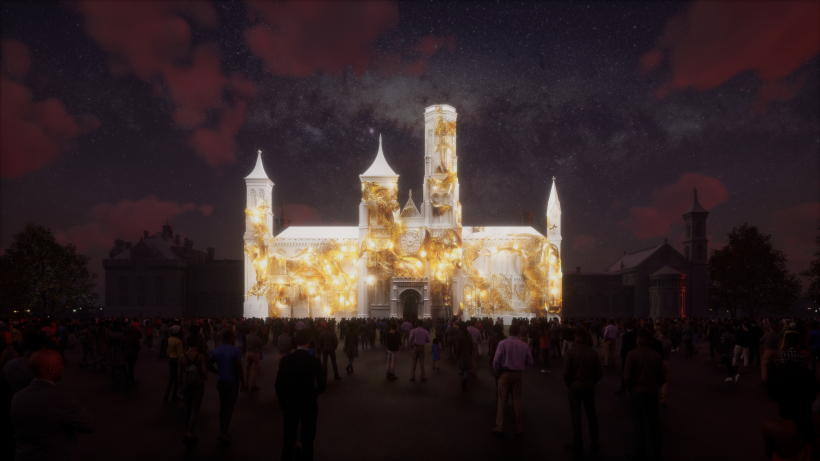
Dubbed Smithsonian Dreams, the new project will see Anadol transform the Smithsonian Castle, the headquarters of the Institution on the National Mall, with an immersive performance of light, sound, and visuals on July 17 and July 18 at 9 p.m..
For the work, Anadol built a custom AI system that reinterprets 200 years of Smithsonian collections and research, amounting to millions of digitized specimens, manuscripts, photographs, artworks, objects, and scientific records. The data is then turned to a projection on the Castle’s facade through a custom visualization system using a UMAP (Uniform Manifold Approximation and Projection) algorithm.
If all this is sounding a bit familiar, that’s because Anadol’s most well known work, Unsupervised, which was shown in the Museum of Modern Art’s lobby for nearly a year, similarly ingested a museum’s collection and then spit out a transformed visualization through a UMAP algorithm. Curatorial text also framed the project as a machine’s “dreams.”
“For me, data is a form of memory,” Anadol said in a statement announcing the Smithsonian project. “The Smithsonian preserves one of humanity’s most extraordinary repositories of knowledge, accumulated across generations of discovery and imagination. ‘Smithsonian Dreams’ asks what might emerge if that vast memory could become dynamic, if the Castle itself could learn from its collections, reflect upon them and dream through them. Using machine intelligence as a creative collaborator, we are transforming the archive into a living experience where history, culture, science and imagination continuously unfold in new ways.”
For those who, like Artnet‘s Ben Davis, see Anadol’s visualizations as a very expensive lava lamp, it seems unlikely the Smithsonian project will change any minds. But, one suspects, for the general public, “Smithsonian Dreams” will be a big hit. Some three million people visited MoMA to see the work, according to the artist’s studio, averaging about 38 minutes in front of the piece.


