






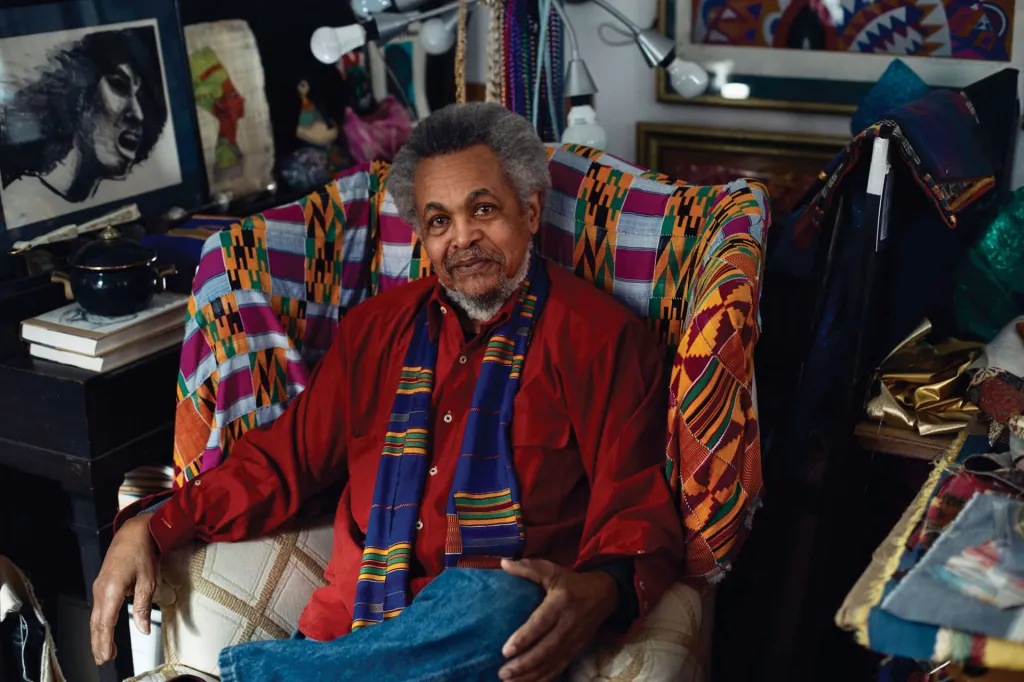
“Do the work” was Napoleon Jones-Henderson’s mantra. He believed that beautiful things grow wherever people invest themselves in the labor of collective empowerment.
Born in Chicago in 1943, Jones-Henderson grew up in the Bronzeville neighborhood on Chicago’s South Side and attended George Washington Carver High School, where he was introduced to weaving by an influential art teacher. This teacher “threw the doors open,” as Jones-Henderson remembered, connecting him more formally to what he called the “life activity” of quilt making and the mending the women in his family undertook at home. After high school, Jones-Henderson received a scholarship to study at the Sorbonne in Paris, where the curriculum was overwhelmingly centered on a European discourse that he found largely unaccommodating to non-European perspectives. Later, at the School of the Art Institute of Chicago, where he earned his BFA, Jones-Henderson had a similar experience, though he counted himself fortunate to study there with artist Else Regensteiner (1906–2003). Alongside a notable few, Regensteiner is credited with advancing the artistic approaches of the Bauhaus movement in the textile arts in America. She also connected Jones-Henderson directly to this lineage.
In 1969, while still a student, Jones-Henderson became a founding member of the influential artist collective the African Commune of Bad Relevant Artists (AfriCOBRA). Often referred to as “the weaver” of the group, Jones-Henderson adapted Regensteiner’s expert use of color and her integration of nontraditional materials, such as metallic thread and found objects, to create his own signature textiles. These works express AfriCOBRA’s aesthetic principles—to create images inspired by the “expressive awesomeness” of the lived experience and the cultures of people of the African diaspora in an accessible, graphic style with shining Kool-Aid colors.
In 1974, Jones-Henderson met artist Calvin Burnett and a group of his students from the Massachusetts College of Art and Design (MassArt) while in Chicago. At their invitation, he came to Boston to teach textile weaving. Inspired by the history of textile manufacturing in the area and the availability of shiny metallic yarns that offered a unique means of expressing AfriCOBRA’s ideas, Jones-Henderson moved into the former home of abolitionist Edward Everett Hale in Roxbury. There, for more than 50 years, he cultivated a rich studio practice where his life and art were fully integrated, creating small- and large-scale works in fiber and mosaic, prints and mixed media works on paper, and shrine-like devotional sculptures.
In its many material manifestations, Jones-Henderson’s work was oriented around themes of empowerment, Pan-Africanism, and racial justice. His kaleidoscopic works are self-affirming and reflective, with an eye toward both a fraught past and a liberated future. He often gravitated to a line from James Baldwin’s 1961 book Nobody Knows My Name: “The artistic image is not intended to represent the thing itself, but rather, the reality of the force the thing contains.”
In the years following Jones-Henderson’s move to Roxbury, he settled into an active role as an educator and a mentor with an outsized presence in the community. He was a member of the Boston Collective, led by esteemed elder artist Allan Rohan Crite, and his home was a key artistic meeting place aligned with the African American Master Artists-in-Residence Program at Northeastern University and the Museum of the National Center of Afro-American Artists. He was deeply involved with the National Conference of Artists for decades and even organized their 24th annual exhibition in Boston in 1982, featuring the work of artists Lethia Robertson, Joyce J. Scott, and Theresa-India Young. His dedication to collective empowerment was unparalleled, which makes his passing an immense loss. But his life’s work is an indisputable reminder to invest in one another and keep doing the work together.


