






When Mount Vesuvius erupted in 79 CE, among the objects and remains preserved for the next two millennia were a collection of carbonized scrolls from a residence in Herculaneum known as the Villa of the Papyri. This ancient Greco-Roman library was situated near Pompeii, just 11 miles from the base of Mount Vesuvius. These ancient scrolls are too fragile to unfurl, stymieing scholars’ attempts over the past few centuries to complete translations of the texts within.
That’s where the Vesuvius Challenge comes in. The University of Kentucky launched the project in 2023, with the goal of using machine learning and X-ray technology to make progress on deciphering the preserved Herculaneum scrolls. Over the past few years, the Vesuvius Challenge has awarded hundreds of thousands of dollars in prize money to scientists and researchers who have moved the project forward, bringing words and passages from the scrolls to light.
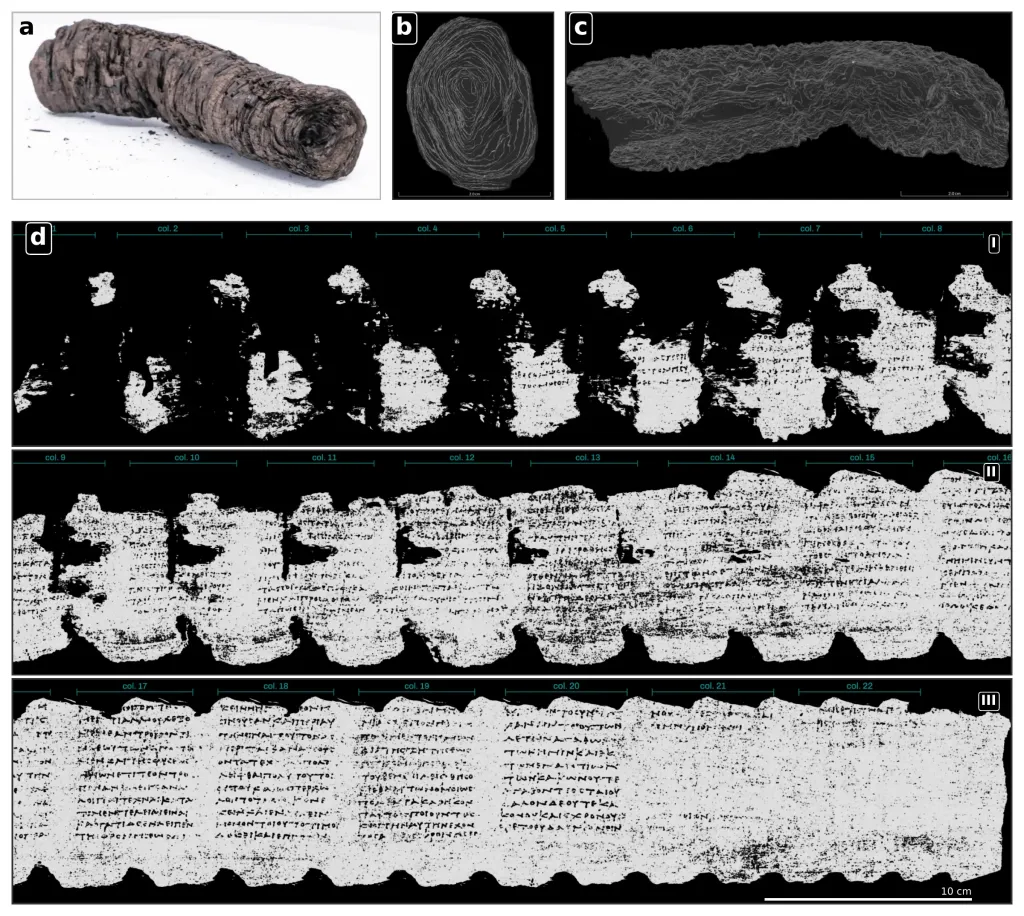
Last week, the university announced a “historic breakthrough” at the Biblioteca Nazionale di Napoli. The team has virtually “unwrapped” a scroll known as PHerc. 1667, enabling scholars to read 20 surviving columns of text; recovered 70 columns of text from another scroll housed at Oxford’s Bodlein Library (PHerc. 172), and identified new books by the Epicurean philosopher Philodemus.
Vesuvius Challenge cofounder Brent Seales, chair of Heritage Science at the University of Kentucky, told Artnet News that a team of researchers in France and the UK used a particle accelerator and a synchrotron to produce unusually high-resolution scans of the scroll. The scans make up the largest dataset (as much as 300 terabytes per scroll) ever produced by the European Synchrotron Radiation Facility, a particle accelerator in Grenoble, France. These datatsets were then used to generate detailed 3D maps of the scrolls.
The software in question, Seales notes, “has significantly improved,” even in the two years since Youssef Nader, Luke Farritor, and Julian Schilliger were awarded the $700,000 Vesuvius Challenge grand prize in 2024.
Federica Nicolardi, a papyrology professor at the Università degli Studi di Napoli Federico II who is on the Vesuvius Challenge team, noted in the press release that PHerc. 1667 had initially been opened—and damaged—in the 1980s, and was given a readability score of zero. “But now,” Nicolardi explained, “with virtual unwrapping, we can follow sustained arguments across multiple columns. That’s a transformational shift.”


