






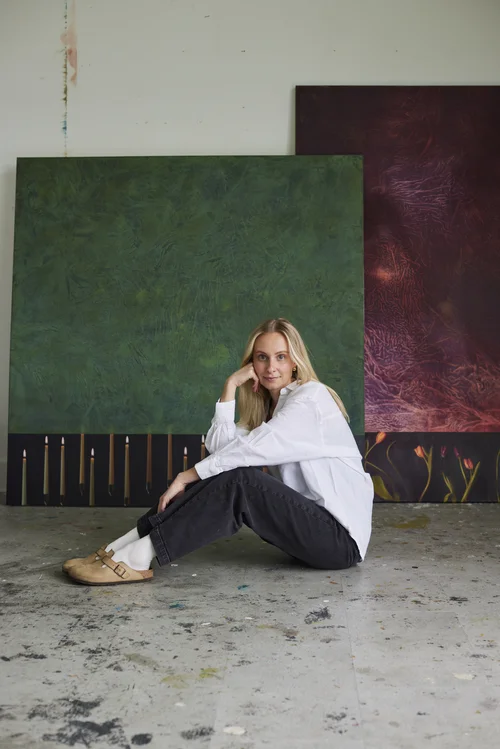
In her New Hampshire studio, painter Danielle Fretwell arranges opulent banquets for no one.
She thinks of herself as the host of an imaginary party and carefully selects pieces of silverware and table linens from a collection she’s assembled over years of scouring New England vintage shops. She arranges fresh fruit, scoops ice cream, and pours wine. When the table setting feels just right, Fretwell photographs it. Then, she packs everything away.
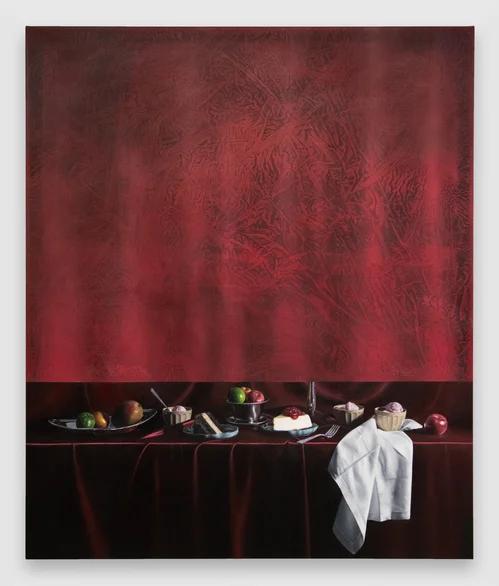

She uses her photographs as the basis for her visually seductive still-life paintings. Fretwell is best known for her “split” compositions, in which she juxtaposes her hyperrealistic renderings of banquet scenes with abstracted fields of color that seem like veils or curtains concealing the image below. The paintings are visual riddles challenging perception and blending illusion and truth.
Fretwell arrived at this characteristic style of painting several years ago, and she’s steadily been gaining the art world’s attention since. Two years after earning her MFA at Boston University in 2021, Fretwell was included in “Infinite Loop,” a group show at Alice Amati in London. That was soon followed by “Shallow Invitations,” her first solo exhibition with Amati in 2024.
Now, Fretwell is making her New York solo debut with “Terms of Consumption” at Olney Gleason, showcasing a suite of new paintings that revel in luminous textures from iridescent tablecloths to the glittering scales of fish. The centerpiece of the exhibition, In Good Taste (2026), measures five and a half feet tall. In it, a crimson veil hangs above a decadent banquet of cakes, bowls of ice cream, and fruits. A crisp white linen napkin hangs off the edge of the table with a trompe l’oeil effect.
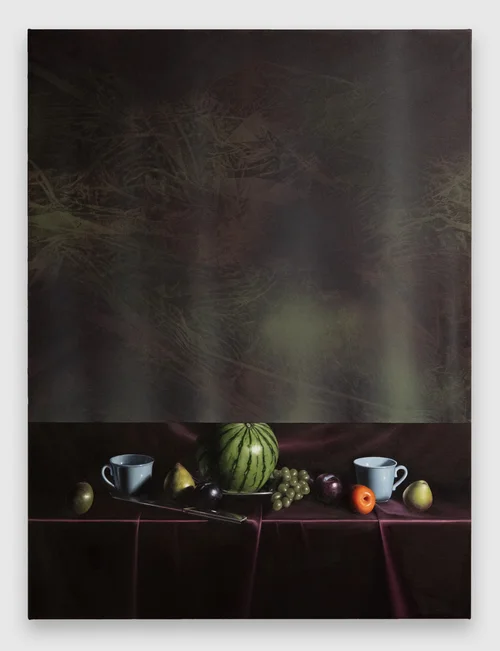

The splendor and decadence of the Dutch Golden Age banquet scenes certainly come to mind in the presence of these new works.
“What I love so much about 17th-century Dutch still life painting is that it had this focus on opulence, but the paintings are also about skill,” Fretwell explained. “These painters were showing off this full array of everything that they could do with surfaces.”
One painting in particular inspired the works at Olney Gleason. Last fall, during a trip to the National Gallery in London, Fretwell was captivated by the painting A Banquet Still Life (1622) by the artist Floris van Dyck, which was recently acquired by the museum. The painting is a bountiful, almost encyclopedic display of foodstuffs arranged on a tabletop.
“It’s probably my favorite painting that I’ve ever seen,” Fretwell remarked. After seeing the painting, Fretwell began researching the subgenre of banquet still life painting, which focused on large arrangements of objects.
Painting food allows Fretwell to show off what she can do, too. “Food is already attractive to us because we need it to survive,” she said. “But in painting, I can get a level of glossiness that heightens its appeal. When I paint a fish, how can I extend how wet the scales are? Painting is always pushing the effect further than it is in reality.”
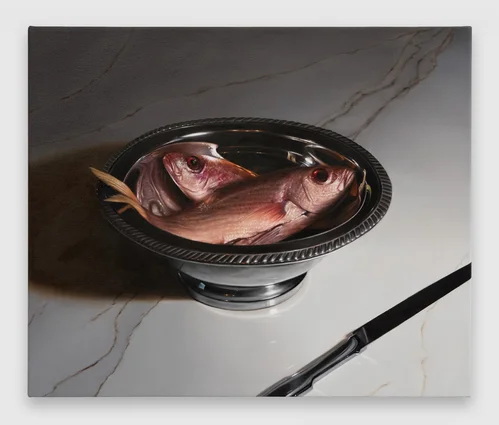

But there’s a counterbalance to the controlled perfection of these still lifes. Fretwell’s passages of abstraction rupture the hyperreality of the rest of the canvas, offering a sense of release and distance. Fretwell creates these abstract veils by dragging and pressing bed sheets across a wet canvas. “I’m crawling all over it. It’s a very physical process, and sometimes you see handprints, knee prints, footprints,” she said. In some ways, she sees these passages as more visually honest than the still lifes. “I use fabric in order to depict fabric on the canvas,” she said, “That feels closer to the truth.”
These abstract passages, she says, were inspired in part by works made by Mark Rothko during the mid-20th century. “I saw a Rothko painting that looked like a tabletop with this veil coming down on it,” Fretwell recalled. “That arrangement of geometry and color-blocking was very inspiring to me.”
For Fretwell, her paintings are ruminations on the limits of perception in our oversaturated age. “I think it’s just important for me to remind viewers with these paintings to be skeptical of what they’re looking at,” she said, referencing the rise of AI and the proliferation of internet misinformation. “We are having to discern what is true all the time. Even in a painting, we can see the same thing and come to different conclusions.”


