








Good Morning!
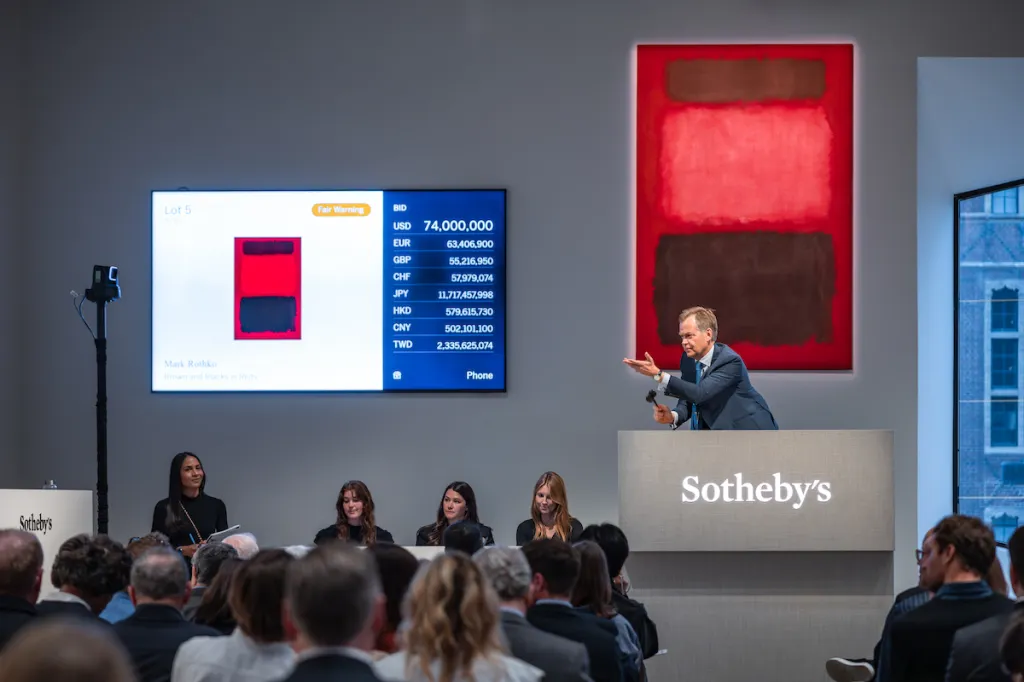
- Sotheby’s kicked off the May marquee auction season with a $433.1 million result at its modern and contemporary art evening sales.
- Australia’s Yindjibarndi Ngurra Aboriginal people say a $107 million payout from a recent land title compensation ruling, which recognized damage to their cultural heritage sites, is not enough.
- The King’s Own Royal Regiment Museum Trust in the UK has returned artifacts to Ethiopia that were taken during the Anglo-Indian Expedition of 1868.
The Headlines
GOING, GOING…PRETTY GOOD. “Solid if unexciting” is how ARTnews’ Brian Boucher and Alex Greenberger describe Thursday’s kickoff of the May auction season at Sotheby’s in New York. A total of $433.1 million in sales from the modern and contemporary art auction, led by an $85.8 million Mark Rothko painting, is certainly nothing to scoff at. “It was a good sale,” agreed advisor Jacob King. “Not particularly exciting, but good.” The late dealer Robert Mnuchin’s estate opened the bidding with 11 works, all of which found buyers, for a total of $166.3 million, including fees. The headline-maker was Rothko’s Brown and Blacks in Reds(1957), estimated at $70 million to $100 million, which Mnuchin purchased in 2003 for just $6.7 million. Thursday’s sale fell just short of Rothko’s auction record of $86.8 million, set in 2012, when Orange, Red, Yellow (1961) sold at Christie’s. The auction also signaled good news for works by women, like Joan Mitchell, as well as “ultra-contemporary” artists such as Ding Shilun and Yu Nishimura. Read on to discover who else performed well, and who barely squeaked by with low estimates.
POLARIZING PAYOUT. TheYindjibarndi Ngurra Aboriginal Corporation (YNAC) is considering appealing a Tuesday verdict by the Australian Federal Court ordering the mining company Fortescue to pay a record AUD 150 million ($107 million) to the Yindjibarndi people, in compensation for cultural and heritage damage caused by mining their native land in north-western Australia without permission, reports the Guardian. The YNAC called the payout “unsatisfactory” because it won’t cover their cultural or financial losses from the Solomon Hub iron ore mine, which has generated an estimated AUD 80 billion ($57 billion) in revenue for Fortescue since it began in 2012. The YNAC launched a native title compensation claim in 2022, seeking about AUD 1.8 billion ($1.3 billion) to cover cultural and economic loss. In Tuesday’s ruling, Justice Stephen Burley agreed that “significant damage has been done to Yindjibarndi songlines and other areas of cultural heritage,” according to ArtAsiaPacific. This has included the removal and remote storage of artifacts from 240 classified heritage sites, and the complete destruction of 124 of those sites. YNAC’s chief executive officer, Michael Woodley, told reporters that in one sense, the Tuesday ruling was a “win” for Indigenous people, because it showed understanding of their connection to the land, but he was adamant that the amount of compensation remains “unsatisfactory in the context of what has been lost.”
The Digest
During a ceremony in Lancaster on May 12, the King’s Own Royal Regiment Museum Trust returned looted ancient artifacts to Ethiopia, which once belonged to Emperor Tewodros II of Abyssinia, including what is believed to be a lock of Tewodros’ hair, and cloth stained with his blood following his 1868 death in battle. [Lancaster Guardian]
Budget cuts to the San Francisco Arts Commissionhave been followed by a “chaotic” downsizing process, despite Mayor Daniel Lurie’screation of two new arts grants and his assertion that the arts “are driving our city’s economic recovery.” [KQED]
Seven billboards calling for peace, echoing Yoko Ono and John Lennon’s 1969 campaign, will appear across Los Angeles as part of Ono’s exhibition at the Broadmuseum, opening May 23. [The Los Angeles Times]
Recently renovated, “sodomized” gargoyles on a historic building near the Santiago de Compostela Cathedral in Spain have locals scratching their heads. [El Pais]
Frida Kahlo and Diego Riveraare the stars of an “eerie” new production at the Metropolitan Opera. [The Financial Times]
The Kicker
THE COLOR OF WASHINGTON’S WHITE HORSE. A 1976 painting by Arnold Friberg of George Washington kneeling by his horse in prayer at Valley Forge has become an increasingly prevalent image used by the US government ahead of the country’s 250th anniversary, reports the New York Times. The idealized image drawn from legend shows Washington praying as a golden light illuminates him and his white horse, during the winter of 1777-8, at a time of uncertainty for the American Revolution. While Washington was private about his Anglican beliefs and a supporter of religious freedom for all faiths, Christian nationalists have been reviving the image, and with it, the claim that the US is an inherently Christian nation at its origin. Lately, the painting has been posted online by the Department of Defense, and on federal and White House-organized material promoting the 250th anniversary. The shift, according to the NYT, signals the instrumentalization of the artwork for political propaganda and the spreading of evangelical viewpoints opposed to the separation of church and state. “Christian nationalists are now in power,” said historian John Fea, from Messiah University in Pennsylvania. “And that is why you are seeing it in different kinds of spaces.”


