








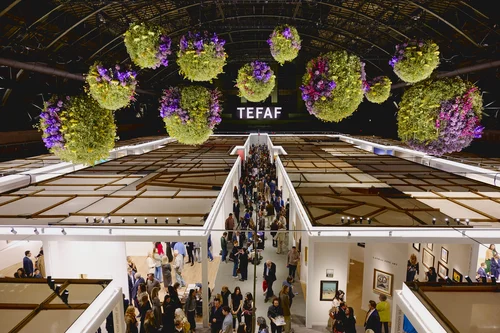
An overcast day on the Upper East Side did little to dampen the spirits at the Park Avenue Armory, as a typically glamorous crowd convened for TEFAF New York 2026.
Marking its 12th edition in New York and its 10th in the May slot, the fair is an established fixture of New York Art Week, complementing the more contemporary-minded fairs taking place this week—such as Independent, NADA, and Frieze—with a more historically focused selection of exhibitors.
That has very much been TEFAF’s stock in trade since it was founded in 1988 in the Dutch city of Maastricht, where the fair claims to present some 7,000 years of art history (something it did with aplomb at its recent outing). There’s a similarly broad attitude at the fair’s stateside edition—ancient sculpture and jewelry can still be found—but with a greater focus on the 20th-century and contemporary art.
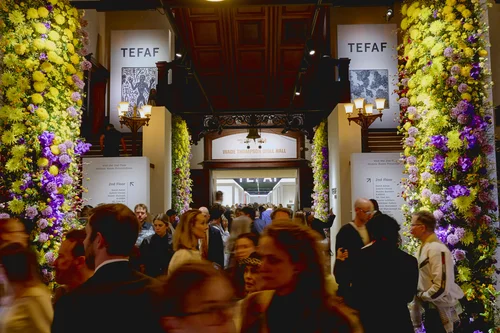

In fact, several galleries used the fair to debut new bodies of work altogether, such as Thaddaeus Ropac’s solo presentation of paintings by Eva Helene Pade. Others paired new works with historical counterparts, as in MASSIMODECARLO’s presentation of new paintings by Alvaro Barrington alongside embroideries by Alighiero Boetti. There were solid works from 20th-century favorites throughout: the likes of Pablo Picasso, Henri Matisse, and Andy Warhol were not in short supply. It’s no surprise, then, that TEFAF ranks among the most expensive fairs of the week—works under $20,000 are a rarity, and many push into the mid-eight figures.
Also not in short supply at the VIP opening day: floral decorations and wine. And cameras and appetites were indulging plentifully in each, respectively. Few art fair opening days are as glamorous.
Here, we present our five best booths from TEFAF New York.
Gagosian
Booth 350
With works by Kathleen Ryan
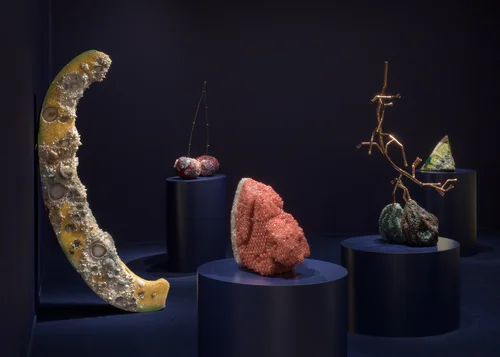

Cherries, melons, and oranges are among the glittering, rotting fruit sculptures that greet TEFAF visitors upon entry to the Park Avenue Armory’s main hall. Gagosian has given over its booth to Kathleen Ryan, showing new works from her ongoing “Bad Fruit” series. Here, the artist portrays oversized produce in slow decomposition, the mold rendered painstakingly in pearls, opals, agates, and semiprecious crystals, each one fixed in place with a single steel pin.
The works are Ryan’s playful take on the American tradition of pushpin-beaded fruit. Bad Cherries (Princess) (2026) hangs a pair of monumental cherries from a long, conjoined wire stem, the rot scattered across each surface like couture sequins. Bad Lime (Treasure) (2026), meanwhile, leans tall against the wall, its decaying flesh crusted with shells, geodes, and milky cabochons that seem more like a coral reef than fruit at first glance.
Half the fun is in recognizing the rinds of these fruit sculptures, which are sourced from salvaged vehicles: the cool blue arc of Bad Melon (Fantasy) (2026) is a former Volkswagen Beetle, while Bad Melon (Little Chunk & Little Baby Chunk) (2020–24) carries the contour of an Airstream trailer.
Gana Art
Booth 372
With works by Choi Jong-Tae, Yoo Youngkuk, and Park Dae-Sung
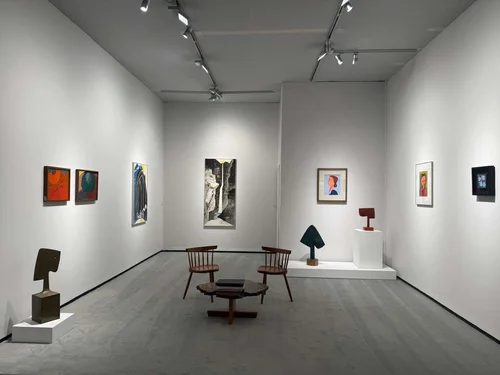

Seoul-based Gana Art gathers standout works by three Korean masters: the abstract painter Yoo Youngkuk, the sculptor Choi Jong-Tae, and the ink painter Park Dae-Sung—three figures whose careers map the relationship between Western modernism and Korean tradition.
Yoo’s Mountain (1972) anchors one side of the booth: an immediately recognizable example of his bold, color-saturated, geometrically simplified abstractions. Choi’s sculptures, meanwhile, are spread throughout—fine bronze and painted-wood examples of his figures and “faces,” rendered almost in silhouette, with sharply angled jaws and features reduced to a few faint marks. Face (1997), a roughly 30-inch bronze, retains a curious flatness, even in three dimensions.
On the other side of the booth, Park’s Guryong Waterfall (2026), made for the fair, returns to one of his most enduring subjects: the Nine Dragons Falls of Mt. Geumgangsan, in North Korea. Park works in the centuries-old Korean sansuhwa (mountain-and-water) ink tradition; here, monumental cliffs are rendered in dense, forceful black ink, while a single thin ribbon of water descends through the center in delicately diluted, almost ghostly strokes. “Using sumi ink with the brushstroke requires such a high level of control,” said Jung Yeon Park, the artist’s daughter.
That technical control is all the more striking given Park’s extraordinary biography: He lost his parents and half of his left arm during the Korean War at the age of four and is largely self-taught. A recent traveling U.S. museum tour at stops including LACMA has positioned him as one of the most institutionally celebrated living Korean painters. Prices for Park’s works range from $50,000 to $100,000.
Galerie Patrick Seguin
Booth 331
With works by Jean Prouvé
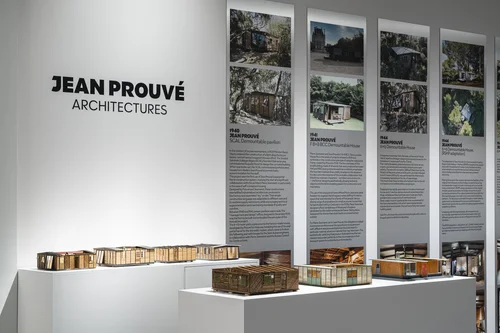
Paris-based Galerie Patrick Seguin assembles one of the most museum-like booths of this year’s fair: a tightly organized survey of Jean Prouvé’s architecture, presented through 12 scale models, explanatory texts, and archival video. Prouvé was known for his prefabricated metal structures. The models aren’t for sale here—the buildings are, and the dealer’s staff will assemble them for the buyer. “The smallest can be built in [one day] by four people,” gallery founder Patrick Seguin told Artsy.
Works span 1940 to 1956 (Prouvé’s most fertile years), and two pieces stand out. The Villa Lopez (1953), which was nicknamed Ombres Bleues for its tinted blue aluminum panels, is being shown publicly for the first time and is the most architecturally ambitious of the lot. A one-off, free-form variation on the standardized system, it was designed for a single family rather than mass-produced. The Better Days (1956) house, designed for an emergency-housing campaign for the Paris homeless, gathers a circular concrete utility core with prefabricated panels radiating outward like petals, and is seen as Prouvé’s most idealistic, and most famously thwarted, social commission.
Around them, the other models prove the consistency of Prouvé’s “constructive system” across radically different functions and scales: the lightweight SCAL 8×8 pavilion (1940), made with Pierre Jeanneret, the 6×6 and 6×9 emergency housing units (1944), conceived for families displaced by the war, the 8×8 reconstruction unit (1945), and the Carnac vacation house (1946), among others.
“They are historical, inspiring, and a real manifestation of architecture,” Seguin enthused. Prices range from $1.8 million to $12 million.
Yares Art
Booth 338
With works by Anthony Caro, Helen Frankenthaler, Robert Motherwell, and David Smith
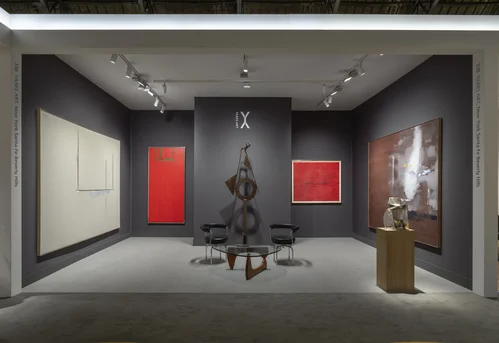

In its TEFAF booth, local stalwart Yares Art presents a selection of works by Anthony Caro, Helen Frankenthaler, Robert Motherwell, and David Smith: a quartet of painter-and-sculptor friends whose transatlantic exchanges helped shape American post-war abstraction.
The anchor is a Frankenthaler-Caro pairing. In Frankenthaler’s Gliding Figure (1961), a long, mustard-yellow brushstroke loops across the upper half of the canvas, while a soft, burnt-orange shape sits inside, its edges bleeding into the cloth: A sterling example of her “soak-stain” technique, in which thinned paint is poured directly onto canvas and allowed to seep. Across from it, Caro’s Silver Piece XXVIII (1984–85) is a low-slung assemblage of polished, curved, welded steel components from his “Silver” series.
“Frankenthaler and Caro were friends from 1959 until she passed away in 2011,” gallery founder Dennis Yares told Artsy. “Though Helen was a painter, she learned sculpting from Caro. And though Caro was a sculptor, he learned painting from Helen. So it’s a 50-plus-year friendship.”
The conversation widens around them. Two Motherwell “Open” paintings—Open #184 (1969) and Scarlet Open (1972)—date almost exactly to the years he was married to Frankenthaler and trades her stained forms for a few charcoal lines sketching a doorway across a flat field of color. Smith’s Voltron XXIV (1963), a nearly eight-foot column of welded steel made two years before his death, supplies the heavy sculptural counterweight that had such an influence on Caro. Prices range from $250,000 to $3.2 million, with the Smith price undisclosed.
Friedman Benda
Booth 325
With works by Wendell Castle, John Chamberlain, Nicole Cherubini, Frida Escobedo, Shiro Kuramata, Joris Laarman, nendo, Gerrit Rietveld, Samuel Ross, Osamu Suzuki, and Faye Toogood
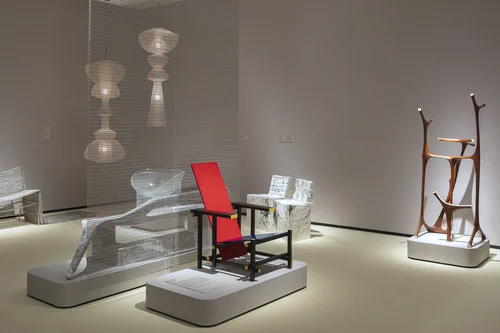
Design heavyweight Friedman Benda frames its stylish booth around “revisiting modernism,” according to gallery co-founder Marc Benda.
“We have this very one-dimensional idea of modernism that it’s all very rational and straight lines and glass and steel,” he told Artsy. “But in reality, modernism, as it developed over time, is a license for creatives to really expand and experiment.”
A standout is an early example of Gerrit Thomas Rietveld’s Red Blue Chair (1920s). It’s an icon of Dutch De Stijl (the style) design—a chair built from intersecting wooden slats and two flat planks, the back painted red, the seat blue, the structural frame black pocked with bright yellow—and it looks like a three-dimensional Piet Mondrian painting. An early Wendell Castle work of stack-laminated, hand-carved walnut showcases the American artist’s organic approach.
Two slender posts rise into forked Y-shaped tops, with a small scooped seat hovering near the floor: It looks half furniture, half creature. Nearby, a small, dark bronze by John Chamberlain, made before he switched to his signature technique with crushed auto-body parts, welds thin vertical rods and horizontal bars into a compact, near-architectural diagram.
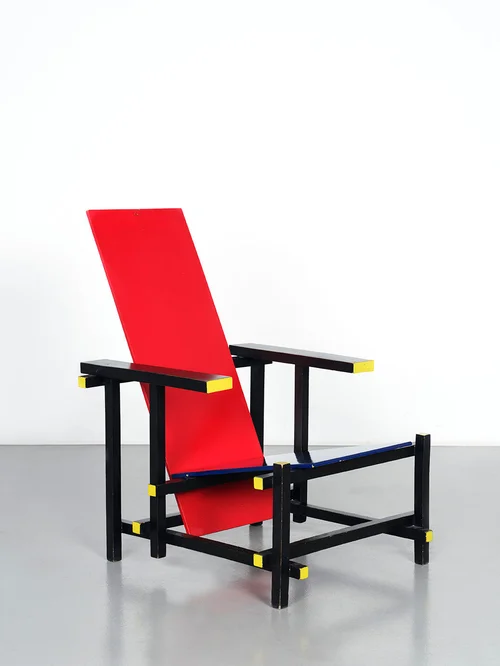

Red Blue Chair, first half of the 1920s
Gerrit Thomas Rietveld
Friedman Benda
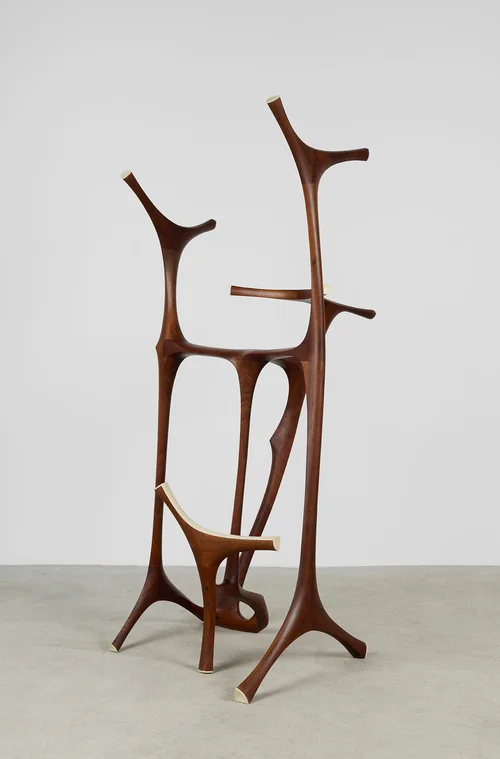

Stool Sculpture, 1959
Wendell Castle
Friedman Benda
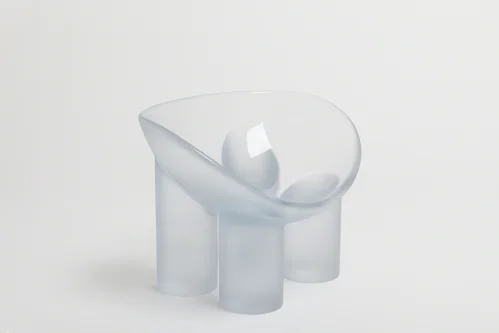
Roly-Poly Chair / Water, 2016
Faye Toogood
Friedman Benda
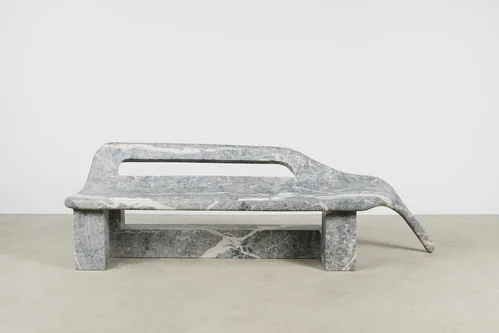
Optimistic uncertainties solicit integration (Material Articulation), 2021
Samuel Ross
Friedman Benda
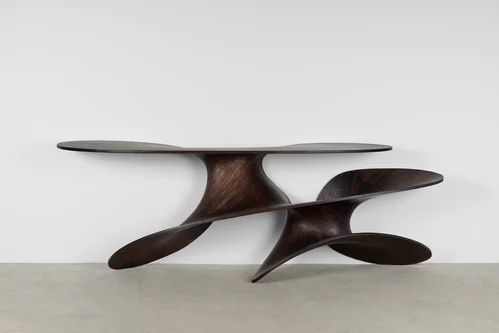
Ply Loop Console, 2026
Joris Laarman
Friedman Benda
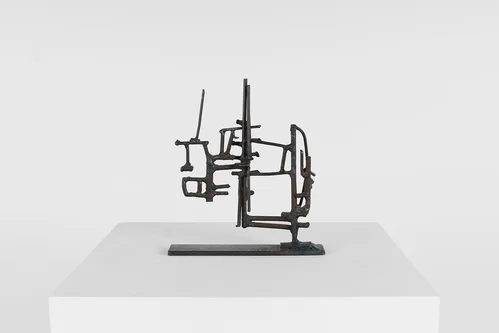
Untitled, 1954
John Chamberlain
Friedman Benda
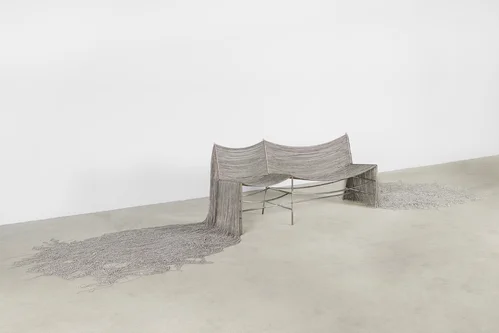
Creek Bench, 2022
Frida Escobedo
Friedman Benda
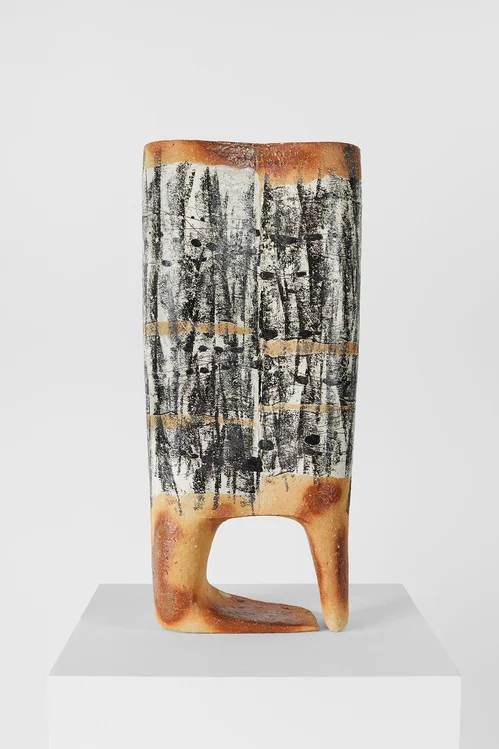

Dogū, 1960
Osamu Suzuki
Friedman Benda
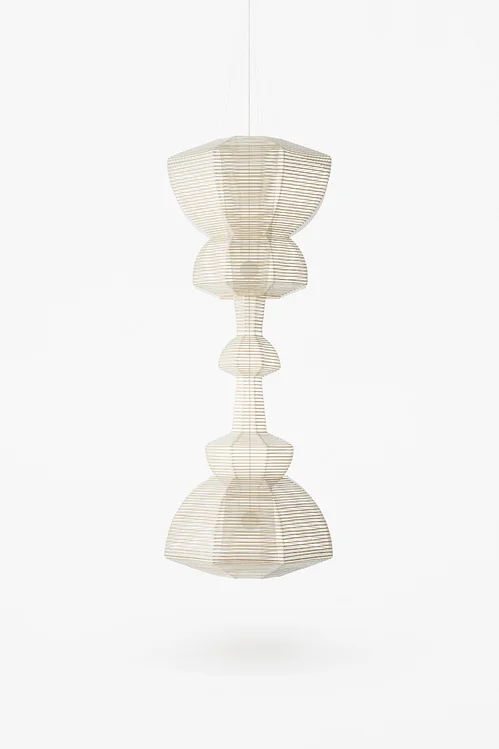

hyouri R (Pendant), 2024
nendo
Friedman Benda
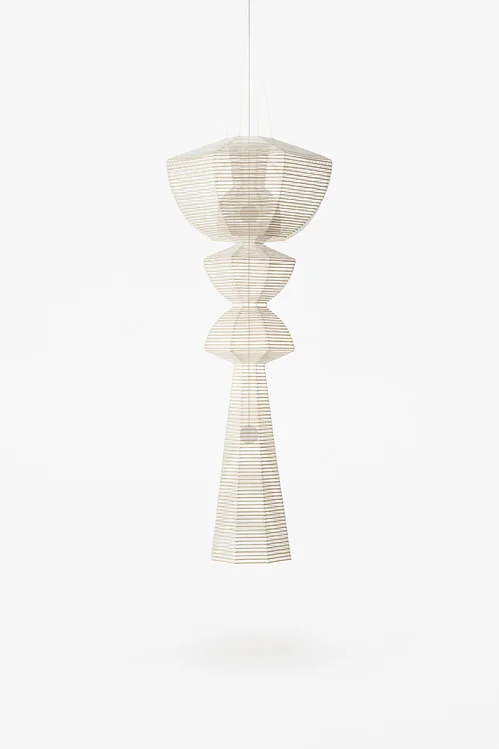
hyouri S (Pendant), 2024
nendo
Friedman Benda
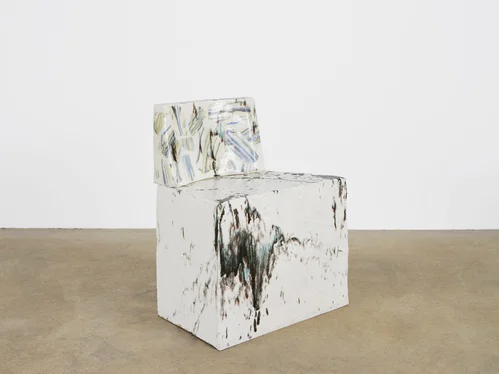

Love seat, left, 2026
Nicole Cherubini
Friedman Benda
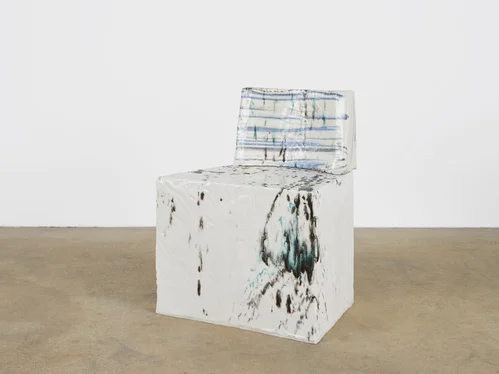
Love seat, right, 2026
Nicole Cherubini
Friedman Benda
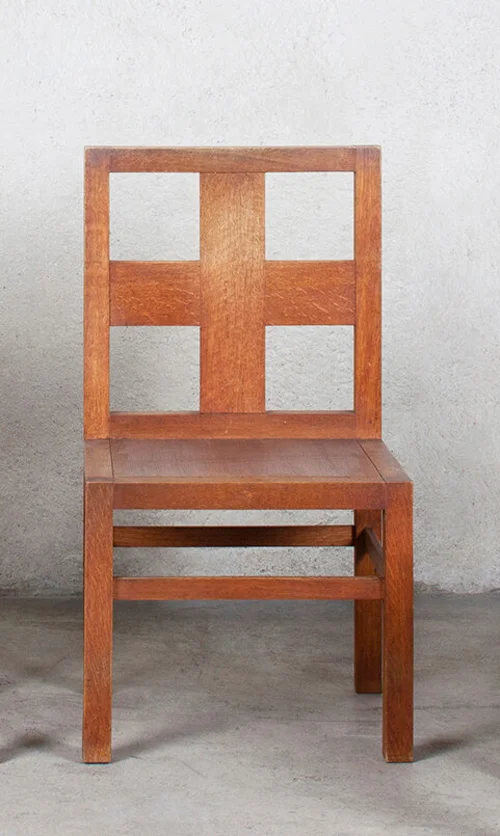

Chair from the Soseikan Yamaguchi House (1974-75), Takarazuka, Hyogo, Japan, 1975-1976
Shiro Kuramata
Friedman Benda
On the more contemporary side, Joris Laarman’s console Ply Loop shield (wall) (2025) picks up the modernist preoccupation with technology and craft. Intricately curved plywood produced through digital fabrication appears to emerge through the wall. Elsewhere, a tall hanging sculpture by the Japanese studio nendo, composed of finely milled ivory laths stacked into tiered hexagonal volumes, adds a spectral note to a corner of the booth. Prices range from $22,000 to $500,000.


