






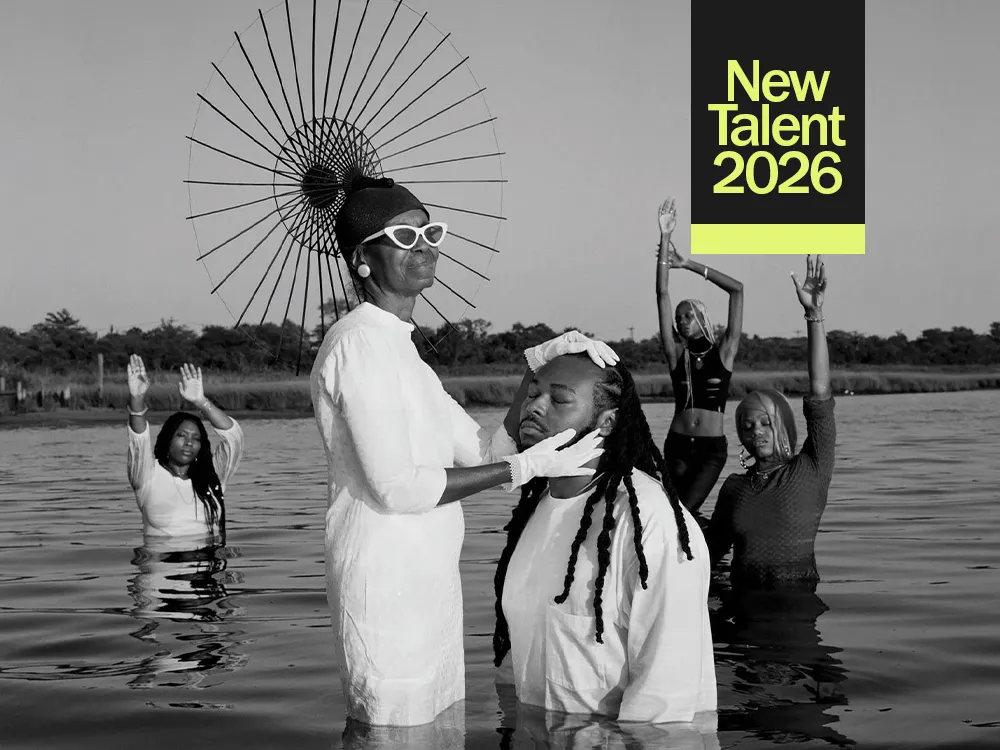
It’s in the gentle, nibbling work of Satchel Lee that astonishing new worlds are built, new terms set. Like Kevin Jerome Everson, Callie Hernandez, and Hong Sang-soo, her attuned senses find, all around her, beauty in the “tiny morbidly life-worn detail,” to borrow a phrase from critic Manny Farber. Beauty: that too-maligned word. Lee’s photographs, videos, miniatures, and music videos testify to a perpetual astonishment. “I love people so much,” she tells me, joyfully. “I love to hear people talk and be. I like narrative, but it can be a bit—hmm—boring? Too neat … versus when you see a second of someone’s face changing; that can say so much more than words.”
Lee has worn many hats. She grew up in New York City, dancing and choreographing. In college, she creative directed Drøme, a queer youth magazine, while studying film at New York University; she got her MFA from the School of the Art Institute of Chicago. She has filmed commercials; shot portraits of intimates ranging from friends to her father, Spike; written zines; and directed music videos—the latter venture resulting in two simple, breathing jewels for the Panamanian singer-songwriter Sofía Valdés, “In Bloom” and “I Hate the Beatles” (both 2022).
Photo by Satchel Lee for Immanuel Wilkins’s album The 7th Hand, 2022.
Her MFA thesis, What a Gift (2024), explores in photograph form the figure of family through self-aware, staged portraits in a brown, Deana Lawson-ish living room: mother (played by the artist herself), father, grandmother, daughter. In the accompanying video—softly inspired by Black Journal creator William Greaves’s ultimate metafictional mindfuck Symbiopsychotaxiplasm: Take One (1968), which Lee tells me is a key touchstone for all her work—we realize they are actors performing as “family,” the idea of a Black bourgeois unit. As the figures shift into smiling poses, a voiceover conversation between Lee and a maternal interlocutor filigrees and wrinkles our interpretation of the images with varying shades of approval, curiosity, and melancholy. At one point, the maternal voice trembles and cries: “This makes me really emotional. Seeing you as mother, in this family context … I haven’t seen you in this way yet.”
Her first solo exhibition, “Where We Find Ourselves” (2025), at the Contemporary Arts Museum Houston, investigated that city’s Freedmen’s Town, one of the ad hoc communities founded by formerly enslaved Black people in several states after Juneteenth 1865. Lee built miniature models of Houston’s surviving Freedmen’s Town buildings, photographed them, then enlarged the images to massive proportions. To accompany the show, she filmed a Black Journal-esque documentary interviewing four current residents of Houston’s Freedmen’s Town. In it, one teacher calls it “holy grounds,” reminding her students that “history is not gonna always be in a book. There are walking books around here. Talk to your grandmothers, talk to your great-grandmothers.”


Satchel Lee: She Had Land and It Still Stands (Isabel Simms House), 2025.
True history, Lee suggests, resists commodification and cannot be reduced to a value determined by 21st-century real estate. “I think a lot about memory as material. How families get involved and pass down memory. Mythmaking. Inheritances. I am interested in events—rendering buildings through memory, buildings that may be falling apart, may be in disarray, but that are still present.” With living ghosts all around, Lee implores us to listen to the whisper.


