






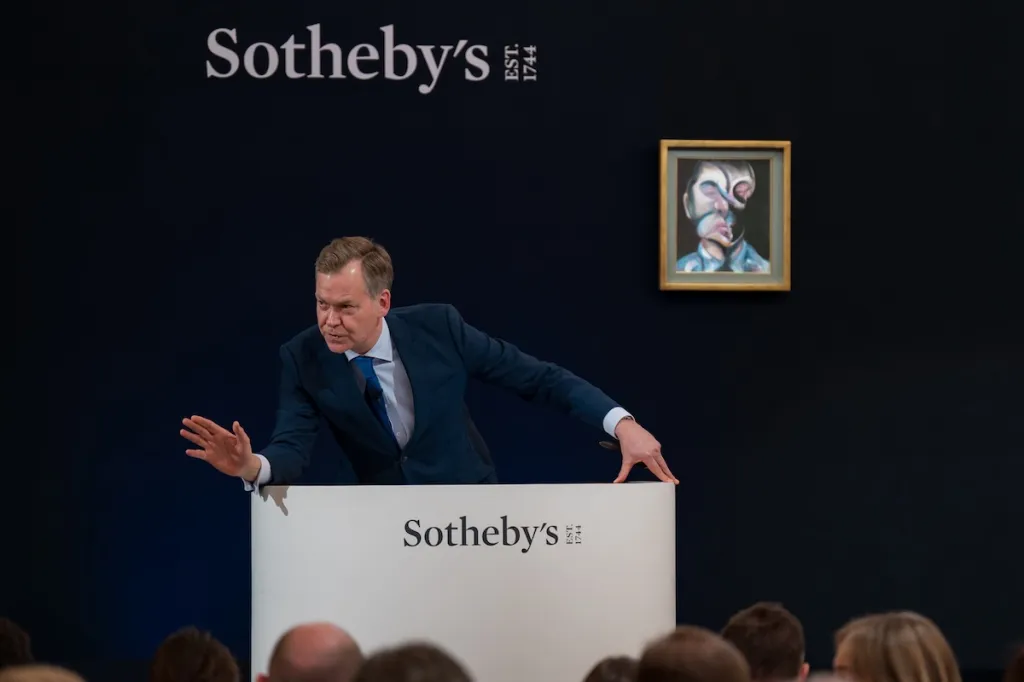
With Sotheby’s London double-header sale last week an unqualified success—generating £393.4 million ($520.7 million), or the “highest total ever achieved in a single night at auction in Europe,” according to the house—its European chairman Oliver Barker is taking a victory lap in the press.
On Monday, the Telegraph published a lengthy profile and interview with the star auctioneer, detailing his (somewhat) humble beginnings in Battersea, London; his decades-long career at Sotheby’s; and, of course, his thoughts on a number of topics pressing to the art world.
But the most interesting comment made by Barker is tucked in toward the end, where he talks about how clients’ sources of wealth have shifted over his years behind the rostrum. In his estimation, aristocrats were replaced by entrepreneurs and, now, tech wealth is entering the field. Or at least, Barker hopes so.
“I was having lunch with someone the other day who said, ‘If you’re employee number 250 at Anthropic, you’re probably a multi-multimillionaire,’ but my question would be: do they currently have the understanding or desire to want to acquire fine art? A lot of it will depend on who the buyer base is,” he told the Telegraph. “Even if we just had 5 percent of those Anthropic employees singly focused on our market, then of course it could change the market radically.”
All the talk of late in the business world is the unbelievable windfall that is about to hit the employees of SpaceX, Anthropic, and OpenAI. SpaceX, the rocket and aerospace company founded by Elon Musk, went public earlier this month, raising $75 billion for a $1.77 trillion valuation. Anthropic and OpenAI, the two leading AI companies, are set to go public in the coming months with valuations estimated to approach $1 trillion. An analysis conducted by the New York Times and Sacra, a private markets research company, projected that those three IPOs will mint 20 new billionaires and more than 16,000 millionaires. Sacra made the projections by analyzing the wealth distribution of previous major tech IPOs, combing SpaceX’s IPO documents, and simulating the other two IPOs; those figures are just for current and former employees, not outside investors, of which there are many.
“The magnitude of wealth creation is unprecedented,” Marcelo Ballvé, Sacra’s head of research, told the Times.
The AI boom is already sending real estate prices in the San Francisco Bay Area surging to never-before-seen heights, per the Guardian. Why not art?
Of course, as Barker notes, that will hinge on whether the new AI elite dive into the art market. At a recent dinner during Frieze New York, one former auction staffer told me their recent foray into art advising is focused on exactly that: convincing Bay Area tech workers to invest in art. What’s their strategy? Perhaps unsurprising given the auction houses’ recent focus on luxury categories, but they told me that they often start by advising on jewelry and collectibles, and then introducing art from there. Hmm, sounds familiar…


