






To receive Morning Links in your inbox every weekday, sign up for our Breakfast with ARTnews newsletter.
Good Morning!
- Sotheby’s attempt at a private sale of Pace founder Arne Glimcher’s Jackson Pollock painting was called off for lack of bidders.
- The chairman of the US Commission of Fine Arts participated in the St. Petersburg International Economic Forum, the first US official to do so in nearly a decade.
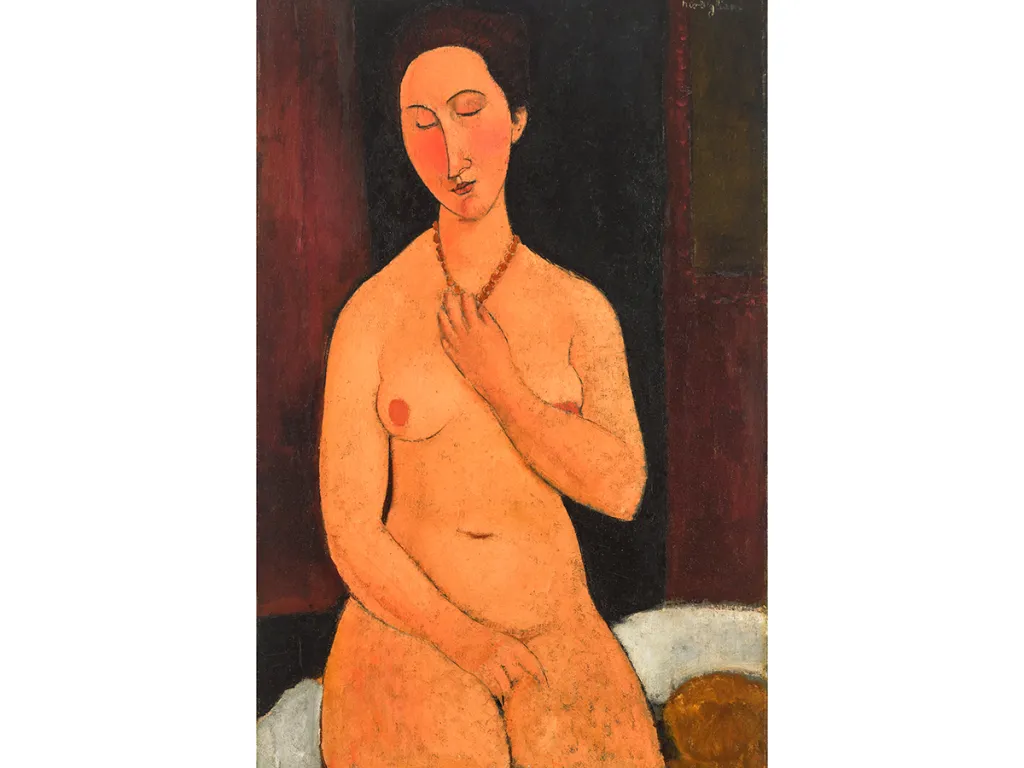
- Sotheby’s will offer Amedeo Modigliani’s Nu assis au collier (Seated Nude with Necklace), 1917, later this month.
The Headlines
BEST KEPT SECRET. According to multiple sources speaking to ARTnews, Sotheby’s recent, and apparently first serious attempt at a private, or “secret,” auction couldn’t get off the ground. With an unusual degree of secrecy, the New York auction house organized a sale early last week of Pace founder Arne Glimcher‘s monumental Jackson Pollock painting, Number 19, 1951, measuring nearly five feet tall and four feet wide, estimated at $50 million. But as ARTnews‘s Daniel Cassady writes, “if the plan was to make sure nobody noticed, it worked remarkably well.” The auction was ultimately called off after Sotheby’s couldn’t find enough bidders. Since the Covid-19 pandemic, Christie’s has developed the private, or secret, auction format for top works that owners don’t want to expose to the scrutiny of traditional evening sales.
“GOOD HELLO” TO RUSSIA. On Friday, Rodney Mims Cook Jr., the chairman of the US Commission of Fine Arts, spoke at a major economic forum hosted by Russian President Vladimir Putin in St. Petersburg, becoming the first US official to attend the event in nearly a decade, according to reports. Dubbed the “Russian Davos,” the St. Petersburg International Economic Forum (SPIEF) is designed to attract foreign investment but has seen a drop in attendance from high-profile Western leaders since Russia’s 2022 invasion of Ukraine. Cook led a US delegation to the forum and spoke during Friday’s plenary session. “You have a beautiful hometown,” Cook told Putin, according to Reuters. “I do give a good hello from your friend, President Trump.” On Thursday, Cook also attended a roundtable titled “Russia-USA: Dialogue of Cultures,” moderated by Russian cultural envoy Mikhail Shvydkoy, who was also key in orchestrating Russia’s participation in this year’s Venice Biennale, the Art Newspaper reports. Among the speakers was also US actor Steven Seagal, whom the Russian Foreign Ministry appointed as a special envoy for Russian-American “humanitarian relations” in 2018.
The Digest
At this month’s London auctions, Sotheby’s will offer Amedeo Modigliani‘s Nu assis au collier (Seated Nude with Necklace), 1917, a rare piece from the artist’s December 1917 exhibition that police shuttered for indecency, estimated at $60.6 million. [Artnet News]
Austrian photographer Elfie Semotan has died at age 84. [Monopol]
Leonardo da Vinci‘s scattered drawings, designs, and loose notes on paper are being united for the first time digitally. [Times of London]
On June 5, France’s Conseil d’État, its highest administrative court, rejected a request by a heritage group to cancel plans to loan the Bayeux Tapestry to London’s British Museum, and said it lacked the legal jurisdiction to intervene in what it concluded was “an act of government” concerning French-British international relations. [Le Journal des Arts]
Oakland-based artist Mildred Howard discusses her first comprehensive retrospective at a major institution, opening at the Oakland Museum of California on June 12, titled “Mildred Howard: Poetics of Memory.” [Guardian]
Read This
DIGITAL DIVIDE. Dataland, the world’s first museum dedicated to AI-generated art, founded by Refik Anadol and his wife, the painter Efsun Erkilic, is preparing to open in Los Angeles later this month. As the Los Angeles Times reports, it will feature an “immersive rainforest journey” powered by an AI system called the Large Nature Model, which uses data gathered “ethically” from the environment. “The system is the art,” Anadol told the Los Angeles Times on a recent preview of the exhibition “Machine Dreams: Rainforest,” which includes options for selecting what the show will smell like, and the possibility of sharing visitor biometrics. But as the New York Times notes in its preview, Anadol’s creations — exemplified by the popular 2022–23 installation Unsupervised, at New York’s MoMA — also embody the art world’s “digital divide.” Is Unsupervised “a massive techno lava lamp,” as Jerry Saltz called it, or “an early masterpiece of AI-generated art,” per critic Sebastian Smee? Still, museums are increasingly embracing Anadol’s vision. “There’s not going to be a future in which this kind of work is not happening,” Michael Govan, CEO of the Los Angeles County Museum of Art (LACMA), told the New York Times. “It’s like Marcel Duchamp — if you know what’s behind it, you’re open to understanding it.


