






“You can’t out-beauty nature,” says the artist Wayne Garrett. He is walking around the sculpture garden of the Minos Palace Resort in Crete as the sun sets behind him, a few last glimmers of orange light playing off the small islands in the bay. “Nothing makes you humbler than working in collaboration with the environment, because it is more powerful than any one of us,” concurs his partner Caitlind R.C. Brown at a press conference the next day.
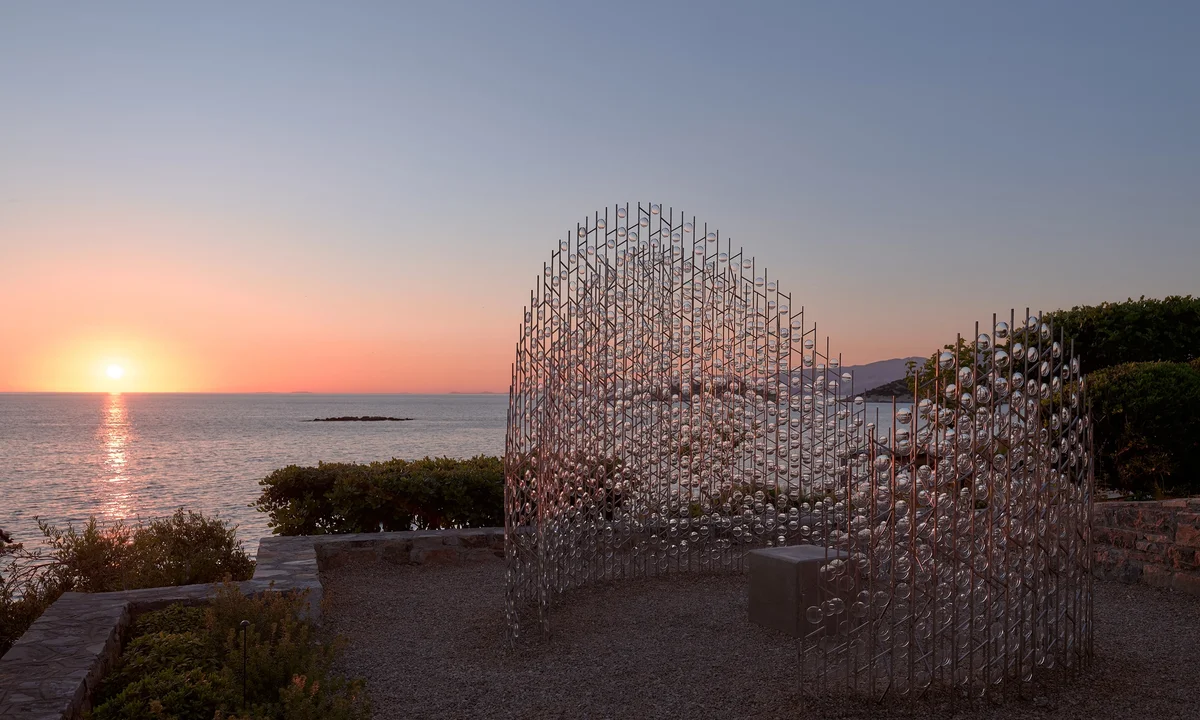
If competing with nature is challenging elsewhere, then it is an impossibility here in this ancient landscape, surrounded by olive trees, dusty hills and the intense blue of the Mediterranean. So, in their winning work for this year’s G. & A. Mamidakis Foundation Art Prize, the two Canadians have opted to bring these surroundings into the piece. Their installation, Chronotopia, is made from hundreds of unused lenses meant for eyeglasses. Sitting inside the piece shatters the horizon into infinite miniature worlds, while a second layer of lenses obscures the viewer from the outside world.
The lenses catch the light in different ways throughout the day and from different locations: the artists even swam out into the bay to see how it looked from the seaward side. It was this relationship with the water that enticed them to enter the prize. “Where we live in Calgary, we’re in the foothills of the Canadian Rocky Mountains,” Brown says. “And we don’t have a relationship with large bodies of water, especially ones with all of the mythology, history and contemporary complexity of the Mediterranean Sea.”
The winners of the G. & A. Mamidakis Foundation Art Prize, Caitlind R.C. Brown and Wayne Garrett, with their work Chronotopia (2026), on display at the Minos Palace Resort © Loukianos Arnaoutakis/G&A Mamidakis Foundation
The artists were not able to visit the site before submitting their proposal, but Garrett made a model to help envision it, and the final location was chosen by the foundation to show the work to its best advantage. “We draw a lot of our inspiration and meaning from the site,” Garrett says, comparing it to their use of found materials in the form of the lenses, which would otherwise have been thrown away. “There’s a lot of power in a recognisable object as opposed to a new material, which can be moulded into anything,” he says, “but sometimes it does feel dead,” Brown concludes.
Chronotopia is the latest work to be added to the Minos Palace Resort’s art collection via the prize. Running since 2019, the competition offers artists a chance to create a site-specific work for the luxury hotel, which sits on a headland in the east of Crete near the town of Agios Nikolaos. This year they received more than 450 proposals from 65 countries.
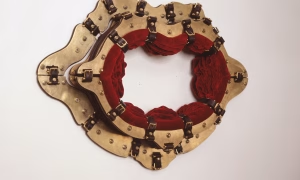
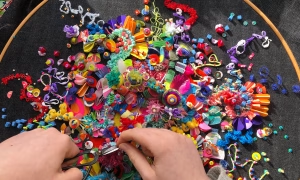
Brown and Garrett are the first international artists to win: last year’s prize went to the Greek sculptor Danae Stratou, who created an ephemerally beautiful land art piece made of a spiral of clay vessels. Other works are installed inside the hotel’s walls, in corridors and communal spaces—Stratis Tavlaridis’s Long Waves is made of long pieces of delicate hand-cut paper that ripple in the breeze, while Katerina Nakou’s The Resilient Thread is composed from woven textiles.

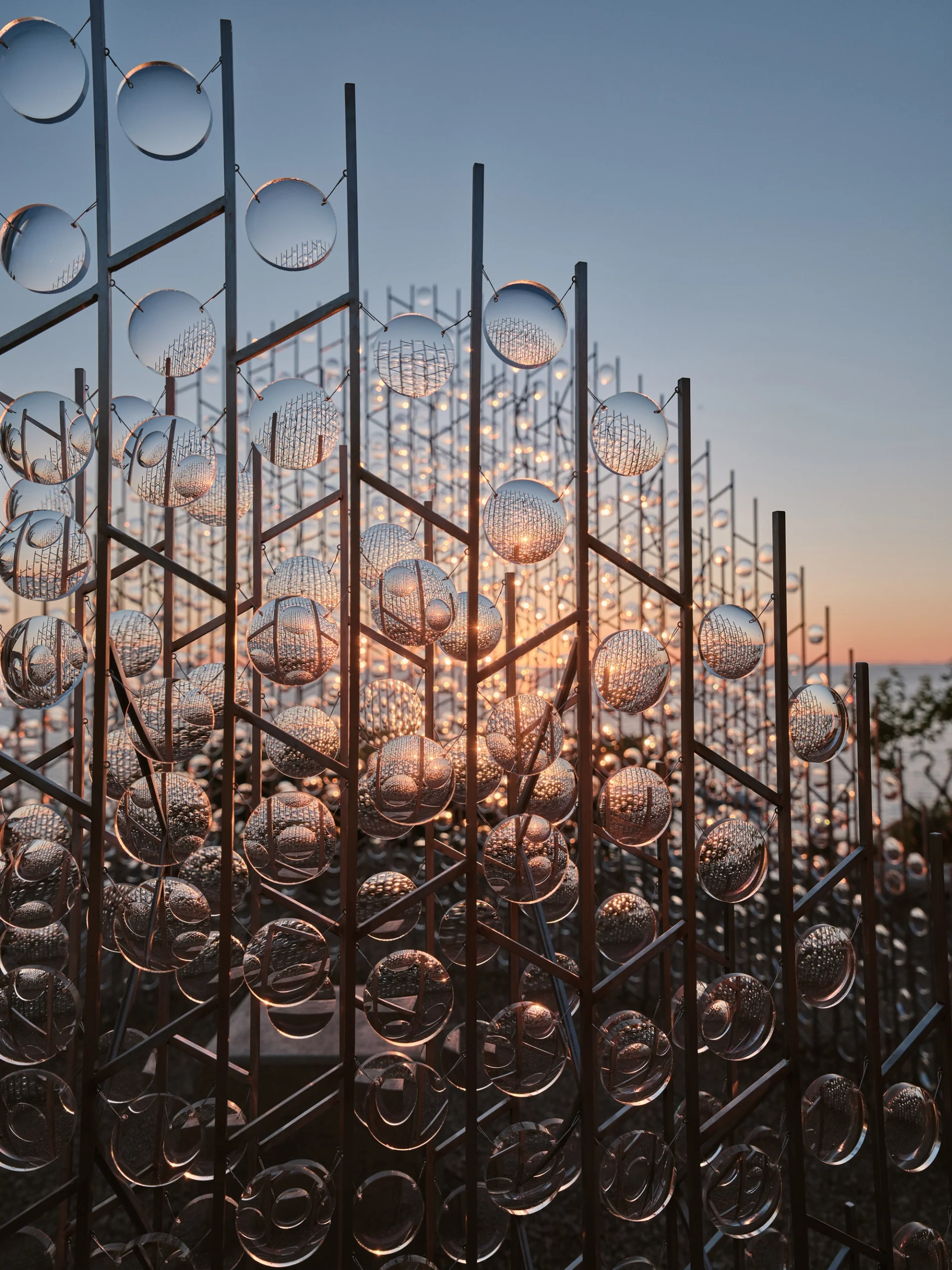
The lenses of Chronotopia (2026) catch the light in different ways throughout the day and from different locations: the artists even swam out into the bay to see how it looked from the seaward side © Loukianos Arnaoutakis/G&A Mamidakis Foundation
The art collection is curated and managed by the G. & A. Mamidakis Foundation, which was set up by the hotel’s owner Gina Mamidaki to continue the legacy of the “symposia” she hosted at the nearby Minos Beach Art Hotel in the 1980s. The first one took place in 1988, inviting five speakers and 32 artists, including the likes of Anish Kapoor, Lynda Benglis and Joseph Kosuth.
“Artists would come here and stay for a few weeks over the summer,” says the foundation’s director, Yota Dimitriou. “The idea was very simple: it was to create artworks for outdoors, which would remain on permanent display, with very simple materials, whatever you can find around you.” These works formed the basis of the foundation’s art collection: it now comprises more than 80 pieces, the vast majority created specifically for the sculpture gardens that surround the two hotels. (The few that were not commissioned often influenced the architecture, the buildings being created to fit the artworks.)
“This is not the traditional way of acquiring art for a hotel,” Dimitriou says. “Gina Mamidaki didn’t want to just purchase art. She wanted the connection to be meaningful, to create a unique experience for guests.” One of the earliest works is Haris (1988) by Eleni Mylonas, a figure made from rope in honour of the symposium’s caretaker. Lynda Benglis made a drawing in space out of metal objects welded together at the top of an existing spiral staircase.

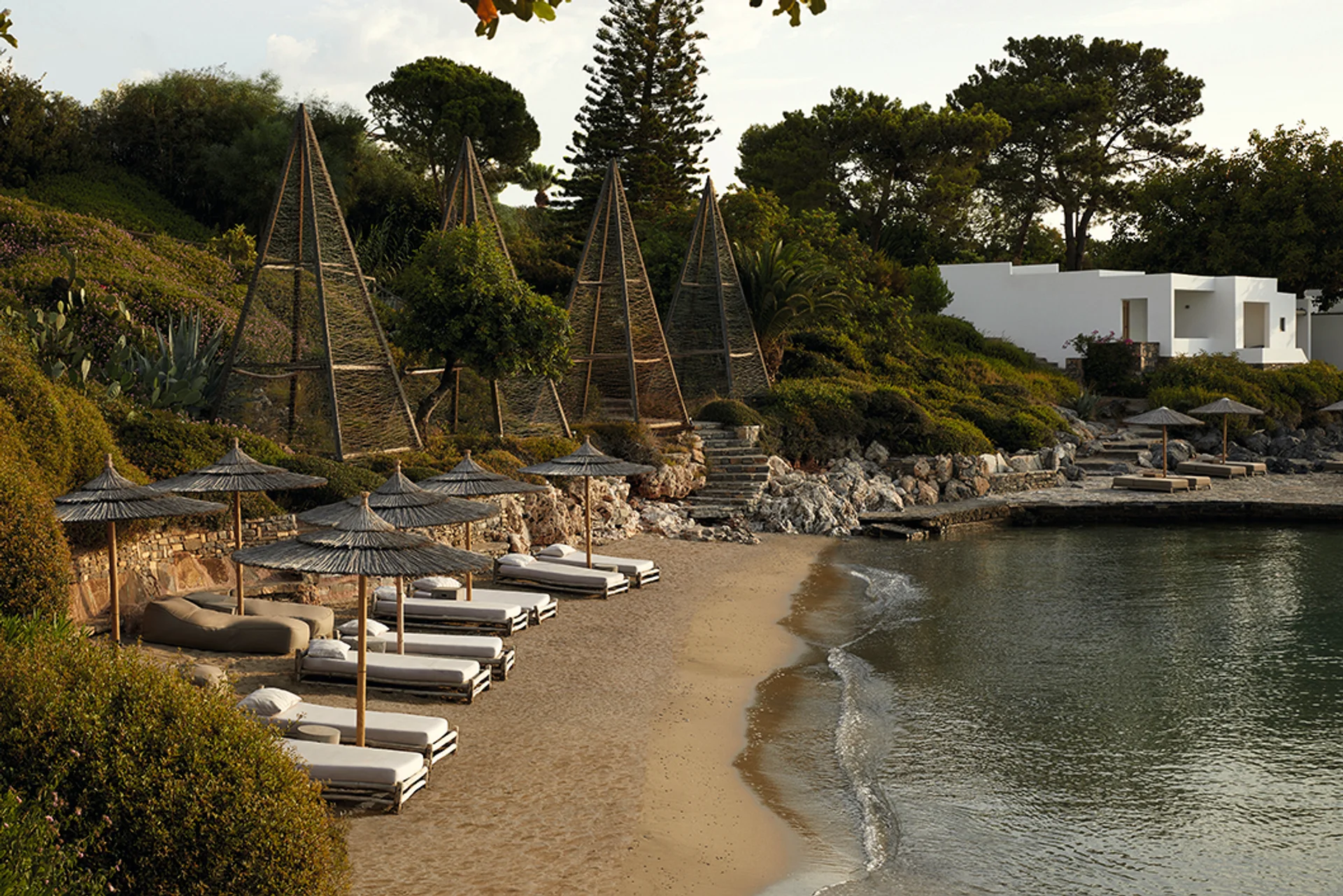
The Painful Pyramids (1993) by Magdalena Abakanowicz, one of the earliest works in the collection © Loukianos Arnaoutakis/G&A Mamidakis Foundation
Later works include three wooden structures by the Polish sculptor Magdalena Abakanowicz. Innocuous from a distance, up close you can see the rusting barbed wire that gives them their title, The Painful Pyramids (1993), an unsettling contrast to the sun-loungers around them on the beach.
Conservation of the works in this environment presents different challenges to art installed in public spaces. Some pieces are stored inside during winter, others are taken to Athens for occasional touch-ups (none of the works are protected by barriers). Brown and Garrett carefully weather-tested their concept, putting a model out into the harsh Canadian climate, but a few days after installation were already finding things they did not think of. “We were surprised by how salt interacted with the lenses and we have built some mitigation strategies,” Brown says. “The lenses will need to be rinsed and then wiped so the salt doesn’t become an abrasive over time.”
But the location also influences what is possible in the work. Brown and Garrett often create pieces for public spaces such as parks, forests, abandoned buildings and car parks, and note that a work of this fragility probably would not survive in another location.
“This is part of the responsibility of working in public spaces because you are engaging with a number of different realities,” Brown says. “There’s a complexity in working within a functional space where you have the sunbathers and the jet skiers and the folks who are maintaining the garden, and there’s all these different things that are part of the surrounding environment. But there is the possibility of this communion with the sky, the land and the sea.”


