





Growing up in the Pacific Northwest, my first border crossing on foot was from the US into Canada. I remember getting the jitters as I offered up my passport—and then it was over in the flick of a turnstile. Terran Last Gun (Piikani) grew up on Montana’s Blackfeet Indian Reservation, less than an hour’s drive away, but rarely made the same crossing in his youth.
During Western expansion, the border line grew in phases along the 49th parallel and eventually divided the rangelands of Last Gun’s ancestors, whose kin now live on both sides. Early on, in the mid-19th century, the Blackfoot people traversed it freely, evading the US Army by weaving into British territory. For this alleviating effect, they called it the Medicine Line. These days, moving within the same territory involves “a lot of showing your papers,” as Last Gun said he has heard from Blackfeet friends.
Last Gun’s studio in Santa Fe, New Mexico, is stacked with the literal receipts of this annexation in the form of antique accounting ledgers, many of them from Montana. In tight cursive, they document the surge of a settler colonial grid over the Great Plains, as well as all sorts of micro-histories therein. “There was a note in one of them,” Last Gun said. “Somebody had erased it, but I could still read it. It was like a crime report—it said, ‘He beat her.’”
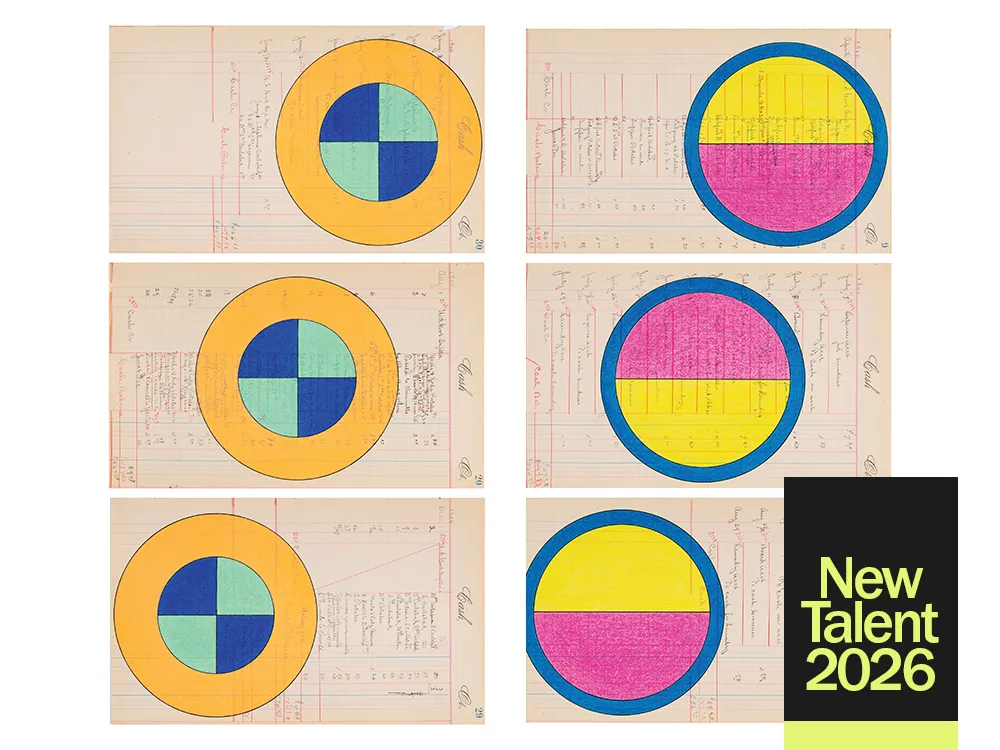
Using ink and colored pencils, Last Gun applies crisp geometric forms to sheets he excises from the tomes he collects. Some of the fields are Ellsworth Kelly–flat; others reveal the thousands of strokes that overtake tidy ledger cells. The underlying grids hold such extreme historical tension that adding anything to them feels charged, opening up an unlikely, unemphatic space for the artist to play.
Return of the Unseen to Offer Guidance from Terran Last Gun’s 2025 series “Another Human Being Experience.”
Courtesy Diane Rosenstein Gallery, Los Angeles/Nerman Museum of Contemporary Art, Overland Park, Kan./©Terran Last Gun
Last Gun pulls in visual motifs related to Blackfoot lodges, hides, and war shirts, excerpted and stylized so as not to reveal “too much” of their sacred contexts. (“Sometimes I wish I could share more,” he said.) He also references color-field painters and printmakers from his studies at Santa Fe’s Institute of American Indian Arts, from which he graduated with a museum studies degree in 2016. Last year, for Site Santa Fe’s latest biennial, he completed a series inspired by the Transcendental Painting Group, a short-lived Southwest collective whose atmospheric abstractions radiate heartbreaking pre-World War II optimism.
Last Gun’s work is a departure from ledger art, a Plains Indian tradition in which late 19th-century artists adapted to reservation confinement by making narrative art on ledgers instead of hides. Historical examples largely feature figurative imagery on blank sheets, whereas Last Gun tends toward geometrics that evoke midcentury architecture, vaporware desktop art—and cheerful censor bars.
During our studio visit, Last Gun lifted a ledger sheet toward a window to reveal its watermark. “They’re craft objects in themselves,” he said of a set of pages from Blaine County in northern Montana—ancestral Blackfeet territory, but not part of the reservation. “My people didn’t have access to these documents,” Last Gun said. “These were dark times. It’s really interesting that I have access now.” He likened the feeling to holding a reclaimed piece of Montana in his hands.


