





When the last Venice Art Biennale was unveiled in 2024, there was a conspicuous absence: Israel. A note taped to the door of the country’s locked pavilion stated it would open only “when a cease-fire and hostage release agreement is reached”.
The war in Gaza had begun six months earlier, when Hamas militants stormed into Israel on 7 October 2023, killing 1,200 people. By the time the Biennale opened, more than 30,000 Palestinians had been killed in Israel’s subsequent invasion, according to Gaza health authorities. Campaigners appalled by Israel’s conduct had called for the country’s exclusion. In the end, less than a week before inauguration, Israel’s artistic team essentially withdrew. “I feel that the time for art is lost,” Ruth Patir, the project’s artist, wrote at the time.
I do not see art as a tool for confrontation or exclusion
Belu-Simion Fainaru, the artist representing Israel this year
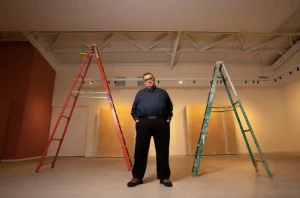
Now, Israel is making a controversial return to the Biennale, sparking renewed calls for a boycott and promises of “disruptive action”. Belu-Simion Fainaru, the country’s artist this year, has appeared determined to open the project. “Regarding the threats and calls for boycott, I do not see art as a tool for confrontation or exclusion,” he tells The Art Newspaper. “I believe art is a medium of hope and openness. It is a place where humanity can meet itself, even in its complexity and contradictions.”
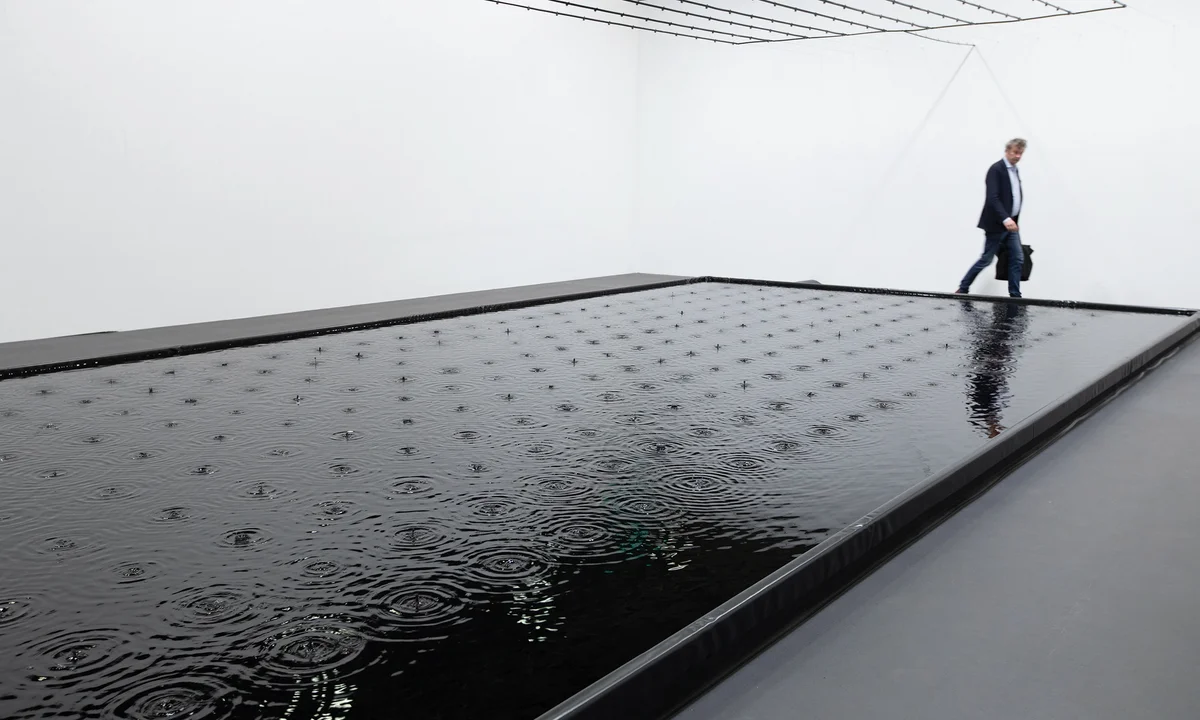
Israel did not participate in last year’s Architecture Biennale, allegedly claiming its pavilion needed to be renovated. The country’s pavilion will remain closed this year, too, with the sprawling Arsenale complex to host Fainaru’s Rose of Nothingness, a project first presented in Berlin in 2015 and exhibited at Art Basel four years later. The project features a pool that collects black water droplets falling from a suspended network of pipes, inspired by the work of the Jewish Romanian poet Paul Celan. Mounting it in the Arsenale “transforms both the scale and the experience of the work”, allowing viewers to “dwell in its rhythm, movement and light”, says Fainaru, who was born in Bucharest and immigrated to Israel.
Strikes and protests
Italy saw large and sometimes violent protests and strikes before last October’s Trump-brokered peace deal in Gaza, amid calls for an end to hostilities and for the Italian government to halt weapon supplies. The Art Not Genocide Alliance (ANGA)—an international network of artists, curators and cultural workers—circulated a letter in March accusing Israel of “committing genocide” and calling for its exclusion. It was signed by almost 200 Biennale participants.
The group has changed strategy since 2024, when a broader base of 24,000 artists, curators, writers and cultural workers signed its petition opposing Israel’s participation. “This is not just public pressure from the outside but it’s also internal pressure,” an ANGA spokesperson tells The Art Newspaper. The group is working with unions around the country to organise strike action during the Biennale, the spokesperson adds. “We are looking to disrupt the actual functioning,” she says.
In its call for artists, Israel’s culture ministry required Biennale applicants to guarantee their exhibition would not be closed in the event of protests, Erev Rav, an Israeli art magazine, reported. The ministry did not reply to a request for comment.
Russia’s pavilion in the Giardini was given to Bolivia in 2024, but will host a Russian exhibition in this year’s Biennale
Photo: Boumenjapet
Russia returns
The Biennale, with its historic system of national pavilions, has long mirrored, and sometimes magnified, geopolitical tensions. The Biennale has taken more exclusionary standpoints in the past, boycotting apartheid-era South Africa from the 1970s to the 1990s. However, Pietrangelo Buttafuoco, the right-wing intellectual and journalist who has led the organisation since 2023, has resisted taking a similar stance. “La Biennale di Venezia rejects any form of exclusion or censorship of culture and art,” he said in a statement on 4 March.
Also returning this year will be Russia, taking part for the first time since its full-scale invasion of Ukraine in February 2022, which members of prime minister Giorgia Meloni’s government, a committed supporter of Ukraine, have robustly condemned. News of Russia’s return has also sparked backlash, with Andrii Sybiha and Tetyana Berezhna, respectively Ukraine’s foreign and culture ministers, saying in a joint statement that the Biennale “must not become a stage for whitewashing the war crimes that Russia commits daily”. The European Union has withdrawn €2m in funding over the affair, the spokesperson Thomas Regnier confirmed on 23 April, providing 30 days for the organisation to defend its decision to include Russia.
Russia’s pavilion will be accessible only by journalists and authorised personnel from 5 to 8 May but will remain closed from 9 May, when the Biennale opens to the public, according to Italian media reports.
KGB connection
After its full-scale invasion in 2022, Russia voluntarily withdrew from the Biennale, and allowed Bolivia to use its pavilion in 2024. This year’s exhibition, The Tree is Rooted in the Sky, is a musical project featuring around 40 artists mainly from Russia. Its curator, Anastasia Karneeva, is the daughter of a former KGB officer, according to reports.
The development has infuriated Alessandro Giuli, Italy’s culture minister. In March, he demanded access to all documentation relating to Russia’s comeback and called for Tamara Gregoretti, the ministry’s representative on the Biennale’s board, to step down. She has refused to do so.
Other Italian cultural institutions have shown openness to hosting Russian artists. A Naples concert scheduled last year with Valery Gergiev, the star conductor long regarded as Russia’s cultural ambassador, and a January ballet performance in Florence by Svetlana Zakharova, a Moscow-based ballerina and former pro-Kremlin MP, were both cancelled following public outcry. The ANGA spokesperson suggests Russia had been allowed back to legitimise Israel’s inclusion.
Political turmoil
Geopolitical turbulence has also affected other countries. Iran—which massacred thousands of protestors in January before Israel and the US launched airstrikes the following month—is currently featured on the Biennale’s list of participants. The Cultural Institute of Iran in Rome indicated that the country’s participation was not confirmed “in light of recent events”, the Linkiesta website reported in March.
Australia’s Khaled Sabsabi, the Lebanon-born Sydney-based artist, was reappointed to represent the country last July. He had been dropped less than a week after his selection in February amid controversy surrounding some of his previous work, including a 2007 depiction of the former Hezbollah leader Hassan Nasrallah, who was assassinated by Israel last year.
In South Africa, meanwhile, the culture minister blocked Gabrielle Goliath, selected last year, from presenting her project, calling it “highly divisive”. Elegy, a performance piece, pays tribute to the Palestinian poet Hiba Abu Nada, who was killed in an Israeli airstrike in October 2023. Goliath has sued the ministry and arranged for the project to be presented at Venice’s Chiesa di Sant’Antonin, which is not part of the Biennale. South Africa’s pavilion, like Israel’s, will remain empty.


