






The head of the Venice Biennale has a simple defense for one of the most contentious decisions of this year’s exhibition: it’s not a courtroom.
Pietrangelo Buttafuoco, the Biennale’s president, made the remark on Wednesday this week as backlash mounted over the return of Russia to the Giardini. The country is reopening its pavilion for the first time since its 2022 invasion of Ukraine, a move that has drawn criticism from European officials and triggered threats to pull roughly $2.3 million in EU funding.
“The Biennale is not a court; it is a garden of peace,” Buttafuoco said, arguing that the exhibition should remain a place for dialogue rather than exclusion. “This whole world born of the French Revolution, the Enlightenment and secularism has flipped into its exact opposite: a laboratory of intolerance, and demands for censorship, closure and exclusion,” he said in a press conference.
That’s the theory. On the ground, the opening days have looked more like a rolling protest.
On Wednesday morning, just outside the Russian Pavilion, members of Pussy Riot and FEMEN staged a loud, theatrical demonstration that quickly drew a crowd. Protesters in pink balaclavas set off smoke flares in the colors of the Ukrainian flag and chanted slogans like “Russia kills! Biennale exhibits!” while blasting punk and hip-hop from portable speakers. For about 20 minutes, the Giardini felt less like a sculpture park than a mosh pit.
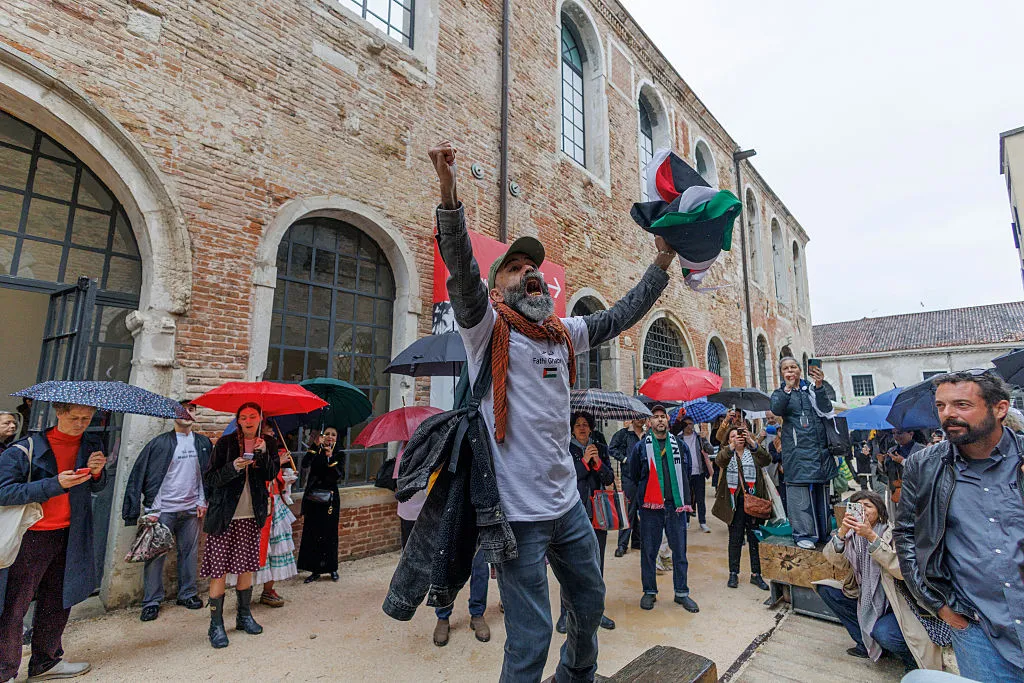
The anger isn’t limited to Russia. Across the lagoon, a separate wave of protests has focused on Israel’s participation. In the days leading up to the public opening, around 60 artists staged a performance titled Solidarity Drone Chorus, gathering at the Giardini entrance to hum a piece by a Gazan composer in what organizers described as an attempt to “sonically occupy space.” The action then moved in procession toward the Central Pavilion, with participants framing it as a way to bring the reality of war into the exhibition itself.
That effort has since escalated. The Art Not Genocide Alliance, a coalition of artists and cultural workers, has called for a 24-hour strike on the day before the Biennale opens to the general public, along with rallies and demonstrations across Venice. The group has already drawn hundreds of supporters to protests outside the Israeli Pavilion, part of a broader campaign that has gathered signatures from more than 200 artists and curators.
Meanwhile, the Russian Pavilion itself is operating under restrictions tied to EU sanctions. It will be open only during the press preview days, with the presentation shifting to video projections visible from outside for the rest of Biennale’s six-month run.
Buttafuoco’s argument is that none of this—war, sanctions, protests—should determine who gets to participate in the show. Critics see the opposite: that the Biennale’s claim to neutrality is precisely what’s at stake.
Either way, the idea of the Biennale as a quiet “garden of peace” is already hard to square with the reality of protests and attempted censorship on the ground.


