






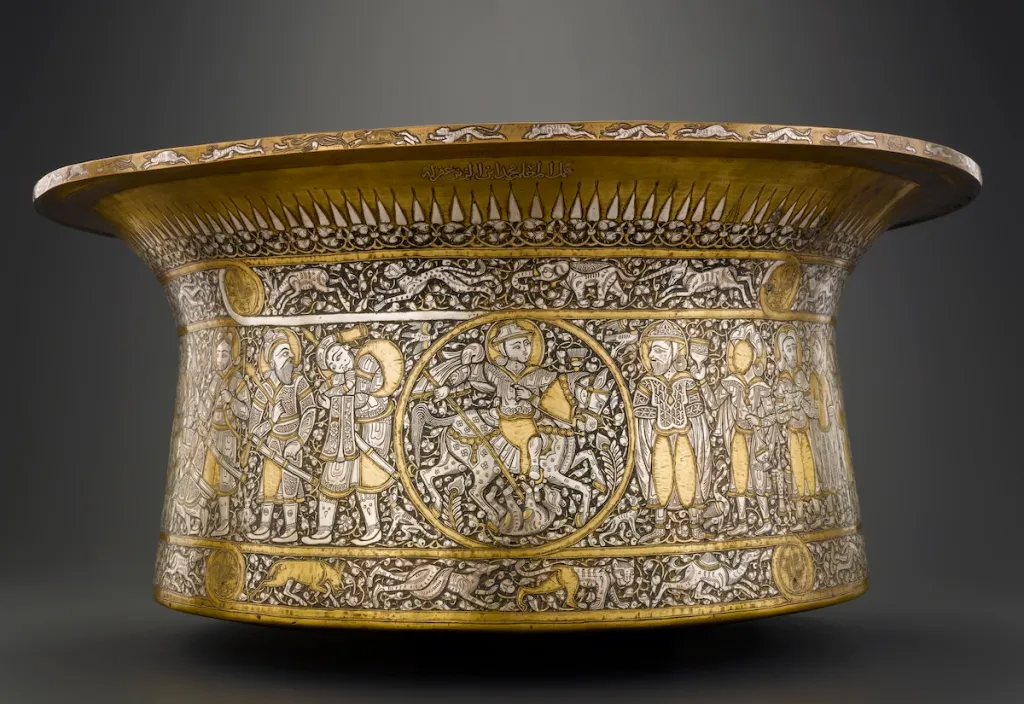
The National Museum of Asian Art, part of the Smithsonian Institution in Washington, D.C., will play home to 26 works on loan from Paris during the run of “From the Louvre: Masterpieces of Islamic Art,” an exhibition opening September 26 and continuing into January 2027.
As reported by The Art Newspaper, “The exhibition will feature a number of stunning objects that have never been shown in the United States, among them a bronze statue from Islamic Spain known as the Lion of Monzón (10th-11th century) and a particularly large decorated ceramic Ottoman bowl dated to around 1480. Spanning the 7th century to the 19th century and territory from present-day Spain to India, the works due to cross the Atlantic include paintings, ceramics, metalwork, jade, glass objects and architectural elements.”
A press release issued by the National Museum of Asia Art said the forthcoming exhibition “invites visitors to consider how artworks become masterpieces over time, highlighting not only artistic mastery but also histories of use and exchange.”
Chase F. Robinson, director of NMAA, said, “Desired for their spectacular artistry and distinct craftsmanship, these objects of the Islamic world were enjoyed by a select few until they entered the Louvre. … Through this exhibition, we examine how masterpieces are shaped not only by their makers, but also by the public that celebrates them.”
The exhibition will include paintings, metalwork, jade, ceramics, glass, and architectural elements, some of which connect directly to a decades-long connection between the Louvre and the NMAA. “In the early 20th century, museum founder Charles Lang Freer developed an artist and collector network, which included Louvre curator Gaston Migeon and French collector and art historian Raymond Koechlin, who frequently corresponded with Freer,” the exhibition’s press release noted. “An object from Koechlin’s collection—a blue and turquoise plate with a peacock from the 16th-century Ottoman Empire—is now at the Louvre and included in this exhibition.”


