








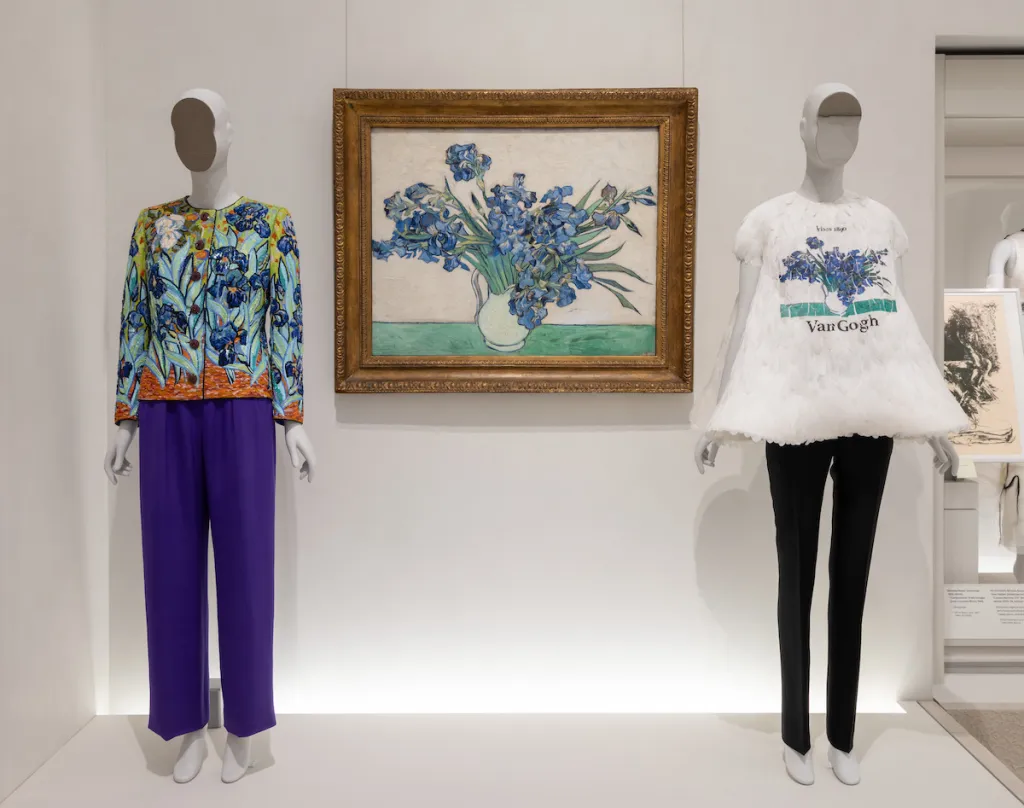
Anyone who’s ever taken an art history course knows the drill: put two artworks side by side, and figure out where they intersect and diverge. The exercise involves IDing those objects, stating who made them and why, and accounting for formal innovations across time and cultural differences. Essentially, the discipline is predicated upon a gussied-up game of compare-and-contrast.
“Costume Art,” the Metropolitan Museum of Art’s big Costume Institute show for the spring season, attempts to continue the tradition. People will flock to this blockbuster to see rarified dresses in sleekly designed galleries, as they always do. But this time the stars of the show also include artworks from the Met’s collection placed next to the fashion on display. Running the gamut from ancient Greek statues to screenprints by Andy Warhol, the artworks are set beside dresses by designers ranging from Charles James to CFGNY, a collective whose work can also be found in the Whitney Biennial.
This all makes “Costume Art” an anomaly within the history of the Costume Institute. The department’s shows have exploded in popularity over the past decade, in large part thanks to the involvement of former Vogue editor-in-chief Anna Wintour, who has chaired the Met Gala since 1995. These spectacularly expensive exhibitions are known for their extravagant presentations of gorgeous garments. (Amazon founder Jeff Bezos and his wife Lauren Sánchez Bezos are listed as the lead supporters of “Costume Art,” having reportedly ponied up an eye-watering $10 million for this year’s edition of the Met Gala. Bezos is currently being protested for his excessive displays of wealth and for Amazon’s role in recent ICE raids.) What these exhibitions are not known for is presenting painting, sculpture, and other mediums in the context of fashion.
Here comes “Costume Art” to change all that. Positioned in the center of the Met, in a new set of galleries off the museum’s atrium where the gift shop could once be found, the exhibition is loosely centered around the body and aspires to “suggest that fashion can expand our understanding of what art can mean,” as curator Andrew Bolton put it at Monday’s press preview of the show. Therein lies the problem: “Costume Art” isn’t very good at wringing meaning from art.
Greek and Roman statues in the Met’s “Costume Art.”
©Anna-Marie Kellen/Metropolitan Museum of Art
Bolton and his team placed plenty of artworks in close proximity to garments of all kinds, suggesting artistic dialogue that transcends geographic and temporal boundaries. The dialogue can be resonant when it’s specific, as in the case of a 1997 Jean Paul Gaultier shirt paired with a 1971 drawing by Joe Brainard. Both the shirt and the drawing feature heart-shaped tattoos splayed across male chests (Gaultier’s is accompanied by text reading “SAFE SEX FOR EVER”), and both are by artists who died of AIDS-related causes. The presentation powerfully situates Brainard and Gaultier within the same lineage of queer artists.


A section called “Abstract Body” in “Costume Art.”
©Anna-Marie Kellen/Metropolitan Museum of Art
But most of the juxtapositions are vague and sloppy. Walk a few steps from the Gaultier shirt, and you’ll find an Ottolinger dress with its sides ripped away. It’s paired with a painting by Adriana Varejão, who is representing Brazil at this year’s Venice Biennale. Varejão’s painting resembles Portuguese azulejo tiles that have been clawed apart to reveal bloody flesh underneath. The artist has described works like this one as metaphors for the violence of colonialism in her home country. And while that much is specified in the exhibition’s wall text, the curators seem more interested in bringing together the painting and the sculpture to draw out a “sartorial articulation of trauma,” as they describe it. That’s a pretty limp assessment, especially when you consider that Ottolinger is based in Germany, a nation with trauma of a different variety.
In “Costume Art,” artworks are less objects to be analyzed than props for visual pleasure. A Willem de Kooning lithograph hangs near a Nadia Pinkney coat, seemingly for no reason other than that they both contain splashes of white and black. A painting by Nahum B. Zenil that sets the artist’s face inside a bleeding heart is placed next to a crimson-colored Yohji Yamamoto dress whose pleats are “akin to a pulse,” per an accompanying text. In a section about disability, mannequins in wheelchairs wearing denim by Levi Strauss & Co. and Lou Dehrot—faceless, like all the mannequins in the show, à la the creepy protagonist of a recent Pierre Huyghe video—sit beneath a photograph of an elevator taken by Nolan Trowe, an artist who uses a wheelchair. Though the Lou Dehrot jeans were designed specifically for wheelchair users, Trowe’s photograph has no precise relationship to these garments.

Pablo Picasso’s The Blind Man’s Meal (1903) in a section of “Costume Art” about disability.
©Anna-Marie Kellen/Metropolitan Museum of Art
Even when the connections between clothes and art are more explicit, the comparisons are rarely productive. Take the case of a black Gaultier dress that was worn by Nicole Kidman to the 2001 premiere of her film Moulin Rouge! The dress is presented alongside a 2004 Adam McEwen painting that purports to be an obituary for Kidman, a co-host of tonight’s Met Gala. Even though Kidman wears the exact Gaultier dress in the image accompanying her faux death notice, the painting may as well not be present at all, since it does little to augment one’s experience of the dress.
It may seem pointless to get too worked up about “Costume Art.” The Met’s other curatorial departments continue to put on rigorous exhibitions on a regular basis—look no further for proof than the museum’s current Raphael show. And Costume Institute exhibitions bring people through the Met’s doors in droves, a valuable asset at a time when the museum’s attendance still has yet to reach pre-pandemic levels. But while most of the Costume Institute’s past shows have not been particularly engaged with art history, this one wants to use fashion to help tell the story of art—and thus needs to be held to a higher standard.

Garments by Issey Miyake, Givenchy, and Yves Saint Laurent, along with an Etruscan breastplate (at lower left), in “Costume Art.”
©Anna-Marie Kellen/Metropolitan Museum of Art
Certainly, the show at least needs to do the work of properly setting the artworks within a specific milieu. That seems too much to ask of the curators, who lamely paired such items as an ensemble from the fashion house Alaïa from last year with an Asante-Akan akua ’ba child figure. The curators note that they trotted out the wood sculpture with a circular face to highlight the curvaceousness of the dress, which they claim was inspired by similar fertility figures. (In fact, a version of the dress was initially presented in a runway show that included sculptures by Mark Manders, which are not included in the Met show.)
What the curators don’t mention is that akua ’ba figures have a functional purpose: They serve as aides-mémoires for family members attempting to recall children—something that is specified on the Met’s website but not in the wall text within the galleries of “Costume Art.” In failing to meaningfully contend with its context, the show veers dangerously close to repeating the mistakes of notorious exhibitions that flatten non-Western artworks into objects meant to be gazed upon.
In the opening wall text for “Costume Art,” the curators write that fashion is “a connective thread linking works across time and place.” It’s curious, then, that the show’s paintings, sculptures, photographs, and drawings don’t get all that necessary context. Were I an art history professor, I would have no choice but to give this show a failing grade.


