







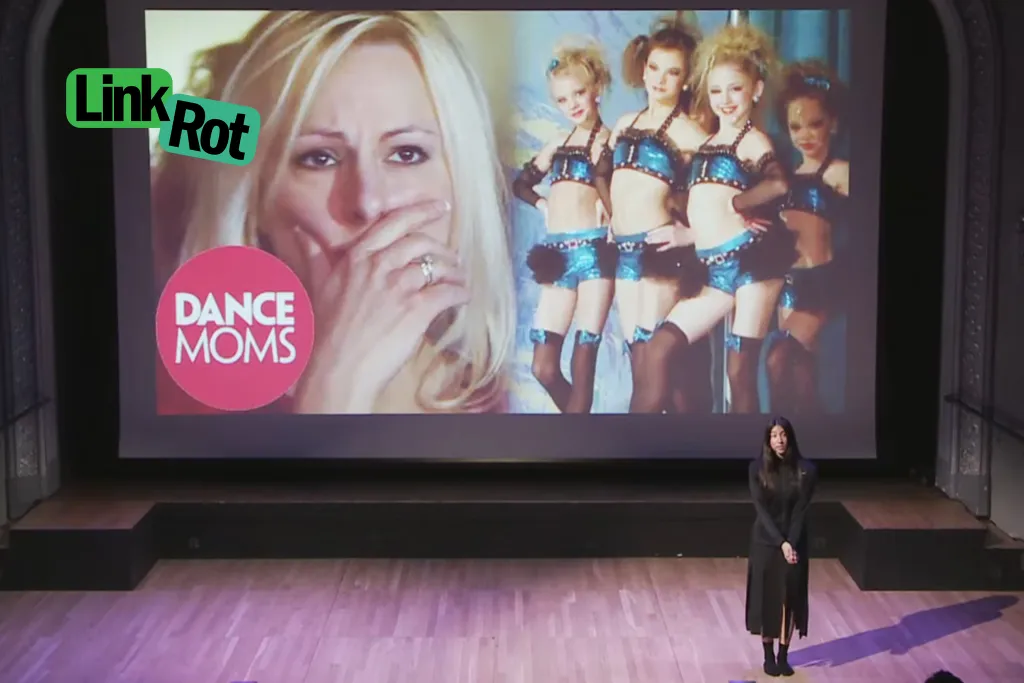
On stage right, a rack of children’s dance costumes: tulle, sparkles, flounce. The lights went dark. When they shone again, artist Maya Man had taken her position. “I always wanted to be a dancer,” Man said. “Look at me now, doing… this kind of performance.”
In mid-May, Man performed StarQuest at the Brooklyn performing arts center Roulette Intermedium, a performance-lecture that grew out of her show “StarPower.” The theater at Roulette was so packed that, in introductory remarks, Ivana Dama, the interim director of Harvestworks, which co-sponsored the performance, kept commenting on how surprised they were to have sold out the show. But the performance-lecture has become an increasingly popular medium that artists—and notably performers coming from a wide range of backgrounds—have taken on with a great deal of success.
Among the biggest hits of late: Mindy Seu’s A Sexual History of the Internet has been on tour since September, with 13 international shows under her belt and at least 10 more to go, in New Delhi, Brisbane, and Los Angeles, for a second time. Gideon Jacobs and Joshua Citarella, both primarily known as cultural critics but who are also performers and artists in their own right, have also taken to the form. Jacobs staged a performance-lecture at Giorno Poetry Systems in May, and Citarella’s live taping of his podcast, Doomscroll, counted toward his participation in the 2026 Whitney Biennial. Influencer Mackenzie Thomas has staged her durational performance I Said What I Said (2026) in Los Angeles, London, and New York to sold-out audiences.
So what is it about this medium that is so attractive to these performers and their audiences today? The performer goes onstage and tells her audience, a mass of darkened faces: this is who I am, this is what I’ve done, this is what I think. Doesn’t it feel quite analogous to turning on the front-facing camera, speaking into it, and projecting oneself onto the crowd? The performance-lecture is the closest one can get to mirroring the content we consume online.
Gideon Jacobs performs at Giorno Poetry Systems in early May.
Shanti Escalante-De Mattei/ARTnews
It’s no coincidence that these artists have significant online followings, ranging from the tens of thousands to the hundreds of thousands. Seu recently announced that she is represented by Figures.company, a talent agency that works with the “alternatively influential”—a designation that variously describes tastemakers and public intellectuals, as well as nutritionists and start-up founders. In fact, Seu comes from a design background. Citarella similarly straddles the labels of artist and influencer. While critic Ben Davis, in his recent review of the Whitney Biennial, described Citarella as having “all but left art-making” and “art as a subject” to pursue his politically focused podcast, he is listed as a participant in the show. There is no “art object” per se, as Davis notes, but just a wall label floating in the hallway “stating that he will be recording episodes of Doomscroll at the museum.”
Meanwhile, both Man and Jacobs wanted to be performers when they were kids and have found a way to pursue those desires outside of the traditional paths. (Jacobs, it must be noted, worked consistently as an actor in his childhood, appearing in Home Alone 4 and Wet Hot American Summer, among other films.) Thomas, for her part, belongs more to that evolving cadre of performer—the internet personality-comedian-aspiring actress—than to the artist. Yet the performance-lecture challenges the medium-based categorization of the creative producer. Thomas’s durational performance lasted four hours, included multiple personal essays, and involved the reading of every single tweet she had posted over the course of 2025. That, like many of the performances noted in this essay, certainly defies an easy label—so why not label it art?
The promiscuity of the performance-lecture, and the discomfort it can provoke, isn’t anything new. The performance-lecture has always been a medium—or is it a genre?—that doesn’t just blur the line between lecture (pedagogy) and performance (art) but one that allows subjects to complicate how their creative output is labeled. Robert Morris, who popularized performance-lectures in the 1960s, was a quintessential category-defying artist. He made sculptures with bodies, sculptures with materials, land art, and performances, and was also an active critic. His performance-lecture 21.3 (1964), in which he lip-syncs an essay by art historian Erwin Panofsky, is seen as a quintessential example of the form and one that has often attracted quite a bit of heated debate.
As art historian Tom Hastings documents in a 2021 essay on Morris, the artist’s 1994 retrospective was derided by New York Times critic Roberta Smith as “weirdly unconnected” and overly “pedantic.” That review led to a roundtable organized by the eminent journal October to discuss Morris’s work and to take stock of the avant-garde production of the ’60s. At the roundtable, critic Silvia Kolbowski said that Morris “sort of whores after every cultural change or shift.” Hastings’s takeaway from the roundtable was a “shared acknowledgement that Morris stands for the infiltration of art by commentary, a problem that is constitutive of art making of the 1960s and continues to haunt its reception.” This infiltration is evident in the format of the performance-lecture itself, which boldly becomes an objectified form of art “through the formalization of the art historian’s method,” Hastings wrote.


Three people using ropes to pull themselves up a plywood ramp, an interactive sculpture by American artist Robert Morris, on display at the Tate Gallery in London, April 27th 1971.
Getty Images
Of course, today we are dealing with a very different sort of commentary. The heyday of criticism has passed. In its place is the massification of talk and performance through social media. This constant addressing of the audience, an imperative for survival online, has itself become the art. In that imperative, distinctions between mediums and genres blur as we are pressured to translate our cultural production into that form of direct address. And yet, making content is not enough to be known as an artist—so you do it live. This represents the evolution of what artist Brad Troemel called “Athletic Aesthetics” in an influential 2013 essay of the same name. In that essay, Troemel argued that artists were bombarding the internet with their work, and that this constant posting represented an essential shift. In his words: “What the artist once accomplished by making commodities that could stand independently from them is now accomplished through their ongoing self-commodification.” Said another way, constant posting has become the oeuvre of the artist, and thus their personal brand is now the work. Yet that era of posting as art has collapsed. It seems that it’s just too difficult to make the distinction between posting-as-content and posting-as-art; whether we like it or not, these distinctions are still how we make meaning. What is fascinating is the suggestion, then, that it is easier to objectify an ephemeral performance as an artwork than a digital artifact like a social media post.
And this is where the second component of the performance-lecture’s effectiveness comes in, specifically for artists who work with technology and the internet as their subject and medium. (I would argue that is the case for all of the artists mentioned here.) In my time reporting on digital art, it has become evident that such work needs to be explained twice. First, there is the artistic explanation we typically encounter in wall text: what does this mean, what is it doing, etc. But for artists working with complex technological objects, one also needs to explain what the technology is and how it works for audiences to decode how the artist is utilizing it as, say, commentary.
In Maya Man’s StarQuest (2025), for example, the performance-lecture becomes a way of educating audiences about the process of making work with generative AI software. The performance is named after a work the artist made by training generative software on episodes of the reality TV show Dance Moms. Man then used written text prompts to generate an uncanny video work that features little girls dancing, crying, and admitting to their failures in interviews. In the performance-lecture, Man talked through the process of training the model, creating a shot list for the scenes she wanted to capture, the prompts that didn’t work, and the addictive quality of generating video after video by tweaking a word or a phrase. This behind-the-scenes look at the process of creating StarQuest was juxtaposed with her own journey as a competitive dancer, which she felt prepared and molded her to perform online. By the end of the performance, she personifies generative AI models, seeing in their constant updating, training, and quest for an ever more believable output the kind of constant self-correction young women performing online engage in. For audiences skeptical of AI, Man’s performance-lecture allows her to educate them about a medium so often associated with automation, shortcuts, and cheating.
The digital, the technological, the screen-based: its materiality seems to lie somewhere between the ephemerality of experience, speech, and performance, and the durability of an object like a painting or a sculpture. What the performance-lecture attempts, in a format that mirrors the direct address of contemporary communication, is a demystification of a medium that often refuses to behave as a commodity that can stand alone and represent the artist. And who knows—with enough performance-lectures under our collective belt, we might yet arrive at an age where digital artifacts are taken up as traditional art objects. But until then, keep talking.


