





Kiah Celeste trained as a photographer, majoring in the medium at SUNY Purchase. But after school, she abandoned it quickly, frustrated by all the rules that accompany such a technical pursuit. When I visited her Brooklyn live/work studio, it was brimming with sculptures, and I asked her if she thought she used her photo training indirectly. “If I do,” she said, “it’s by avoiding every single thing I learned.”
Instead, Celeste credits her hands-on post-college experience as an art handler—first around New York and then at the Louvre Abu Dhabi—as the genesis of her sculptural practice. One day, in Abu Dhabi, colleagues were organizing a pop-up show; she wanted to participate, but resources were tight. So Celeste set about collecting refuse, happening upon a marble tub that she turned into Balance Bath (2019), an inclined pink fixture adorned with Memphis Group–like shapes and squiggles.
Kiah Celeste: Pending Mobile, 2024.
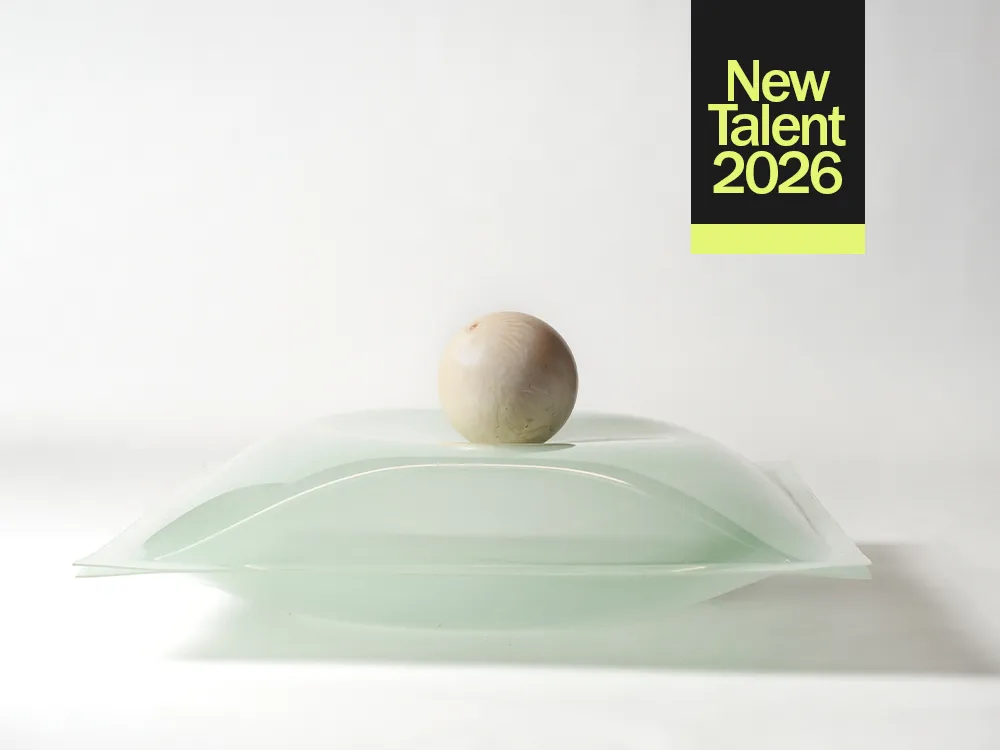
Celeste, a New York native, has been “foraging” for materials ever since. She has an incredible knack for making everyday objects feel foreign and familiar at the same time. Ouroboros (2025), for instance, is a seductive string of old CDs. Works in her “Dream of Pearl” (2023)series look like pearls on pillows—a sort of reverse princess-and-the-pea situation—but are made of acrylic skylight domes and bowling balls that, in her hands, appear weightless.
I asked Celeste if she has rules for herself, and she told me they are loose: “I don’t like to do too much to an object,” she explained, “but I also don’t want it to be a readymade.” Also: “I try not to use anything new.” This is partly an environmentalist position—less a solution to the piles of trash filling our planet than an inspiring ethos of resourcefulness, a reminder that there is beauty to be found even in refuse. Besides, used objects “make sense financially,” she added. They also “have a history, have character.”


Kiah Celeste: Ouroboros, 2025.
Courtesy Swivel Gallery, New York
It’s wild how, once I’m able to name the objects I’m seeing, my sense of her sculptures shift starkly: The effortlessly floating pearl gives way to a heavy but impressively engineered bowling ball. But if Celeste’s abstractions have a subject, it is tension—between the abstract and nameable components, but also between classes and movements. She balances the elegant restraint of Minimalism with the ordinary accessibility of readymades and Pop. Sometimes the tension is physical: Pending Mobile (2024) literalizes (and reverses) the proverbial fitting of a square into a circle with its round ball stretched through a gridded cube, looking ready to burst. Her works are best described with active verbs—stretched, pierced, bent, suspended—never static, but always on a precipice. Doubling down on all the dualities, Celeste often participates in two-person shows: with Gordon Hall at Document Gallery in Chicago in 2025; with Eric Oglander at Swivel Gallery in New York in 2023; and with Vivian Springford this past spring, also at Swivel.
On some level, Celeste sees her sculptures as self-portraits—not literally, exclusively, or even consciously, but in the sense that most, if not all, artwork reflects something of the sensibility of the artist. She sees herself in the push-pull, describing her inner world as “tumultuous” and naming a split sense of belonging among different worlds—Black and Jewish, feminine and androgynous, to name just a few listed on her website. Still, for Celeste, all the tension “feels almost romantic.” I was surprised by that adjective—romantic yoga balls and bowling balls?—but then convinced. After all, she manages to make decidedly discrete things harmonize beautifully, despite their dissonances.


