






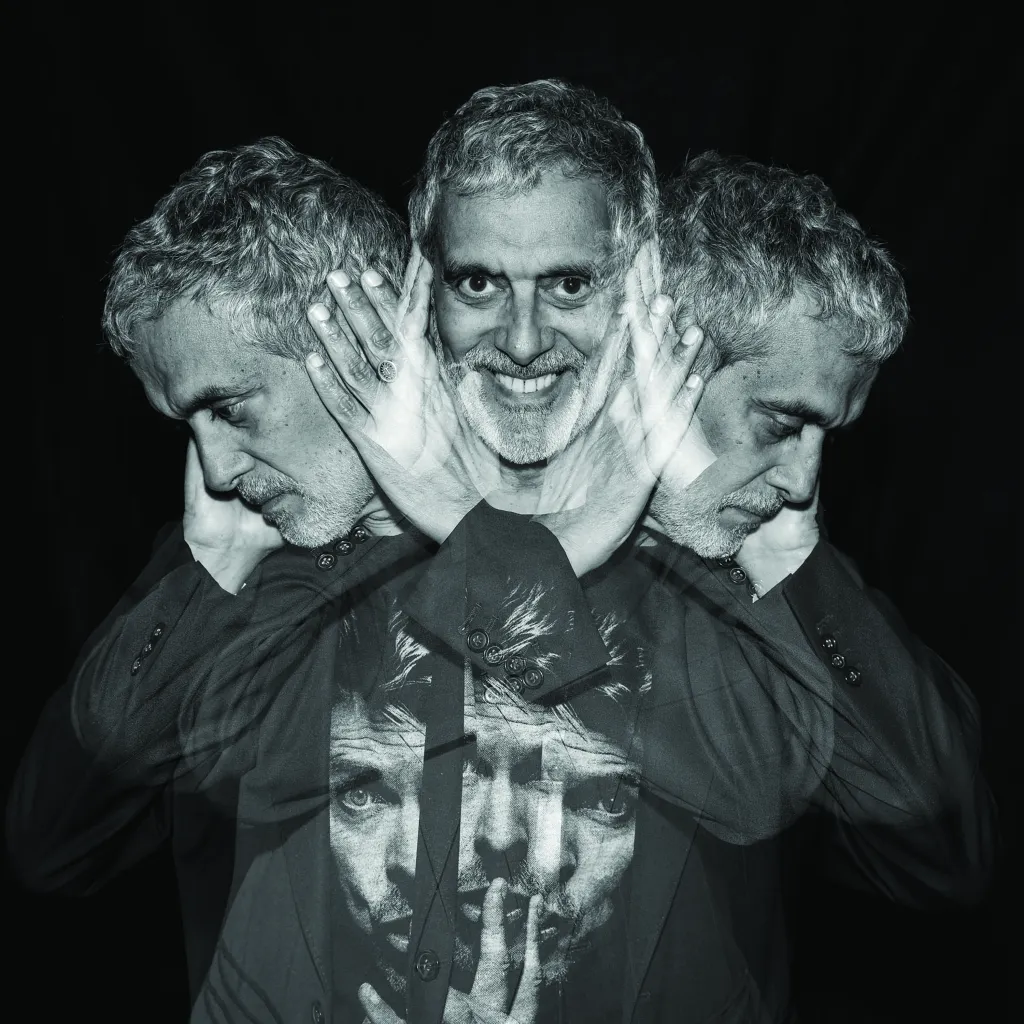
Theo Eshetu has made mesmeric films for cinema, television, and exhibitions for more than four decades, often with an eye to the multiple ways films can be shown. In Brave New World (1999), the viewer is presented with a mirror box with a continuous loop of bisymmetrical clips. In the 2015 video installation The Slave Ship (The Law of the Sea), the film unfolds in an ovoid frame. His 2017 commission for Documenta 14 includes two versions of the film Atlas Fractured, one projected on a cave wall and the other on a banner that had previously hung at the entrance to the Ethnological Museum in Berlin.
Throughout his career, Eshetu has been interested in what he has called a “hypothesis of a world vision.” In his work, he looks for ways to reflect the cosmopolitanism at the heart of his personal history—he was born to Ethiopian and Dutch parents in 1958—but also the ways in which the world’s narratives are interlinked. His most notable films include Till Death Us Do Part (1982/1987), a 20-screen investigation on the growth of 1980s media culture, and The Return of the Axum Obelisk (2009), a 15-screen documentation of the restitution of a cultural artifact from Italy to Ethiopia.
At the Venice Biennale, Eshetu is showing The Garden of the Broken-Hearted (2026), a new work that revolves around an olive tree mounted on a rotating dais—with a video of the tree projected onto the tree itself. A.i.A. spoke with Eshetu about the formal audacity of his practice and how he considers his care for the tree an artwork of its own.
What does it mean for you to be included in the Venice Biennale? You had conversations with the exhibition’s curator, Koyo Kouoh, before she passed away. How does her absence figure into the work?
I can’t detach myself from the fact that we were extremely close friends. I owe her a lot. I was devastated by her loss. During preparations for Venice, we spoke of gardens. I was trying to find another way of looking at gardens, not as a space of greenery or ecology, but as a space to look at humanity away from narratives of culture—to look at the myth of the Garden of Eden, to see it not as a paradise but as the birthplace of human consciousness. I could imagine it as a pre-pagan garden, a garden where we don’t know ourselves yet, and we go there to find out about ourselves and have a relationship with nature. She liked these ideas and was interested to know where they would lead.
We also talked a lot about mourning—mourning the present, mourning the difficulties of creating in a moment when we feel sorrow and a lack of faith in human nature because of all the tragedies that surround us. I reduced my garden project to a single olive tree, which I will put on a rotating platform.
Theo Eshetu: The Garden of the Broken-Hearted, 2026.
Courtesy Theo Eshetu
How big is the tree?
It’s about four and a half meters high. I’m dealing with the logistics of getting it to Venice and fitting it through doorways. I’ve always worked with video, so I have no idea about these things—I’m used to making my work and sending the file. This project is really about absence, but it’s ironic how physically challenging it is.
It seems like a transformation to go from the representation of the world in a film to presenting something concrete.
That’s exactly what this is all about. You might have understood from previous works that there is always some quest to understand the spirit of things. This project is the ultimate expression of that, where the video as the medium of expression disappears and we are left with just the tree, the subject of what would have been a video. The idea is that anyone looking at it can bring their own narrative, their own symbolic interpretation, though I don’t intend the work to be symbolic. Its rotation on the platform suggests narratives and storytelling in their most elemental form. It’s just a tree, and my work is about the care needed for its survival.


Theo Eshetu: Adieu Les Demoiselles, 2019.
Courtesy Theo Eshetu
It’s a surprise, because I had assumed for the Venice Biennale you would present several videos or a multichannel work.
The more I think about it and work on it, the more I feel it’s right. Reactions might be that I didn’t do anything, but somehow that’s the point. I’ve never worked so hard for a show. To Koyo I did mention that this was going to be a kind of return to the roots: not to the way we understand roots as ethnicity, but rather going back to our roots before we became human—to a time before thought, a consciousness that plants might have—to learn what plants might teach, which could be lessons we might have forgotten, because cultures have led us to more human-centric paths.
How does it connect to your previous work? When you mentioned moving the tree, I couldn’t help but think of your film about the transportation of the Axum Obelisk.
I’m also making a film about the tree’s journey to Venice that won’t be in the exhibition. It’s like the Axum Obelisk in the sense that transporting an object which is not meant to be moved unleashes narratives and stories. In Documenta I presented a project where masks and statues were projected onto people’s faces. And for an exhibition in Austin, I projected Picasso’s Les Demoiselles d’Avignon onto five performers. For Venice, I plan to project the image of the tree turning onto the tree as it turns. The work for Documenta was very much about the ambiguity of identities. Here it’s just the tree on the tree, to suggest that it’s the tree that is emanating light.
I don’t know if I would have thought of putting the tree on a rotating platform if I weren’t a video artist. I am very conscious of moving images, so it seems natural for me that the tree should keep moving once it’s brought to Venice.

Theo Eshetu: The Return of the Axum Obelisk, 2010.
Courtesy Theo Eshetu
Where is the tree from? Are you moving it from within Italy?
It comes from nature! Everyone seems concerned with where it comes from. I have grown up with this question: Where do I come from? I am listed as an African artist but also as the only Italian artist in the main pavilion. No one is claiming my Dutch identity; after all, my mother is Dutch and my name is Theo. The British don’t seem to be interested in claiming me, but they’re welcome to, as I am also a British citizen. I’ve gladly got some support for my project from Germany, because I live there. This whole thing of where I come from seems irrelevant to me. It’s other people’s concern and not mine. The olive tree comes from where olive trees come from.
The olive tree, like the apple tree in the Garden of Eden, stands as an emblem for these times, when everything is so difficult, when all our reasoning is so clogged up and logic is turned on its head. We might need to go back to the garden to try to find other realities, other ways of feeling, other ways of thinking, other ways of looking at things.
Trees also have to find balance, because as they grow downward they also grow upward. But part of what you seem to be doing is an attempt to dislocate a tree, to take it and put it into a different context.
That might be the tragedy of culture. After all, art is the artificial representation of something real. Art is the representation of something which points to something else. The dislocation of the tree is the introduction of a natural element into the contemplative space of art, into this space of culture and representation of reality. There might be a kind of contradiction of placing nature in a gallery space, but it’s a gesture of stepping back to look at the mechanisms of the art world.
How did you conceive what to project onto the tree?
The image of the tree turning will be projected onto the tree turning, and we’re working very hard to synchronize the two. In our dream, we would like to make every leaf project onto where the leaf is. It’s an impossible mission to map them perfectly. We will experience our failure. We will experience how we tried and didn’t quite succeed. But something might happen in that mistake and in the imperfection.
You’ve always been interested in what kinds of surfaces videos can exist on.
Anything that’s not supposed to move that moves tells a story. It’s movement which is a narrative. I have filmed a boat moving from one museum to another and an obelisk moving from one country to another. Movement is a story.


