






To receive Morning Links in your inbox every weekday, sign up for our Breakfast with ARTnews newsletter.
Good Morning!
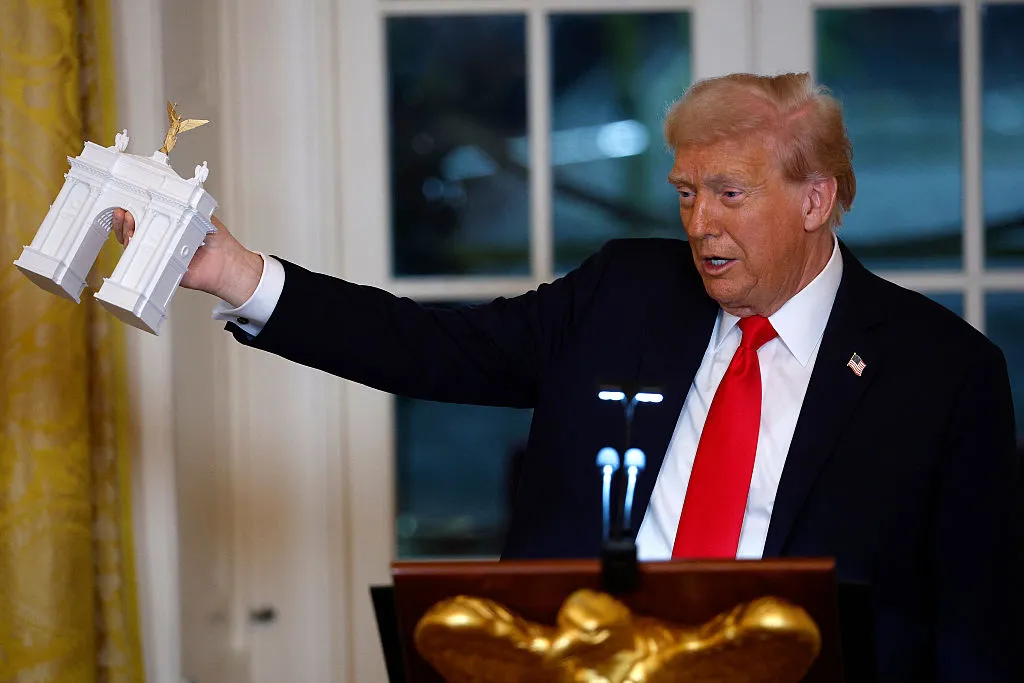
- Trump is proceeding with the construction of his triumphal arch despite lacking federal approval.
- Record heatwaves in France cost national monuments and museums hundreds of thousands of dollars.
- Germany’s arts sector is closely watching whether the far-right gains ground during this weekend’s regional elections, after threats to restrict arts funding for alleged anti-German views.
The Headlines
OVER-ARCHING AUTHORITY. President Trump is breaking ground on his massive triumphal arch, despite legal challenges and without required approval from federal review processes, reports the New York Times. Such a move was feared by those who warned that the administration would be emboldened by the Supreme Court’s recent greenlighting of Trump’s ballroom pet project, erected on the White House’s demolished East Wing, as the Times reports. Yet the Thursday announcement on social media that construction would start was—even for this administration—something of a slap in the face to ordinary legal processes. The administration now appears to have brushed aside its own previous displays of commitment to at least some legal requirements, such as providing 14 days’ notice in a legal filing before going ahead with the arch construction. “This demonstrates that they’ve never really taken seriously what they’ve been saying to the court, which is ‘allow the process to work itself out,’” said Nicolas Sansone, a lawyer for Public Citizen Litigation Group.
FEELING THE HEAT. Record heatwaves in France cost museums and monuments hundreds of thousands of dollars in lost revenue, with the Louvre taking at least €1 million ($1.16 million) in losses, reports Le Monde. The Center of National Monuments also reported it had to reimburse as much as €525,000 ($610,000) in ticket sales, following a series of closures at public museums and monuments, that were ill-equipped to deal with the heat. Institutions also reported a drop in attendance due to visitors avoiding city centers and venturing outdoors.
The Digest
If the far-right Alternative for Germany (AfD) grabs key votes in this weekend’s regional elections, as projected, the arts sector risks facing potential restrictions on funding, such as showing adequate proof of being “for Germany.” [The Art Newspaper]
The Faro Santander, a new private museum and cultural center on the northern coast of Spain, is opening in the David Chipperfield-remodeled headquarters of Banco Santander, featuring a collection featuring works by Rubens, Velázquez, El Greco, Goya, and Van Dyck, as well as a temporary exhibition from the Gelman Santander Collection, controversially traveling from Mexico. [El Pais]
Police unwittingly rushed to what they believed was a night rescue mission at Vancouver’s Access Gallery, only to learn that the body of a person stuck halfway through a wooden art crate was a sculpture by Allysa Pierre. [The Art Newspaper]
Minor Attractions, the alternative London fair, will stage its largest edition to date with over 75 participating galleries in a new location at the Fitzrovia luxury hotel The Newman, from October 13 to 17. [Minor Attractions]
The acclaimed actress Sandra Hüller will play the late German writer and painter Wolfgang Herrndorf (1965–2013) in a film titled Work and Structure, based on the artist’s autobiographical writing, and directed by Maria Schrader. [Monopol]
The Kicker
SEEDS OF HOPE. In Tehran’s inaugural art month, artists are grappling with and surviving the violence around them—whether from the war with the US and Israel, or from their own regime—through their creations, reports the Financial Times. “It’s a way of life for us. Now we have to continue as a social responsibility. Art is saving us,” said one gallerist who asked not to be named. Artworks on view in a series of gallery and city-wide venues don’t shy from addressing politically sensitive issues either, such as women’s rights. Yet participants are modest about what impact they may have. “This art fair will not create a serious shock to the visual arts scene, nor are we seeking an immediate impact,” said Hossein Mohseni, director of Tehran Art Month and Artibition. “Rather, we are sowing the seeds of hope for long-term growth.”


