





Mano ultramar, 2026
Juana Gonzalez
Arma Gallery
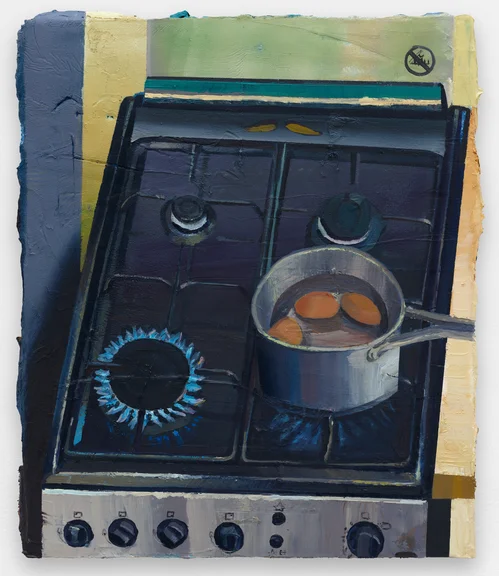

Matière noire, 2026
Mathieu Cherkit
Semiose
In this monthly roundup, we spotlight five stellar exhibitions at small and rising galleries.
Juana González
“Manos de hacer”
Arma Gallery, Madrid
Sep. 10–Oct. 10
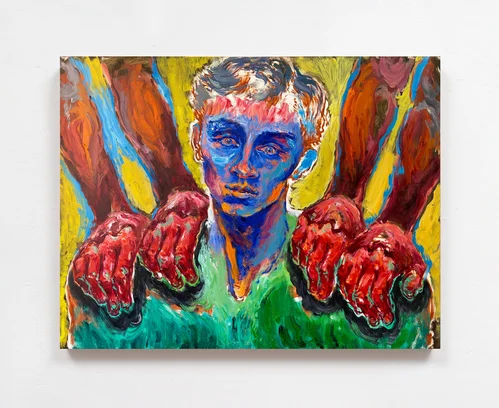

Apoyo en chico ultramar, 2026
Juana Gonzalez
Arma Gallery
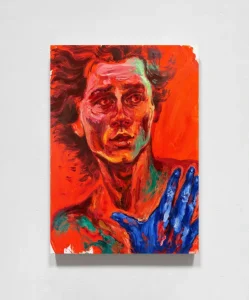
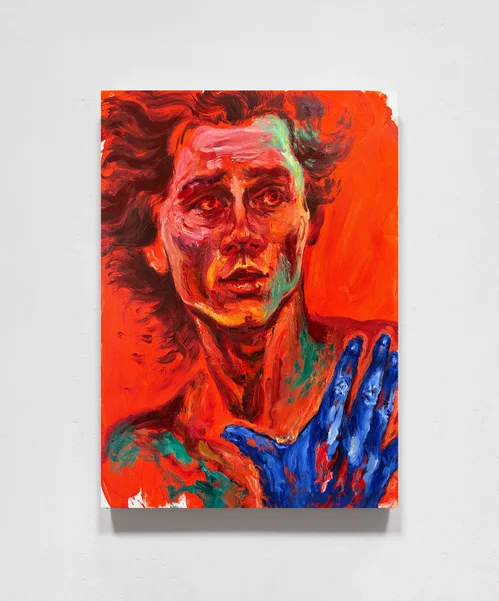
Hands are notoriously hard to paint, the Achilles’ heel of many otherwise capable artists. Spanish artist Juana González has audaciously made the difficult subject matter the central focus of “Manos de hacer,” her new exhibition at Arma Gallery in Madrid.
Known for her expressive figurative paintings that teeter toward the Baroque, González has frequently used hands as a mode of conveying emotion and dramatic tension. But the artist never noticed the power of hands in her compositions until other artists pointed it out to her. Now, in just over a dozen recent paintings, González homes in on hands in a series of electrically colorful paintings centered on knobby, powerful-looking hands. In one painting, Apoyo en chico ultramar (2026), four red, muscular hands grasp the two shoulders of a young man who casts a faraway glance. In another, Pelo (2022), two massive hands stroke the hair of a young woman.
González holds a degree in fine arts from the Complutense University of Madrid, and her work has been exhibited at institutions including the Cervantes Institute in Munich, Centro de Arte Alcobendas, and the Museum of the University of Alicante.
Mark Francis
“Chroma”
Bernhard Knaus Fine Art, Frankfurt, Germany
Sep. 4–Nov. 21
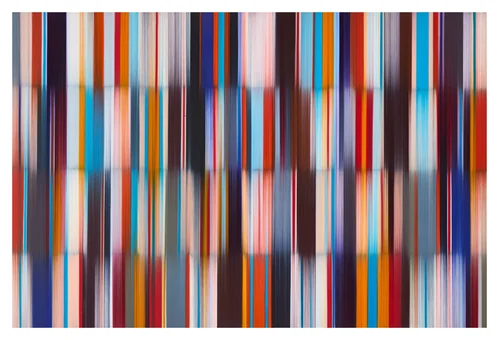

Strata, 2026
Mark Francis
Bernhard Knaus Fine Art
What if color had a sound? In a new exhibition, Northern Irish painter Mark Francis creates abstract paintings that treat color as a kind of audio frequency. In 16 paintings, vertical stripes of color zip down the canvases, with small, glitchlike alterations reminiscent of printer banding.
Francis overlaps, echoes, and layers these marks, creating compositions that look like you should be able to hear them. Works such as Audio Division II and Scaler (both 2026) underscore these sonic sensibilities in their titles without ever being too specific. The works thrive in these spaces of recognition and dissolution.
Over the past 30 years, Francis has established a painting practice closely aligned with science. His wet-on-wet paintings have explored theories of chaos and order, astronomy, and his own personal interest in mycology—the study of fungi. Francis studied painting at Central Saint Martins, followed by Chelsea College of Arts, where he completed his MA in painting in 1986. His works are in the collections of the Irish Museum of Modern Art and the Tate. Francis’s work is also currently on view in “Sea of Sound” for the Republic of San Marino at the 2026 Venice Biennale.
Olayami Dabls
“Looking Back”
Matéria Gallery, Detroit
Sep. 11–Oct. 31
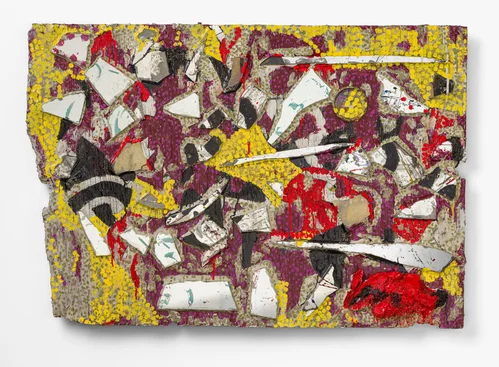

Looking Back #3, 2025
Olayami Dabls
Matéria Gallery
In this show, Detroit artist and cultural historian Olayami Dabls debuts nine new large-scale wall works made in 2025 and 2026. Born in 1948, Dabls is known in Detroit as “the bead man”; he founded the Dabls Mbad African Bead Museum in 2004, an art campus dedicated to preserving and presenting African material culture and heritage. The artist’s own works incorporate materials found locally, and in this show he uses iron, rocks, wood, and mirrors for their associations with certain healing properties.
Iron, for instance, acts as a metaphor for abundance, strength, and advancement. Mirrors, in African culture, can be used to repel negative energies. These mixed-media works draw from the heritages of African material culture, Detroit’s urban landscape, and Dabls’s personal symbology.
Earlier this year, Dabls presented his first museum retrospective, “Detroit Cosmologies,” at the Museum of Contemporary Art Detroit (MOCAD). In 2022, he was named the Kresge Eminent Artist for his lifetime of excellence in the arts and community service in Detroit.
Mathieu Cherkit
“Tendrement”
Semiose, Paris
Through Oct. 31
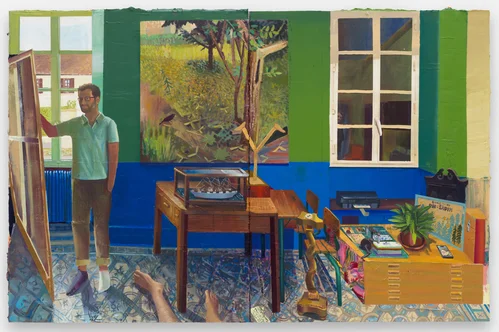

Tendrement, 2026
Mathieu Cherkit
Semiose
French artist Mathieu Cherkit draws inspiration from close to home—literally. The artist is best known for his paintings of the house where he lives with his family. In his first exhibition at Semiose, Cherkit presents 15 new paintings centered on this subject.
His methods are both precise and inventive: Cherkit paints each section of his paintings at set times of day. One corner might be painted every morning, another in late afternoon, until the painting is complete. He works from sketches, but also from memory, and playfully rearranges perspectives and proportions in ways he finds interesting. The painting Matière Noire (2026), for instance, shows a saucepan filled with eggs in a few inches of water, cooking on a stovetop. Seemingly straightforward at first, the painting is a perspectival riddle, with the burner, grate, pan, and knobs all painted from differing angles, in a nod to the Cubist approach.
Born in 1982, the artist lives and works in Vallery, France. He graduated from the Nantes School of Fine Arts and the Hochschule für Grafik und Buchkunst in Leipzig, Germany. His work is included in the collections of Paris’s Centre National des Arts Plastiques and the Musée d’Art Moderne de Paris.
Bang Soyun and Jaiyoung Cho
“mine”
SPACE SO, Seoul
Through Sep. 12
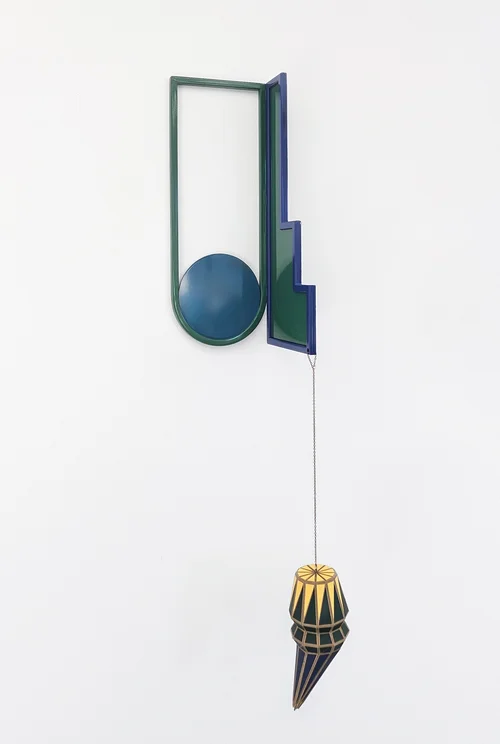

Body Module, 2026
Jaiyoung Cho
SPACE SO
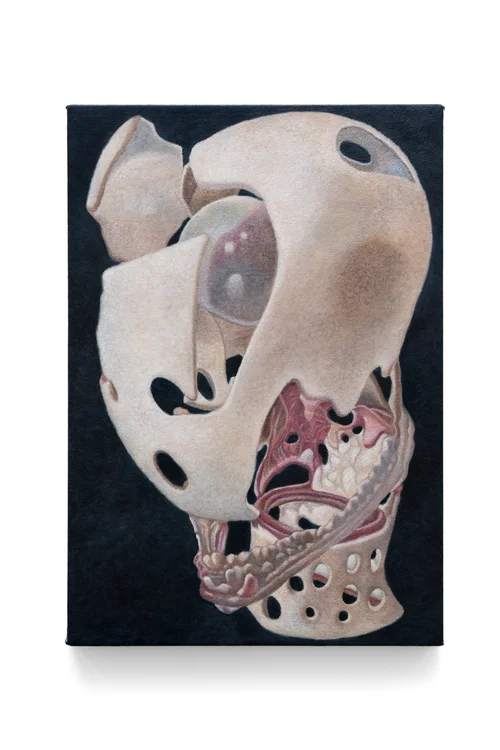

The Layers – Piercing #1, 2026
Bang Soyun
SPACE SO
Korean contemporary artists Bang Soyun and Jaiyoung Cho grapple with the body, individuality, and questions of collapse and collision in this dual exhibition spanning painting and mixed-media sculpture. Bang Soyun’s oil-and-acrylic paintings are uncanny arrangements of entrails, bones, and eyes. In her painting The Layers – Piercing #1 (2026), these skeletal forms teeter atop one another like a precarious sculptural form. Soyun also brings these subjects into three dimensions with small-scale sculptures made from acrylic, sand, and plastic. The artist, born in 1992, uses 3D modeling software and AR to visualize these creations.
Jaiyoung Cho, meanwhile, presents works in sculpture and installation made with materials such as cardboard, metal, thread, and fabric. These forms are flexible in format, made through layering, cutting, and arrangement, often in response to their architectural surroundings. Works from the series “Body Module” are small-scale, colorful wall pieces, each an open, framelike form with a dangling pendant suspended from a chain. Other works from the “Body & Bodies” series are freestanding sculptures reminiscent of room dividers, but often with cutouts or openings that draw attention to the gallery space instead.
Born in 1979, Jaiyoung Cho received her BFA and MFA in sculpture from Ewha Womans University in Seoul and an MA in fine art from the Utrecht School of the Arts in the Netherlands. Her work has been exhibited at galleries including Wooson Gallery and Carvalho, as well as institutions including the Kumho Museum of Art and Atelier Hermès.


