








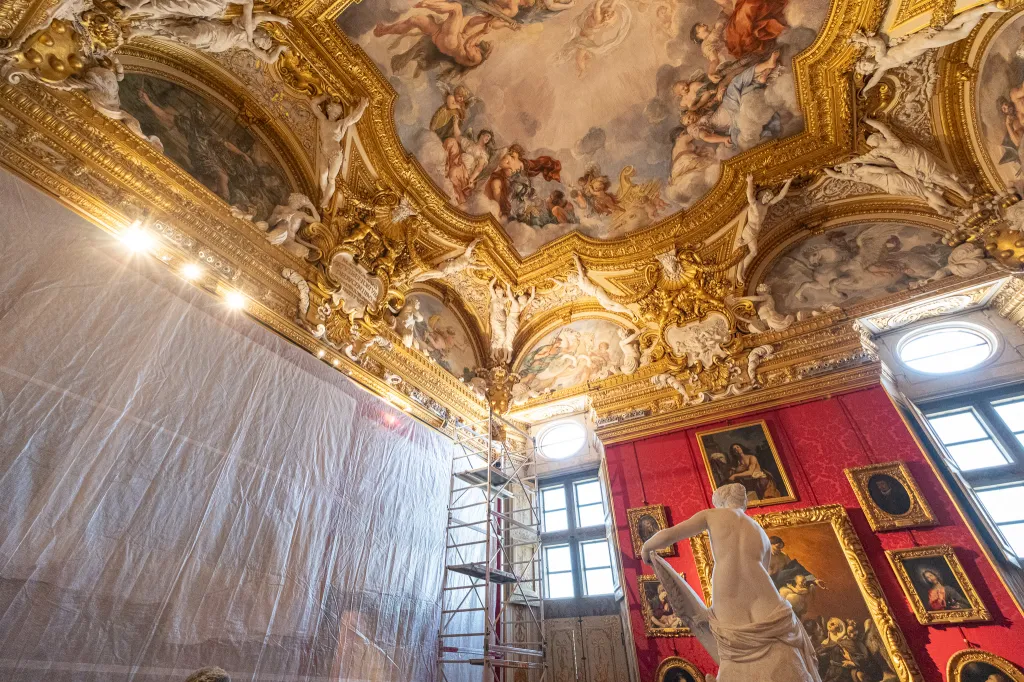
Yesterday, the Uffizi Galleries in Florence, Italy, revealed the extent of ongoing €50 million renovation plans spread across the museum. The revamp includes dozens of projects in the Gallery of Statues and Paintings, the nearby Palazzo Pitti, and the Boboli Gardens, some of which have already begun, while others are scheduled to start in the coming months, allowing the museum to remain open.
“An operation of unprecedented scale and depth is underway,” said Uffizi director Simone Verde in a statement. “The museum complex will emerge from it even more beautiful, and an ever more essential icon of Italy.”
Projects include new, more “visitor-friendly” services, displays, labels and signage, rehung galleries, artwork and gallery restorations, new lighting and the repurposing of spaces, allowing for more exhibition space, that “will radically transform” the monument.
A museum representative told ARTnews via email that renovations “should end—we hope—in two years from now.” The €50 million ($57.6 million) award package, they added, was granted by Italy’s Ministry of Culture, along with private contributions, including €5 million ($5.76 million) from the American philanthropist Veronika Atkins.
A model showing the redesign of the new Uffizi Galleries reception area to the Magliabechiana Hall. Photo courtesy of the Uffizi Galleries.
Among revamp highlights is a major upgrade to the museum’s climate control systems, including the purchase of two cooling towers. Those works appear particularly timely, as parts of Europe continue to bear the brunt of one of its hottest summers on record, forcing some museums and monuments to partially or entirely close.
There is also the renovation of the Boboli Gardens’ amphitheater for public performances, the Fountain of Neptune, and the Isolotto [little island] basin. The top floor of the Palazzo Pitti, known as the Piano degli Occhi [Floor of the Eyes], 1,000 square meters, will be transformed into a new exhibition space, while the Uffizi’s Flemish galleries will reopen with an entirely new display. Visitors can also anticipate a new section devoted to the history of the Uffizi collection, plus a new reception area to the museum’s Magliabechiana Hall overlooking the Piazza del Grano, to name just a few changes ahead.
Already, the Botticelli rooms have been restored to a more traditional display inspired by the museum’s history, with walls painted “Renaissance gray” over the more modern white and, in contrast, darkened baseboards, similar to how they appeared in the past. Botticelli’s Primavera and Birth of Venus have also been installed in new cases that open easily for inspection, as The New York Times reported. In addition, the museum announced that over the past two years, over 3,600 plants have been added to the Boboli Gardens.


Restoration of Stoldo Lorenzi’s Neptune Fountain in the Boboli Gardens. Photo courtesy of the Uffizi Galleries
Last year, 5.3 million visitors flocked to the Uffizi, where its narrow hallways and relatively small rows of galleries can quickly fill up. They were originally commissioned by the Duke of Florence, Cosimo I de’Medici, as administrative offices for the city after he settled into his gilded residence across the Arno River in 1550, the Palazzo Pitti.


