







It could be said that we are living during the “dog days”—an era of excess, of things being “too much”. We turn on our electronic devices and are flooded with images and information, much of it distorted and much of it concerning abuses of power. Oppressive temperatures, both literal and metaphoric, are pushing societies to the brink of collapse.
It is this sense of saturation that underpins the exhibition Canicula (the Latin name for “dog days”: the hottest days of summer), the third and final presentation in the Trilogy of Uncertainties, which opens at the Complesso dell’Ospedaletto on 6 May. “This show feels very appropriate for the time we are living in,” says Leonardo Bigazzi, the curator of the nomadic Fondazione In Between Art Film, which has commissioned eight new site-specific films for the exhibition.
Each of the shows in the trilogy has proved uncannily in step with its times. Penumbra (2022), which explored the ambiguity of dim light, opened just weeks after the Russian invasion of Ukraine, while Nebula (2024), which was about navigating a path through disorientating fog, came several months after the tragedy of 7 October in Israel and the subsequent assault on Gaza. The third show will be “radically different”, notes Alessandro Rabottini, the artistic director of the foundation, “because it is about hyper stimulation of the senses and being plunged into an excess of things”.
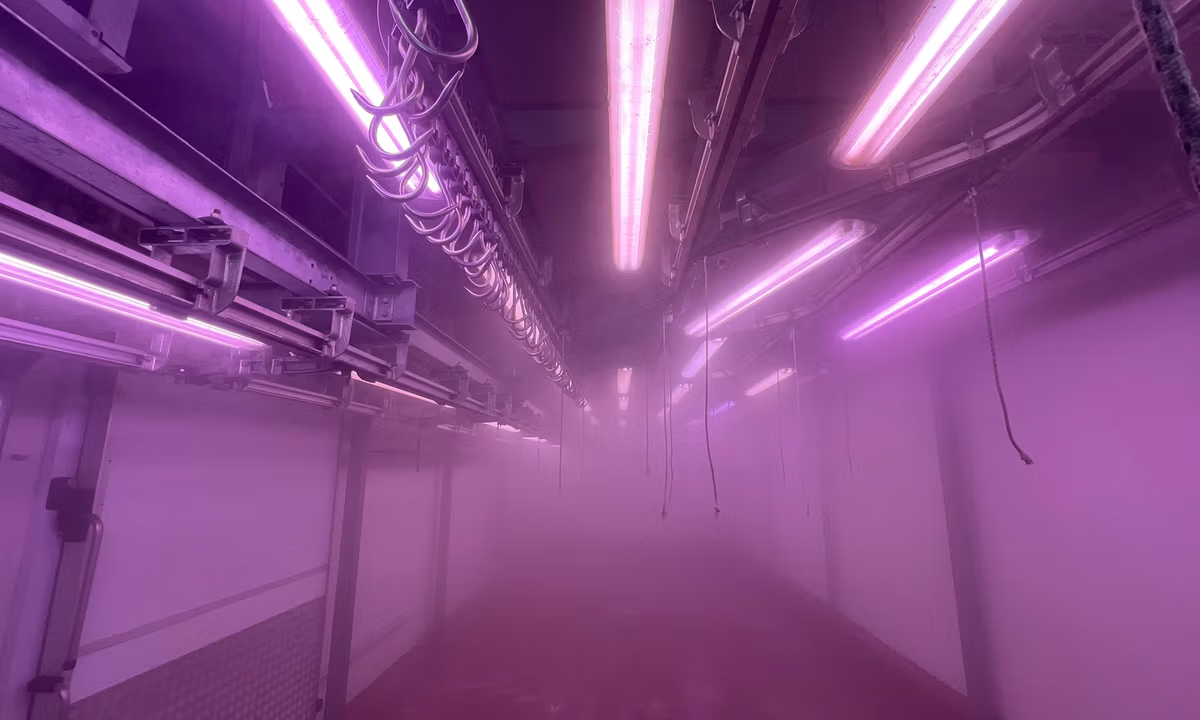
Affirmations is a futuristic study of Russian soldiers’ memories of the war against Ukraine
Courtesy of the artists and Fondazione In Between Art Film
Navigating uncertainty
Political and social issues run through all the films on show—a position the costume designer Beatrice Bulgari has taken since she established the foundation in Rome in 2019. “To commission is to take a position; it means believing that artists can offer tools to navigate uncertainty, not by providing answers, but by reshaping the way we see and feel,” she says.
She notes that, in moments of geopolitical tension, “it becomes even more important to create spaces where complexity can be held rather than simplified”. With Canicula, she adds, “We are not trying to represent reality directly, but to engage with its deeper conditions—excess, pressure and distortion.”
The Ukrainian artists and film-makers Roman Khimei and Yarema Malashchuk are presenting a multi-channel video installation, Affirmations (2026), which features a series of fictional deathbed testimonies from elderly Russian soldiers recounting their roles in the war against Ukraine. “Will they regret what they did? Will they still be proud of what they did? Will they have developed some form of empathy for the enemy, or will they still hate the enemy? These are the questions that the work asks,” Rabottini says.

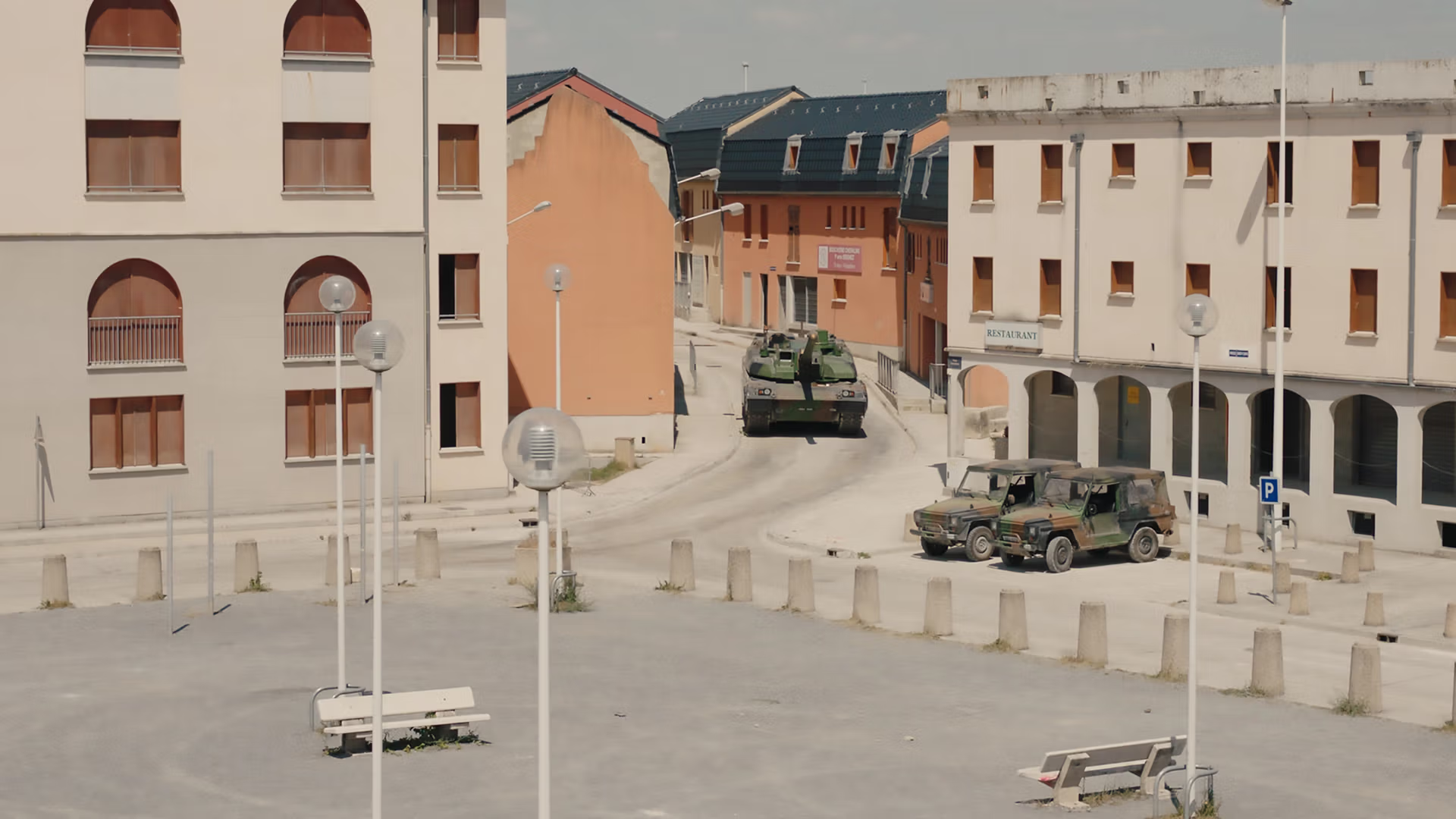
A still from Massimo D’Anolfi and Martina Parenti’s 24 Landscapes + A Vision (2026) Courtesy of the artists and Fondazione In Between Art Film
Acoustic onslaught
War of another kind forms the basis of 450XL: The Story of a Fugitive Sound (2026), a film by the Jordanian-born artist Lawrence Abu Hamdan that chronicles the sonic attack on a silent vigil in Belgrade, Serbia in 2025. Abu Hamdan and his team analysed 19 videos, conducted 15 earwitness interviews and researched 3,244 written testimonies. The findings challenge the official report by Serbian and Russian authorities—that the disorder began when the crowd set off fireworks, instead demonstrating an unprecedented attack using an LRAD 450XL directional acoustic weapon.
In her film, Jarkov (2025-26), the Peruvian artist Maya Watanabe considers the accelerated melting of the Arctic that has brought to light numerous remains from the Pleistocene Epoch. Jarkov is the name given to a 20,000-year-old woolly mammoth that was discovered in 1997 almost intact and extracted from the Arctic tundra as a single, frozen block. The paradox of a work about the dark depths of the Arctic ice in the context of an exhibition about excessive light is that access to the mammoth has only been granted by the heating of the planet.
It is an experience that will affect us all, with wildfires increasingly blighting Europe—and particularly Italy. Bigazzi believes that the effects of war and ruin that Canicula deals with are also closer than we think. “If we look at the world six years ago, when we started this trilogy, the distance between us and these tragedies has narrowed,” he says. “It’s now on our doorstep, it’s affecting our friends, it’s affecting the families of artists we are working with. It’s really very close.”
• Canicula, 6 May-22 November, Complesso dell’Ospedaletto


