






In March of this year, I flew to Los Angeles to see the literally groundbreaking exhibition “Monuments,” curated by Hamza Walker, Bennett Simpson, and Kara Walker and co-presented by the Museum of Contemporary Art (MOCA) and the Brick. Because that show engaged many dialogues around the presence and removal of monuments, it had a generative impact on how I consider the role of monuments in our national lives. Once I returned to New York, I wondered what form alternative public sculptures could take. Instead of warmongering, colonialist steel, stone, or granite horses and men on the lawns of government buildings, what should accompany us in our daily historicizing? Maybe, I thought, it’s as simple as turning our attention to the lawn itself—or, to be more exact, to the soil that made that lawn possible.
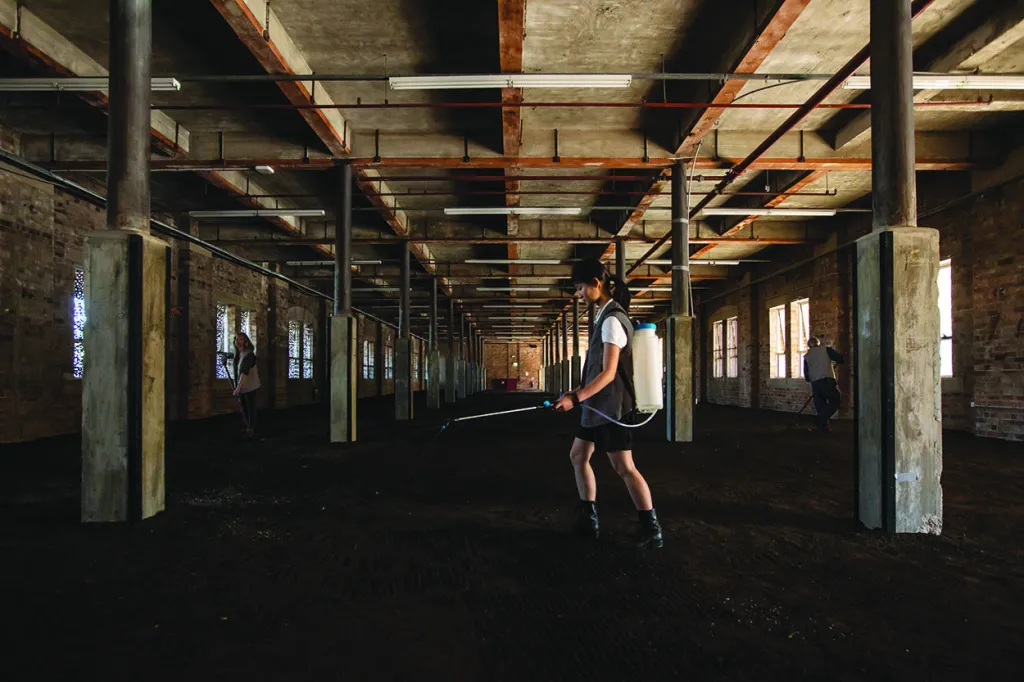
Little in life remains more permanent and more generative than soil. Nothing holds the remnants of our history, our cultural artifacts, the bones of our ancestors, and our own futures more honestly than soil. And though the word “soiled,” as in ruined, stained, and unclean, can feel closer in these times, everything comes from the soil. No matter what, the soil lives on. It consumes the debris. It is this that the artist Asad Raza puts forward in Absorption (2019).
Absorption, which has been exhibited around the globe as a site-responsive installation, lives within a series of works Raza refers to as “Metabolisms.” Each installation in this series, begun in 2015, supports a form of growth, in a manner of speaking. The neo-soil in Absorption, as distinct from dirt, contains microbial life that needs to be kept alive through pH testing, moisture maintenance, and the integration of new material. This means once the neo-soil constitutes itself from sands, clays, bacteria, fungi, plants, insects, arthropods, decomposing organic matter, and whatever else it absorbs, human custodians rake and water it in recognition of its needs. It needs us. It assumes our presence. The work brings to mind David Hammons placing, during snowstorms, a red scarf around the head of a Black woman sculpted at the base of a monument in Brooklyn. The monument should demand a response from those who interact with it.
Raza first came up with the recipe for this soil with his daughter. Like children, we are closer to the soil in these times as we are left with images of landscapes returned to rubble. Impermanence is in immediate and perilous conversation with elemental survival. I like to think Raza’s work venerates change and growth because after everything, after all we have put our belief and trust in collapses, that’s what left.


