







The UK sculptural landscape has an important new addition—a work honouring the Ford Dagenham sewing machinists whose strike action led to the 1970 Equal Pay Act.
The pair of sculptures by UK artist Ruth Ewan were unveiled this week in Dagenham Green in east London, a new neighbourhood development on the site of the former Ford automotive factory. The works are located near the site of the original picket lines close to the Ford car plant which is still operational.
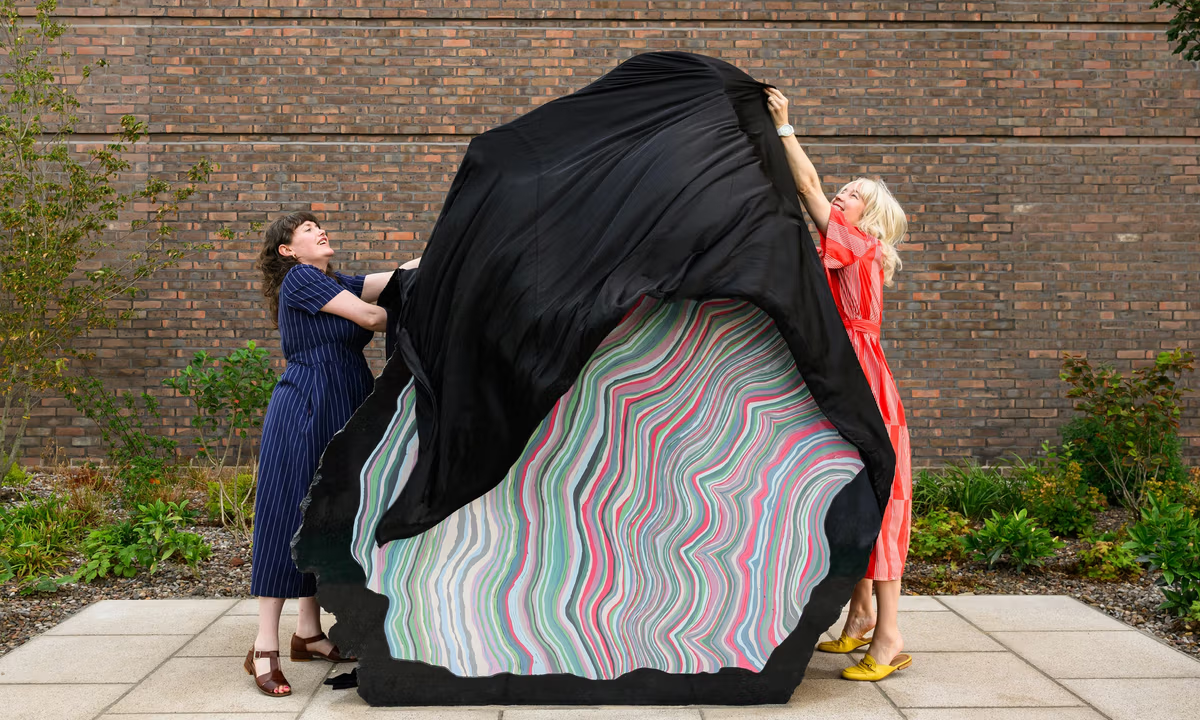
Ewan’s sculptures comprise two boulders split open to reveal bands of colour. “The colours used are matched to the paint colours of the cars in production during the respective strike periods—including the iconic Ford Cortina—when the Dagenham plant was a hub of British car manufacturing,” says a statement.
The sculptures, entitled The Dagenham Agates, were commissioned by the non-profit housing association Peabody and the developer Hill Residential Ltd. Adriana Marques, Peabody’s assistant director of Cultural Programming and Strategy, said in a statement: “Initiatives and commissions such as this should not be regarded as decorative add-ons, but as essential civic infrastructure.”
The 1968 strike action by the sewing machinists at Ford Dagenham paved the way for the landmark 1970 Equal Pay Act that “prevents discrimination, as regards terms and conditions of employment, between men and women”, says the legislation.
The first strike was “a landmark event in UK labour relations”, writes Kevin Wilson of the London School of Economics. The machinists were graded as a B, when men doing a similar job elsewhere in the factory were given a higher grade of C, denoting “skilled labour”.
After four weeks on strike, the machinists voted to return to work following an offer of 92% of a male B grade rate. The women were only regraded as category C following a further six-week strike in 1984.
Ruth Ewan, The Dagenham Agates (2026)
Photo: Jack Hall/PA Media Assignments
The layers of one of the sculptures, Dagenham Agate 1968, represents each of the 187 women who took part in the initial strike; these layers were created by members of the local community, including students, in workshops at Barking and Dagenham College.Dagenham Agate (1984–85) comprises 150 layers, honouring the women who joined the later strike in the winter of 1984–85.
The public art commissioning organisation UP Projects produced Ewan’s works and also helped organise the workshops. “Our role was to curate and produce Ruth’s commission; the original brief from Peabody and The Hill group was to help create an artist-led heritage trail for Dagenham Green,” says Emma Underhill, the Founder of UP Projects.
She adds: “Our role was to put together a public art strategy [for the site]; we then devised a brief and a shortlist for the inaugural commission and Ruth was selected. She will create other works for the site and there will be opportunities for other artists to reveal and explore the fascinating history of the site as it develops over time.” Ewan’s work will form the beginning of a heritage trail that will cross the Dagenham Green site under development on the site of the 45-acre former Ford Stamping and Tooling Operations works.
The database of the Public Statues and Sculpture Association (PSSA) includes 12 statues unveiled in the UK in the past year by women artists; these include Standing In This Place by Rachel Carter which is located in Nottingham and Anne Duk Hee Jordan’s Snail on me in Wigan.
“The subject-matter and type of sculpture is wide-ranging. Only a third are figurative works and all of these works celebrate women. Of these, one is of particular interest in terms of subject: Carter’s Standing In This Place, which is drawing attention to both the thousands of unnamed women working in the East Midlands cotton textile industry during industrialisation and in enslaved African cotton fields,” says a PSSA spokesperson.
“Ewan’s attractive abstract work is another significant step towards redressing the balance and drawing attention to the important and most often unrecognised role women have played in supporting society.”


