







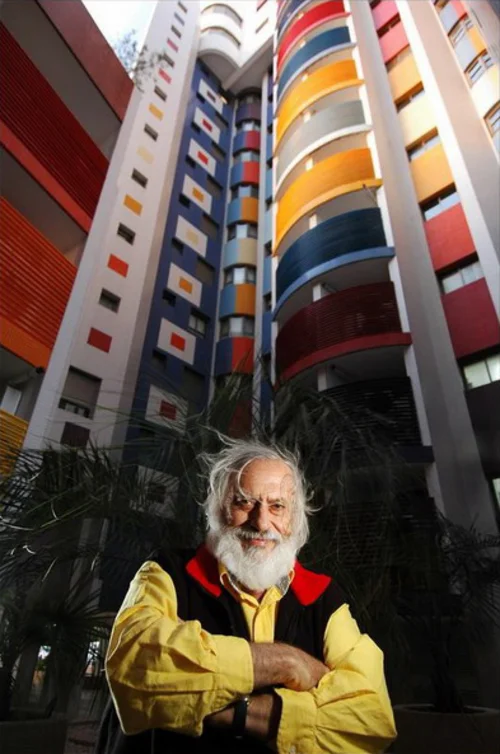
Israeli artist Yaacov Agam, whose pioneering explorations of movement and perception helped define kinetic art in the postwar era, died on June 21st at age 98.
Born in Rishon LeZion, then part of British Mandate Palestine in 1928, Agam was raised in a religious household by his father, a rabbi and kabbalist. He studied at the Bezalel Academy of Art and Design in Jerusalem before continuing his education in Zürich under Bauhaus painter Johannes Itten. In 1951, Agam moved to Paris, where he developed the visual language that would make him a pioneering figure in kinetic and optical art. His work has been shown in significant museums around the world, in particular, the Museum of Modern Art’s major 1964 show of optical art, “The Responsive Eye.”
Throughout his practice, Agam rejected the notion of images as fixed. Across paintings, sculptures, fountains, and architectural commissions, he created works that changed according to the viewer’s position, frequently incorporating light, color, sound, and physical participation. His lenticular works, known as “Agamographs,” invite viewers to experience multiple images and realities within a single artwork, shifting perceptions.
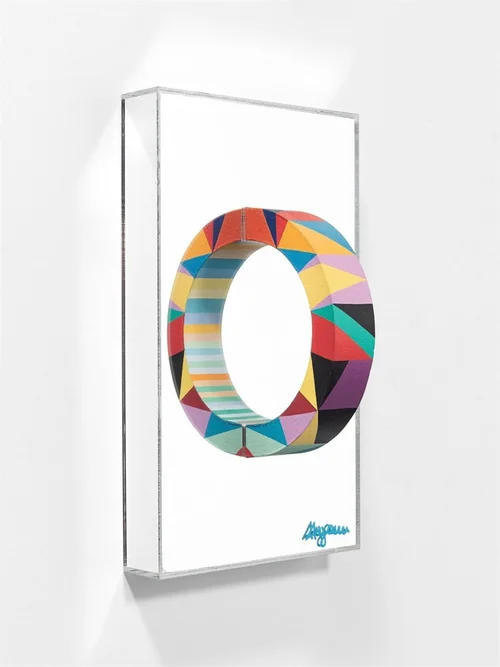

Untitled, 1982
Yaacov Agam
Janet Rady Fine Art
Over the course of his career, Agam realized numerous public commissions, including the Fire and Water Fountain in Tel Aviv’s Dizengoff Square and a monumental fountain at Paris’s La Défense business district. He is also behind the design of the world’s largest menorah; standing 32 feet tall, it has been a prominent fixture in New York City’s annual Hanukkah celebrations since 1977. Just months before his death, Agam also received the 2026 Israel Prize for Visual Arts, the country’s highest cultural honor.
In 2017, the city of Rishon LeZion opened the Yaacov Agam Museum of Art, a permanent institution dedicated to the artist’s work and artistic philosophy. Following news of his death, Ruth Maccabee, the museum’s director and chief curator, said in a statement that Agam was “one of the rare artists who managed to change the way we perceive art.” She added: “He didn’t just create works; he created a new way of looking at the world. For him, movement, time and change were the heart of the work, and the viewer was an active partner in its completion.”


