





This year’s Venice Biennale is awash with controversies: the cancellation and subsequent reinstation of Australia’s representative artist Khaled Sabsabi, ongoing calls to bar Israel from participating, and the Biennale’s highly criticized decision to allow the Russian Federation to participate. More recently, voices have mounted to exclude the U.S. in response to President Donald Trump’s warmongering in Iran.
But art goes on. Some of the city’s most exciting shows will take place away from the Giardini’s politically charged atmosphere. Artists including Lorna Simpson and Marina Abramović are returning to Venice, while others get their debuts in generous solo shows. This year, large spaces across the city will also celebrate a number of Black and Indigenous artists for the first time. Here is our roundup of the best shows to see alongside the 61st Venice Biennale, which opens on May 9th.
Marina Abramović
“Transforming Energy”
Gallerie dell’Accademia
May 6–Oct. 19
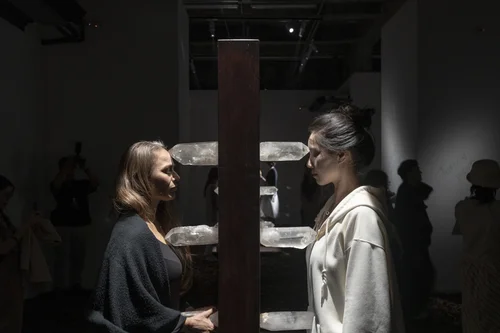

Marina Abramović is forever making history. This year, she will be the first living woman artist to have a dedicated exhibition at the Gallerie dell’Accademia, almost 30 years after she became the first woman to win the Golden Lion for Best Artist at the 1997 Venice Biennale.
“Transforming Energy” debuted at Shanghai’s Museum of Modern Art last year. The museum’s artistic director Shai Baitel is curating the Venice iteration in close collaboration with Abramović. It extends across both the museum’s permanent and temporary exhibition spaces (in another first for the institution) and puts her work in dialogue with Renaissance masterpieces. The show’s major pairing juxtaposes her 1983 photograph Pietà (with Ulay) with Titian’s final, unfinished canvas Pietà (ca. 1575–76). Palma Giovane completed the work, which celebrates its 450th anniversary this year.
“Peggy Guggenheim in London: The Making of a Collector”
Peggy Guggenheim Collection
Apr. 25–Oct. 19


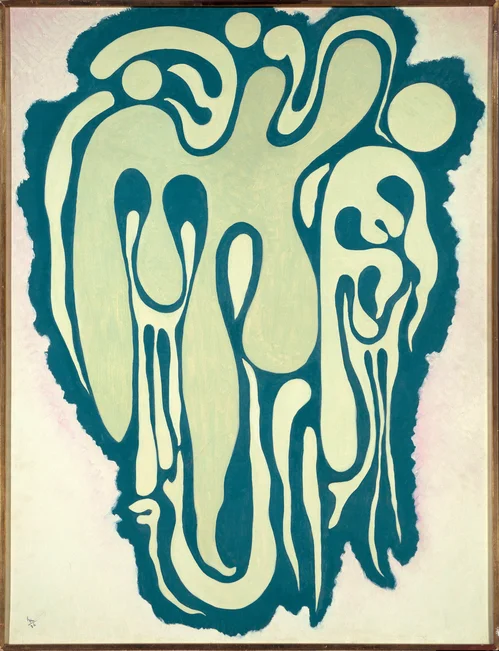

Before the Palazzo Venier dei Leoni, there was 30 Cork Street, where a young Peggy Guggenheim opened her first gallery, Guggenheim Jeune, in London in 1938. It was active for a whirlwind 18 months, showing controversial works by Salvador Dalí, Jean Cocteau, and Wassily Kandinsky, as well as a teenage Lucian Freud—artists with whom Guggenheim would forever be associated. Although popular with critics and the public alike, the gallery leaked money and was forced to close at the outbreak of World War II, whereupon Guggenheim whisked her valuable collection overseas, away from the Blitz. But those audacious shows had a considerable impact on the London art world, pushing the limits of what was considered contemporary art at the time. Now her trailblazing taste is finally getting due attention in an exhibition at the Peggy Guggenheim Collection, which will then head to London’s Royal Academy of Arts in the fall and the Guggenheim New York in 2027.
Lorna Simpson
“Third Person”
Punta della Dogana
Mar. 29–Nov. 22
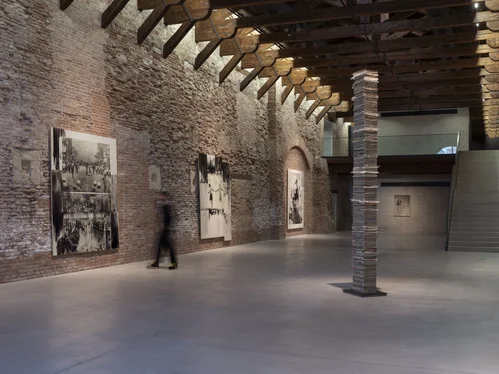

Choosing arguably the biggest event on the global arts calendar to debut a completely new medium in your practice is an audacious—and risky—move. Yet that’s exactly what the American artist Lorna Simpson did at the 2015 Venice Biennale with a series of moody, cloud-hued paintings of ghostly figures. Some of those paintings will return to Venice in this exhibition—the largest she’s ever had in Europe—alongside collages, video, installations and sculptures. This show had its first outing as “Source Notes” at the Metropolitan Museum of Art last year and has since been updated with artworks made especially for the Punta della Dogana’s unique space.
Michael Armitage
“The Promise of Change”
Palazzo Grassi
Mar. 29–Jan. 10, 2027
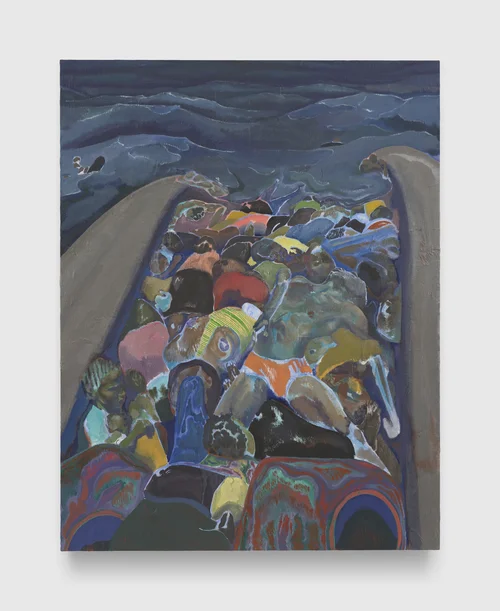

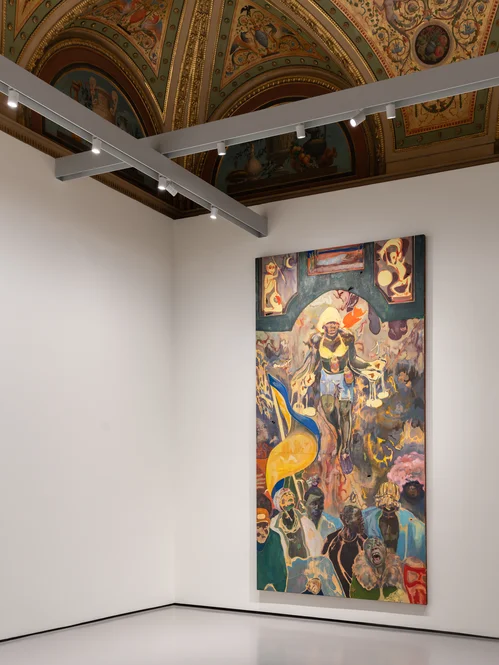

Kenyan British artist Michael Armitage’s arresting, uncompromising paintings are the subject of a major exhibition at the Pinault Collection’s second site in Venice, Palazzo Grassi. Forty-five paintings and more than 100 studies present a brutally truthful look at conflict, social upheaval, and tragedy, usually in the context of East Africa. Armitage paints with oil on Lubugo bark cloth—a deliberate rejection of the Western tradition of painting on canvas—and creates dense, sensual scenes with a vibrant, sometimes tropical, color palette. His paintings tackle hard subjects: street violence during political rallies, people drowned in migration attempts, or images from the 2020 COVID-19 lockdown. Armitage’s unique pictorial language combines the harsh reality of these daily scenes with dreamlike landscapes and abstract forms.
Amoako Boafo
Museo di Palazzo Grimani
May 9–Nov. 22
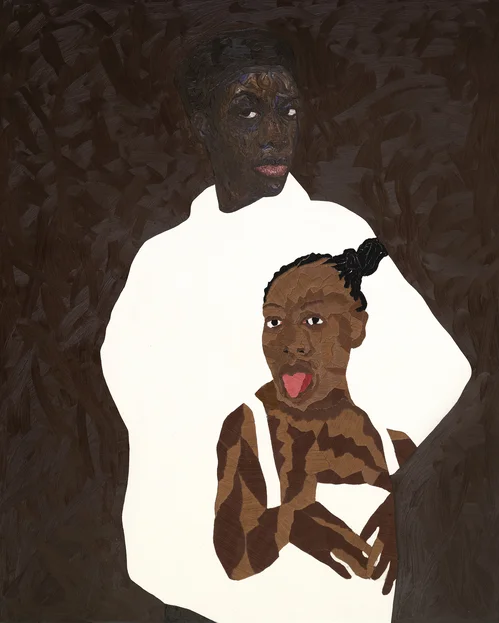

Amoako Boafo’s meteoric career is still on the rise. The Ghanaian painter shot to art world acclaim when Kehinde Wiley discovered his portraits on Instagram in 2018 and tipped off galleries that Boafo was one to watch. By February 2019, his works were selling at Frieze Los Angeles. Before long, mega-dealer Larry Gagosian dubbed him “the future of portraiture,” thanks to his colorful, gestural compositions for which he uses his fingers to paint his subjects’ skin. Boafo subsequently became the first African artist to develop a fashion line with French fashion house Dior.
Now the Museo di Palazzo Grimani will host Boafo’s first solo exhibition in Italy, placing his contemporary portraits of Black subjects in dialogue with the medieval palazzo’s collection of Renaissance portraits. This is the second time that Gagosian has collaborated with the museum: Boafo’s work follows a show by Georg Baselitz that was installed in 2021 and later made permanent. The artist will create a series of new works expressly for this show.
Jenny Saville
Ca’ Pesaro
Mar. 28–Nov. 22
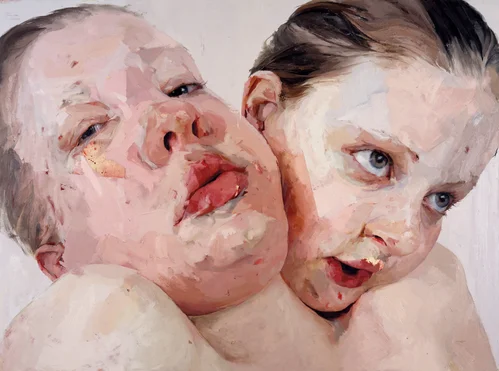

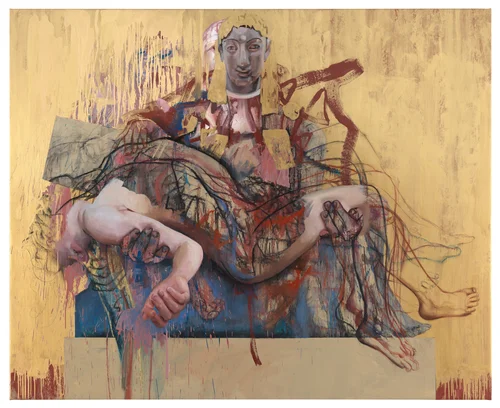
Gagosian also has a hand in painter Jenny Saville’s landmark show at Venice’s Ca’ Pesaro International Gallery of Modern Art, the city’s first major exhibition of her work. It follows her acclaimed retrospective “The Anatomy of Painting,” at London’s National Portrait Gallery last year. Many of the same monumental canvases will be on display, as well as a collection of never-before-seen works made especially for the final room in this show. The exhibition will trace the development of Saville’s painting practice, from the enormous nudes that made her name during the YBA era, to her recent abstract experimentations and borrowings of imagery and names from mythology or literature. Expect big, blowsy, sensual close-ups and visceral representations of the body in all of its grotesquery.
Arthur Jafa and Richard Prince
“Helter Skelter”
Fondazione Prada
May 9–Nov. 23


Arthur Jafa and Richard Prince are an obvious pairing. Both American artists mine images from popular culture and mass media for use in their artworks. Curator Nancy Spector even describes them as “image scavengers” in the show notes—vultures who cherry-pick from society’s relentless flood of images and visual stimulation, transforming their findings into art in the style of Marcel Duchamp’s readymades.
This exhibition is a broad exploration of American culture and what it means to be American, hopping between a variety of media, from photography and film to sculptures and painting. Both artists have created work from opposite sides of a spectrum: Jafa has examined Black American identity throughout his career, notably in his celebrated film Love Is the Message, the Message Is Death (2017), and Prince has explored the unvarnished underbelly of white America. The two men collaborated for this show, sharing images with each other and creating a zine that will be displayed alongside new work by each artist.
Joseph Kosuth
“The-exchange-value-of-language-has-fallen-to-zero”
Berggruen Institute Europe, Casa dei Tre Oci
Mar. 28–Nov. 22
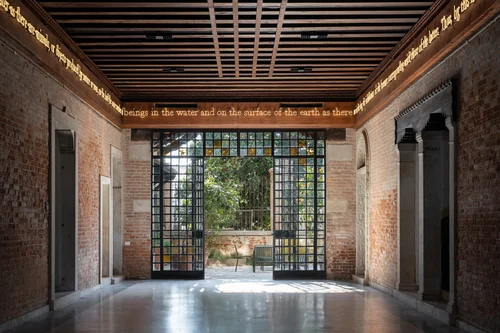
The American conceptual artist Joseph Kosuth has a long-standing relationship with the city of Venice. In fact, he’s participated in eight Biennales (including his 1993 representation at Hungary’s pavilion) and has artworks permanently on display in two Venetian institutions, the Querini Stampalia and Ca’ Foscari University. Now his work is crossing the water to Berggruen Arts & Culture’s outpost on the island of Giudecca, in the grand Casa dei Tre Oci. The exhibition begins with a newly commissioned neon artwork that wraps around the ground floor, before continuing upstairs with a selection of photographs, texts, and installations that examine the process of how we infer meaning from language. Some of Kosuth’s seminal works are on display, including the maddening brain teasers printed on index cards in The Fifth Investigation (1969) and Text/Context, his 1979 work that used billboards as exhibition space.
Repatriates Collective
“Tide of Returns”
Ocean Space
Mar. 28–Oct. 11
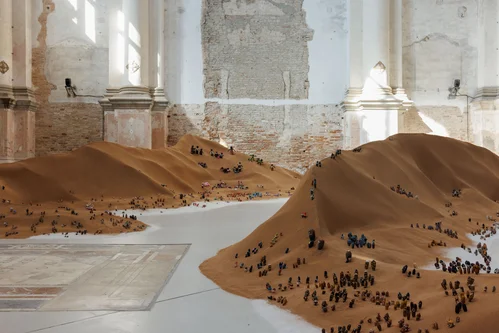
Every year, Ocean Space transforms the deconsecrated San Lorenzo church into an alternate landscape, filling the swooping space under its arches with large-scale installations, video art, and performances. This year, mounds of sand snake their way through the first hall of the church, dotted with figures made from painted shells. This is the work of Repatriates Collective, a group of artists who promote the return of cultural objects to Indigenous communities around the world. The Benin bronzes or the Elgin marbles are frequently in the news regarding questions of ownership and belonging, but we forget smaller symbols of ritual; here, the Dadikwakwa-kwa (shell dolls). An accompanying film shows Indigenous women tending these shell dolls on the dark red beaches of the Gulf of Carpentaria. Performances and soundscapes recreate this traditional ritual, in a space that straddles the contemporary and the ancient.
Lee Ufan
SMAC Venice
May 9–Nov.22
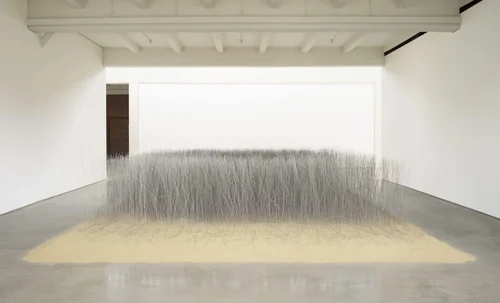

Lee Ufan’s retrospective at San Marco Art Centre (SMAC) on St. Mark’s Square, one of 31 official collateral Venice Biennale events, is pegged to the South Korean artist’s 90th birthday and celebrates seven decades of his creative practice.
A new, site-specific commission is at the heart of the show, which is staged across eight galleries and takes the visitor through the arc of Ufan’s career as a leading figure of the Japanese Mono-ha movement. One highlight is his sculpture Relatum (formerly Iron Field) (1969/2019), a bed of iron rods nestled in sand, looking as wispy and delicate as a sea of algae despite its solid materiality. The show ends with new paintings characterized by bold brushstrokes and thick, minerally bands of color.


