


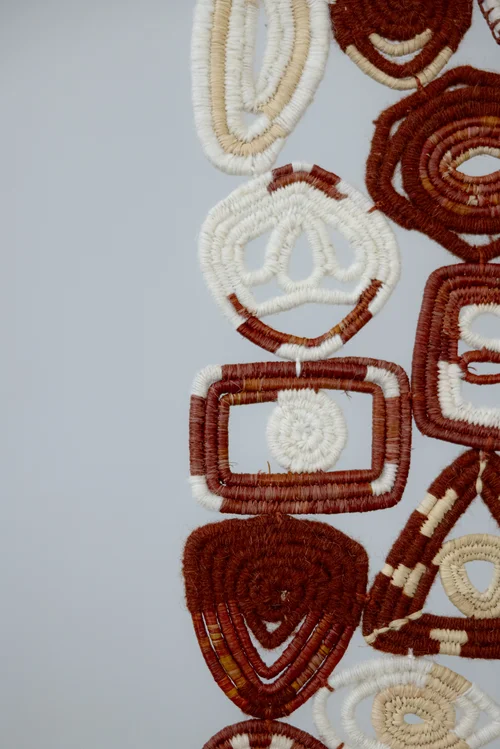
The loom has always been a form of thinking. For centuries in North Africa, weavers have articulated narratives and philosophies through colorful, patterned rugs. They use a grammar of signs, stitches, rhythm, color, and designs to communicate.
While these tapestries were once diminished by academia and the avant-garde as mere “womanly craft,” contemporary artists from the Maghreb region in Northwest Africa are transforming the medium in ways that both honor and update longstanding traditions. Many grew up around looms and recall their grandmothers’ hands on raw wool, their mothers’ crochet, or the cooperative workshops in their region. They attend to the labor, gestures, and knowledge that lived in the bodies of their women ancestors. Finally, biennales, fairs, and museums around the world are starting to catch on.
Here are five of the most exciting contemporary artists inspired by Moroccan rugs and North African weaving.
Amina Agueznay
B. 1963, Casablanca, Morocco. Lives and works in Marrakech, Morocco.
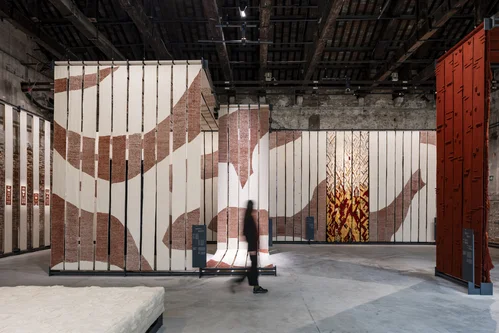
“Weaving is both sculpture and heritage, tactile and insulating,” Amina Agueznay told me days before the opening of her pavilion at the 61st Venice Biennale, where she is representing Morocco. “It’s an amazing medium for improvisation.”
The title of Agueznay’s monumental presentation, Asəṭṭa (2026), comes from the Amazigh (a Berber tribe) word for ritual weaving. Asəṭṭa, which was curated by Meriem Berrada and developed through workshops and on-site research with artisan communities across Morocco, centers on the concept of âatba: the threshold.
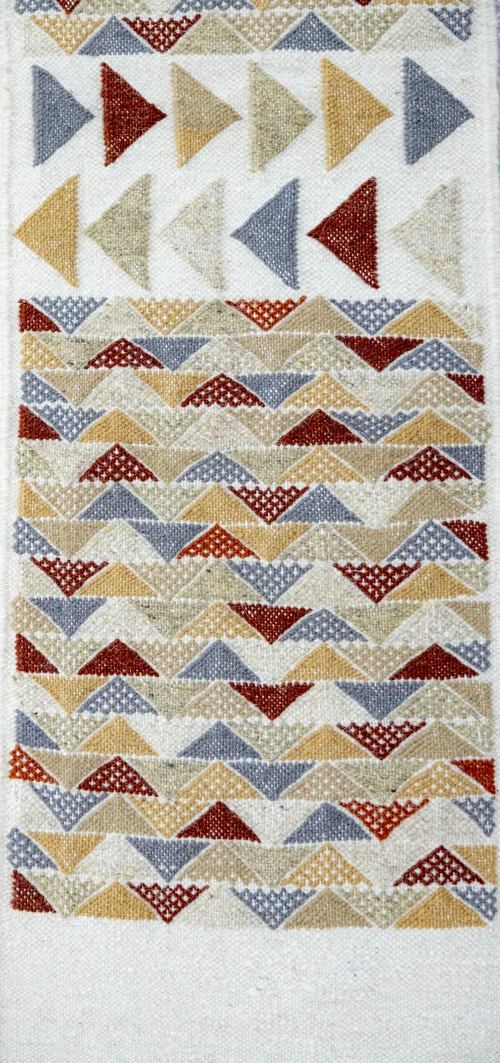
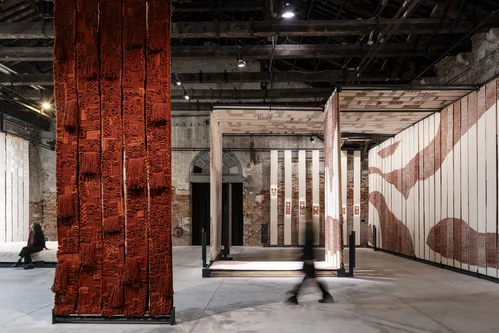
In the Arsenale, the artist has mounted more than 150 wool panels, woven on vertical looms and stitched with raffia, which cascade from the ceiling. From afar, they resemble Japanese scrolls. Up close, they reveal composite surfaces threaded with Murano glass, metallic filaments, and materials native to the North African craft tradition. Visitors settle into an expansive woven sofa, contemplate the fabric, and become part of the composition.
“Palm husk, wool, natural fibers…these materials have been used by artisans from different regions in their vocabulary, and together they form my lexicon,” Agueznay said.
The artist trained as an architect in Washington, D.C., before returning to Morocco in 1997. She presented her first monumental installation, titled Skin, in 2016 at the Museum Mohamed VI of Modern and Contemporary Art in Rabat, Morocco. The work emerged from a workshop the artist organized in Bouznika, a fishing town on Morocco’s Atlantic coast, where Agueznay collaborated with a group of craftswomen skilled in crochet, knitting, weaving, macramé, braiding, embroidery, and beading. The resulting sculpture, composed of recycled fishing nets interwoven with twine, wires, sequins, and paper, documented a social process and collective female knowledge.
Agueznay has now worked with artisans for almost two decades. She sees this process as a sacred act, requiring her to leave her ego at the door. “It’s about communicating with gestures, drawings, individual kindnesses, and encouragements, embracing flaws, understanding matter,” she said.
Ghizlane Sahli
B. 1973, Meknes, Morocco. Lives and works in Marrakech.
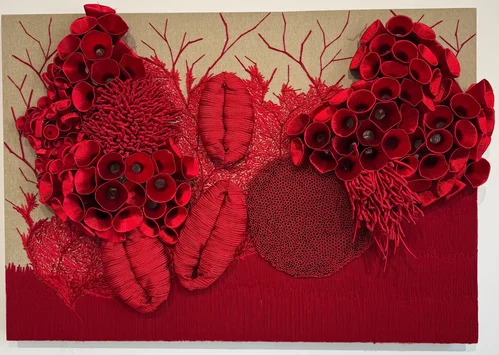
The Flows that Weave us 04, 2025
Ghizlane Sahli
Galerie le sud
A weaver once told Moroccan artist Ghizlane Sahli: “From the womb, a girl from a weaving tribe feels the rhythm of the loom. As a baby at her mother’s breast, she is surrounded by the scent of raw wool.”
Sahli, who initially trained as an architect in Paris, has similarly connected with textile practices via matriarchal traditions. Femininity and the body became central to her artistic language, which embraces softness, repetition, and time.
“My mother, who used to sew and knit, transmitted this early sensitivity and love for textiles through everyday gestures that were both simple and meaningful,” Sahli said. “These domestic practices formed an intimate environment in which threading became something natural and familiar.”
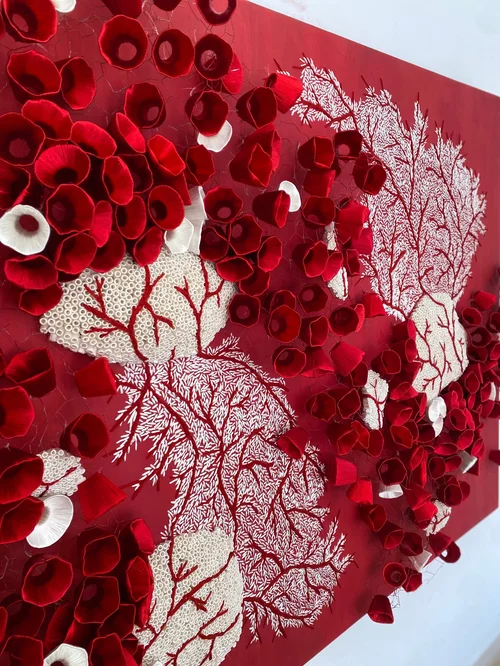
Et la sève fut… 8, 2023
Ghizlane Sahli
Christophe Person
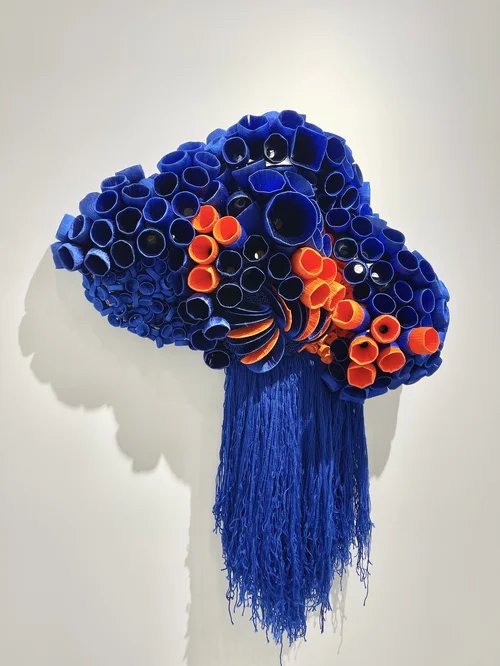
La Mer, Origine du Monde (MOM 021), 2021
Ghizlane Sahli
Firetti Contemporary
Sahli spent years working alongside local artisans in embroidery ateliers in Morocco. “Our relationship is based on respect, trust, and love,” she said. “It creates a space of exchange where knowledge circulates horizontally rather than hierarchically.” Such collaboration connects and passes knowledge through different generations of women.
The artist is best known for her “Alveoles,” elements in her sculptural compositions made from recycled plastic bottle caps, which the artist wraps and assembles with silk thread. They resemble membranes, tissues, protective skins, sea anemones, or bulging coral as they evoke the fragility of the human body and the vulnerability of the natural world. Sahli first presented her “Alveoles” in Metamorphosis, a 2014 installation at Dar Bellarj in Marrakech.
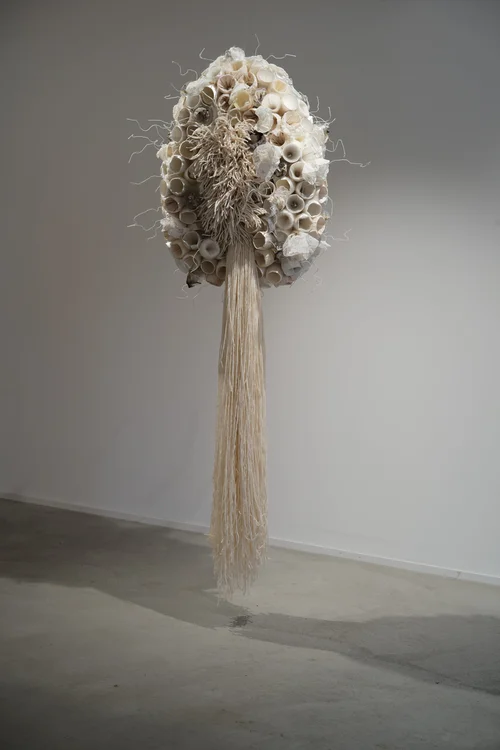
L'Affranchie, 2023
Ghizlane Sahli
Galerie le sud
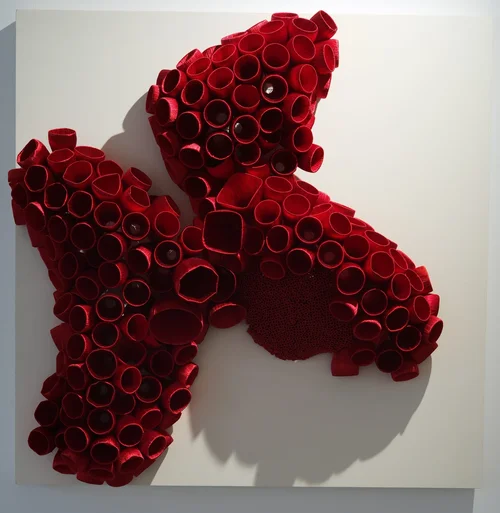
Histoires de tripes HT052, 2019
Ghizlane Sahli
Galerie le sud
In recent years, the artist has shifted from a near-monochromatic register to a palette that embraces color, warmth, and celebration. This is evident across her newest work, which she’ll exhibit in "Flowers also grow in Water, where Bodies are born…,” her upcoming December 2026 show at Atelier 21 in Casablanca. “Perhaps this is a response to the chaotic world we are living in today,” she said.
This year, the artist’s monumental piece Fields of Roses (2026) was also installed in the atrium of the new U.S. Consulate in Casablanca.
Mina Abouzahra
B. The Netherlands. Lives and works in Amsterdam and Morocco.
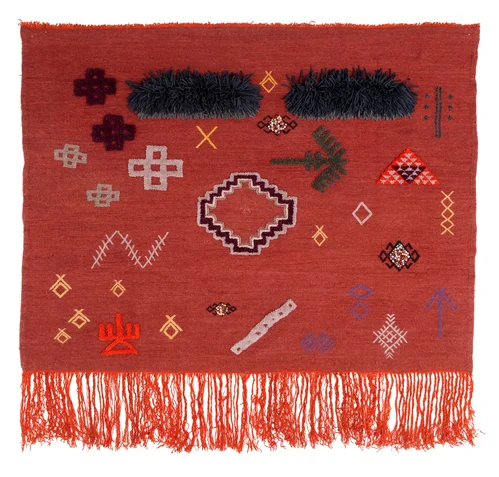
Brick Wall tapestry (One and a half Women), 2026
Mina Abouzahra
Rademakers Gallery
Mina Abouzahra’s motto is: A rug is never just a rug. “In the Amazigh tradition, it represents a document, a record of life, woven with symbols and colors that carry meaning across generations. To reduce it to a commodity is to erase the person who made it,” the Dutch-Moroccan artist said.
Abouzahra’s geometric, minimalist, and playful work unites elements of Dutch contemporary design with Moroccan forms. The artist recently discovered that both her grandmothers had been weavers. “I was stunned my mother had never mentioned it before,” she said. “When she said those words, everything fell into place.”
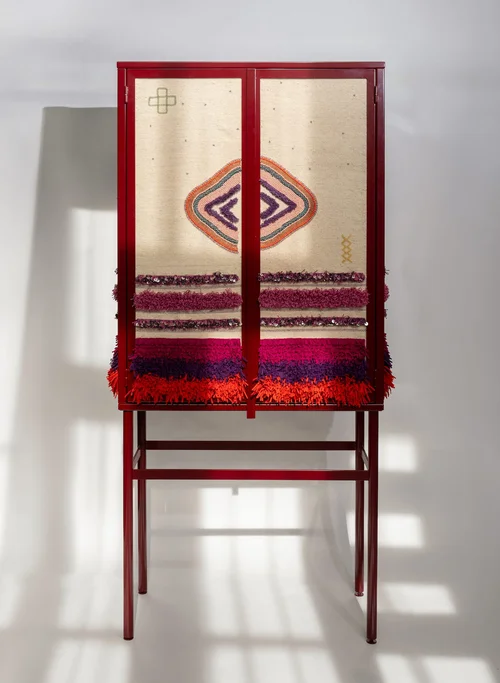
Roukia no.2, 2024
Mina Abouzahra
Rademakers Gallery
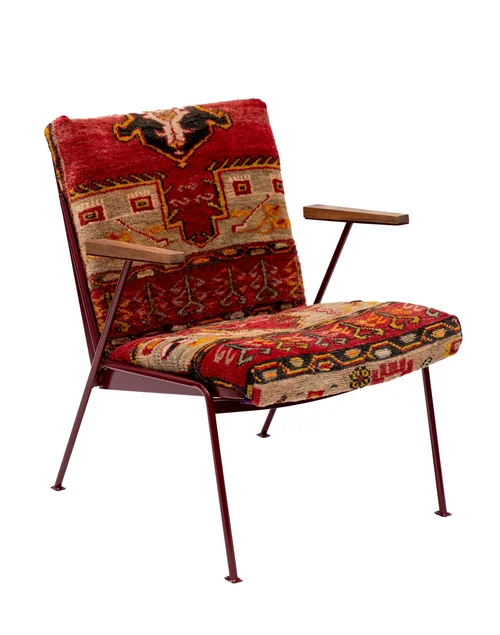
Ghada Samman Chair, 2026
Mina Abouzahra
Rademakers Gallery
In 2023, the artist participated in a year-long residency at a weaving cooperative in Taznakht, Morocco. Her work grew into “The Soul of a Rug,” an immersive exhibition that debuted at the 1-54 Contemporary African Art Fair Marrakech in 2025. It consisted of a 360-degree virtual reality film that documented the full arc of rug production in Taznakht. The artist also included meaningful objects, including a woven letter, created in the Amazigh bridal tradition, which served as communication between a newly married young woman and her family of origin.
Abouzahra’s approach is political. She feels a deep tension between the intimacy of her handmade work and the brutality of the global market. To counteract those pressures, she collaborates directly with cooperatives and insists on fair compensation and shared authorship.
The artist is currently preparing for a solo exhibition at the Gouda Museum in the Netherlands, opening September 2026. She has started weaving on a Jacquard machine, which allows for both precision and intimacy.
Amira Lamti
B. 1996, Sousse, Tunisia. Lives and works in Sousse.
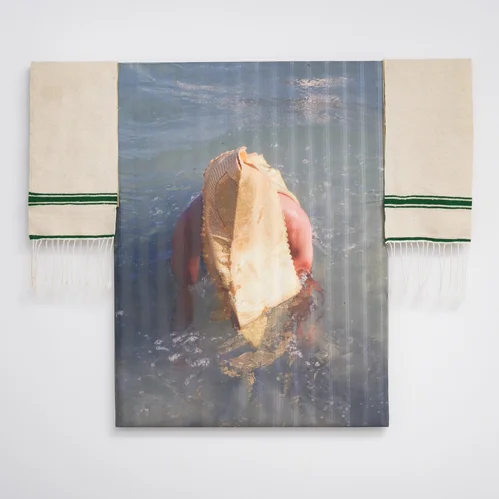
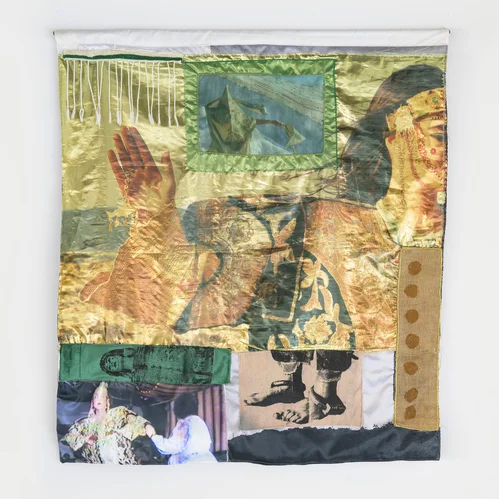
Amira Lamti’s practice excavates the ritual knowledge of North African women. “Weaving and traditional craft have mostly been transmitted orally; there are no traces to follow,” she said. “It’s a subject that allows you to go toward people and listen to stories, and sometimes it’s really the mystical that takes over.”
The artist trained in photography and video at the Institut Supérieur des Beaux-Arts de Sousse. While she started working primarily with photography, video, installation, and performance, textile has rapidly become one of her media of choice.
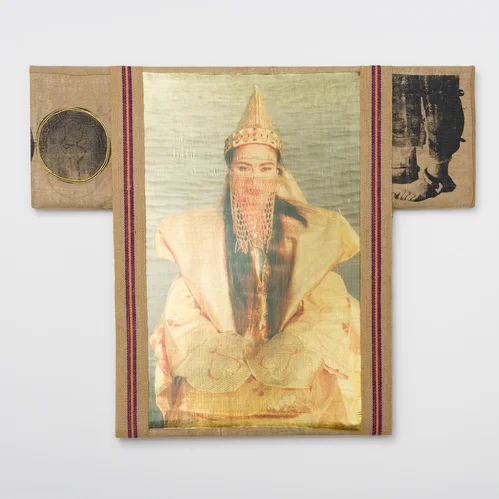
Lamti structured her exhibition “Bent el Machta”—or “Daughter of the Machta”—presented at the Yosr Ben Ammar Gallery in Tunis, Tunisia, as part of the 2024 Biennale Jaou, around a figure both intimate and mythic: the machta, or the woman who prepares a bride for the ritual Jelwa ceremony, in which the bride dances in circles while wearing a traditional, heavily embroidered golden garment.
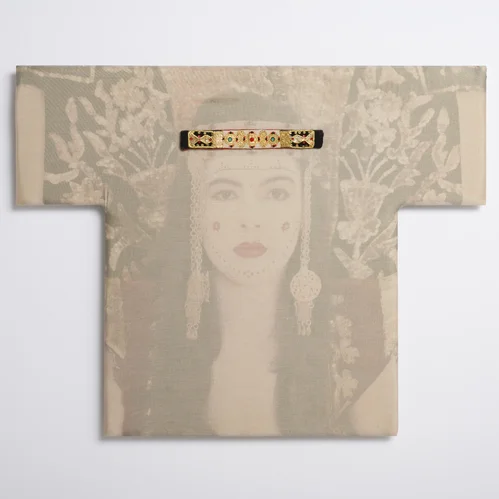
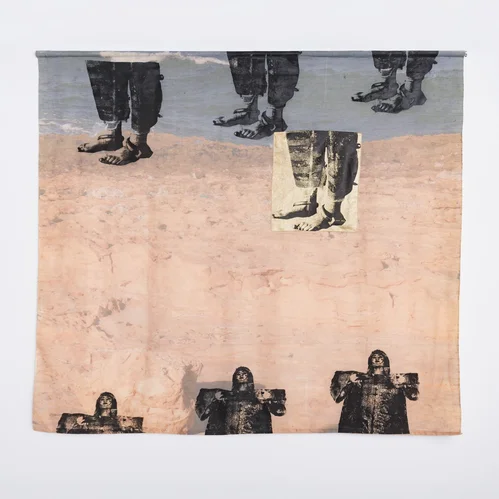
Lamti often prints her own photographs onto traditional Tunisian sefseri, ivory veils woven from silk or fine wool. In her installations, she unites these pieces with archival footage from her family’s VHS cassettes, which documents Outia ceremonies (similar to bridal showers) across generations.
The artist is currently in residence at the Tassarout cultural association in Rabat, making a new body of work that similarly blends textile and photography. At its center are the female Sufi saints of Morocco who, in coastal mythology, protected sailors and fishermen from harm.
Work from “Bent el Machta” will be shown this summer at Les Rencontres d’Arles, the annual summer photography festival in Arles, France.
Amina Saoudi Aït Khay
B. 1955, Casablanca. Lives and works in Akouda, Tunisia.
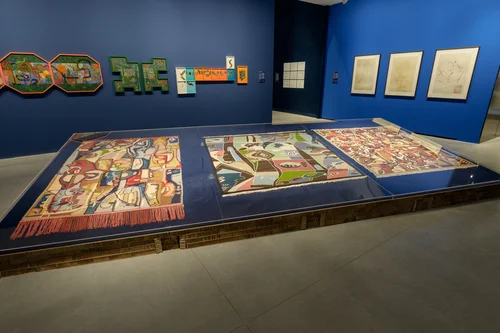
A former physics and chemistry teacher in Casablanca, Amina Saoudi Aït Khay started making art in 1994. She began painting on silk, then transitioned into weaving: “I felt the need to reclaim the artisanal know-how I had acquired at a very young age behind my mother’s loom,” she said. “She was a great traditional weaver, and she initiated my brother and I to help her out.”
2026 has been a major year for the artist, whose work featured in the Diriyah Contemporary Art Bienniale and is now included in the 61st Venice Biennale.
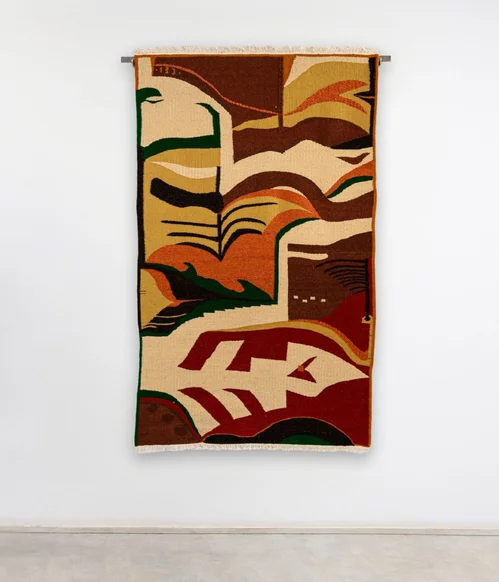
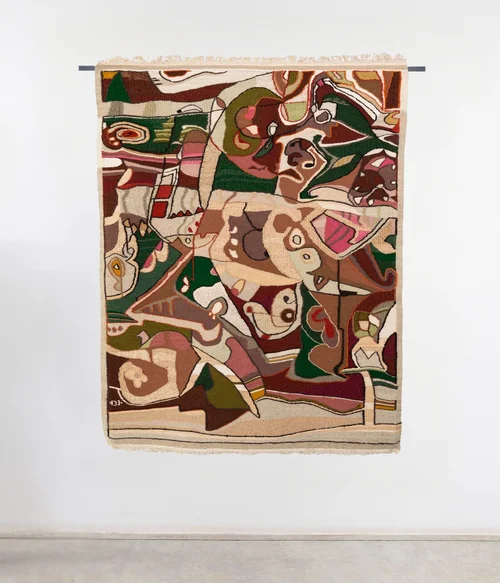
Saoudi Aït Khay initially followed tradition, then decided to weave without a cartoon, or weaving blueprint. “I adopted an approach based on improvisation, which is quite unconventional,” she said.
The results are tapestries that often look like abstracted landscapes: They’re large, with warm tones, built from irregular forms, which the artist describes as “an organic living body.”
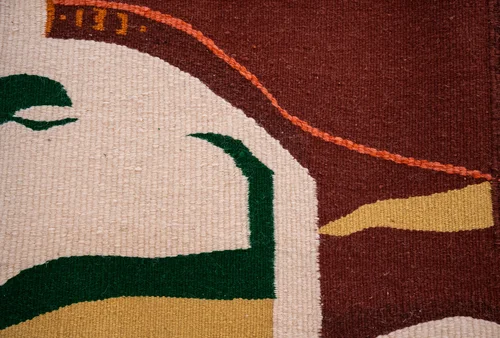
Saoudi Aït Khay was invisible to the larger cultural scene for many years. The Tunisian art world of the 1970s and ’80s viewed her tapestries as neither functional craft nor recognizable art. Over time, her works’ “in-betweenness” became their value, especially as the international art community took an interest in textile art and Tunisian contemporary art rooted in tradition. The artist’s work became part of the collections of the Guggenheim Abu Dhabi, the Barjeel Art Foundation, and the National Museum of Modern and Contemporary Art in Tunisia.
Saoudi Aït Khay produces only two or three tapestries a year, and over 20 years, her oeuvre has grown to around 30 works.
