


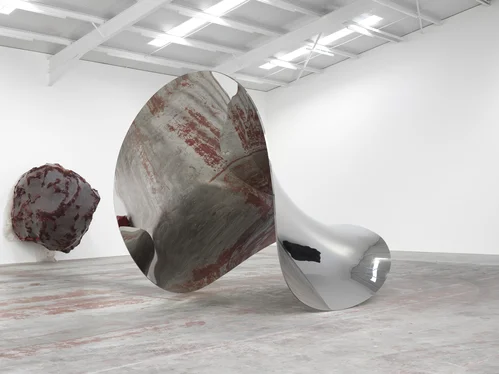
Anish Kapoor is renowned across the world for his light-absorbing and reflective artworks that probe the limits of perception. For more than four decades, his paintings and sculptures have employed a wide array of materials to explore how we experience color, space, and scale.
Institutions across Europe are celebrating Kapoor’s distinctive approach this summer. Through mid-October, the Hayward Gallery in London is presenting a major retrospective of Kapoor’s practice, encompassing paintings and sculptures from across his career as well as colossal new installations. Further large-scale exhibitions of his work are simultaneously being held in Venice at the Palazzo Manfrin, which houses the artist’s foundation, and in Duisburg, Germany, at the Lehmbruck Museum.
Born in Mumbai in 1954, Kapoor moved to London to attend art school in the 1970s, the heyday of the “New British Sculpture” movement. His early works—geometric forms covered in vibrant powdered pigment—showcased his unique take on postminimalist abstract sculpture, as well as a burgeoning interest in the interplay between materiality and perception which continues today.
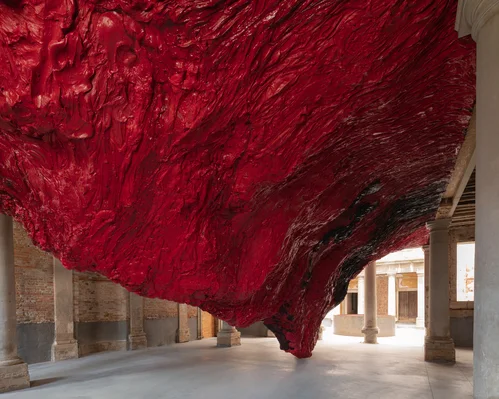
In 1985, Kapoor began experimenting with concave wall-bound “voids,” mysterious cavities which, rather than empty, appear full of negative space. This shape became a starting point for him to explore two extremes of illusion—reflection and its opposite, absorption. Both inside the gallery space and outdoors, Kapoor started executing beguiling mirror-like pieces out of polished metal which distort the space around them. He also pushed the limits of the light-absorbing qualities of dark pigment, even controversially purchasing exclusive artistic rights to “Vantablack” in 2016. (Known as the world’s “blackest black,” the material captures 99.96 percent of visible light.) Kapoor’s interest in the relationship between form and space has also led to visceral paintings and site-specific installations, such as a massive block of red wax which the artist famously spread through the galleries of the Royal Academy of Arts in London.
Kapoor is one of the most influential artists of his generation, and his preoccupation with perception has challenged artists across the globe to explore the spatial and material boundaries of their work. Here are eight artists who, like Kapoor, encourage us to reconsider with fresh eyes the physical and psychological experience of viewing art itself.
Simon Hitchens
B. 1967, Sussex, England. Lives and works in Somerset, England.
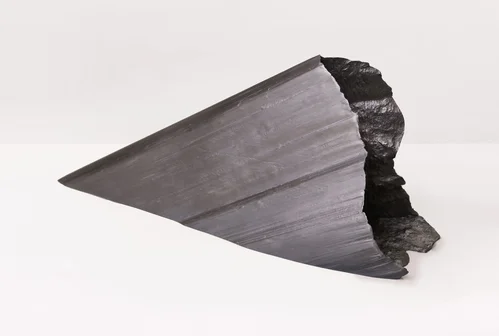
Casting a Shadow Over The Cambrian, 2022
Simon Hitchens
Anima Mundi
British artist Simon Hitchens creates monumental sculptures which push the boundary between presence and absence, reminiscent of Kapoor’s signature exploration of dualities. Indeed, Hitchens was directly inspired by Kapoor: in the 1990s, he even worked as an assistant carving stone sculptures in Kapoor’s studio.
Hitchens’s “Shadow” series are black concrete casts of the shadows cast by ancient boulders. Many of these works incorporate cave-like voids and polished reflective surfaces, echoing Kapoor’s manipulations of material surface and perception. “My sculptures subtly investigate the essence of the things we perceive: the physical world, nature, and our place within it,” Hitchens wrote in an artist statement.
A work from his “Shadow” series, Bearing Witness to Things Unseen (2025), was included in the 2025 edition of Frieze Sculpture, the annual outdoor display in Regent’s Park, London, that coincides with the U.K.’s biggest art fair. He is currently working on a controversial 180-foot-tall monument to Queen Elizabeth II in the north of England, which has generated substantial media interest.
Shirin Abedinirad
B. 1986, Tabriz, Iran. Lives and works in Utah.
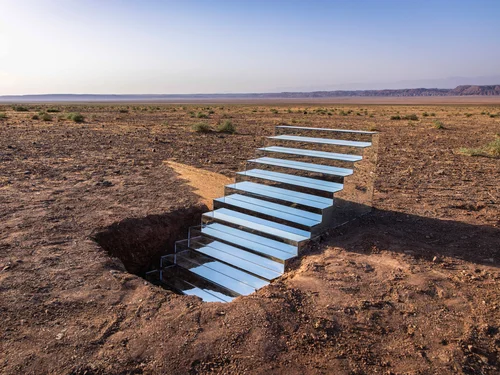
Dilemma, 2022
Shirin Abedinirad
Coalition for the Homeless Benefit Auction
Shirin Abedinirad is a U.S.-based Iranian artist whose large-scale mirror installations evoke Kapoor’s colossal optical illusions. She seeks to unite the natural world with ancient spirituality through reflective, site-specific land artworks which take the shape of architectural structures from the Ancient Near East, such as ziggurats and pyramids.
Like Kapoor’s disorienting sculptures, Abedinirad’s installations warp the environment around them by utilizing polished stainless steel to challenge human perception. The reflective surfaces of her works dissolve boundaries between earth, viewer, and sky, as well as serving a deeply symbolic purpose. “For me, the use of mirrors is integral to creating a paradise; mirrors give light, an important mystical concept in Persian culture,” Abedinirad explained on her website.
Recently, Abedinirad was an artist-in-residence at Kates-Ferri Projects, New York, which hosted a solo exhibition of her practice in April 2024. This year, she is completing a residency at the Watermill Center, in Water Mill, New York. Her works have been installed in public spaces across the world, including in the Central Desert of Iran; Golden Spike National Historical Park, Utah; Grand Rapids, Michigan; and Treviso, Italy.
Josiah McElheny
B. 1966, Boston, Massachusetts. Lives and works in New York City.
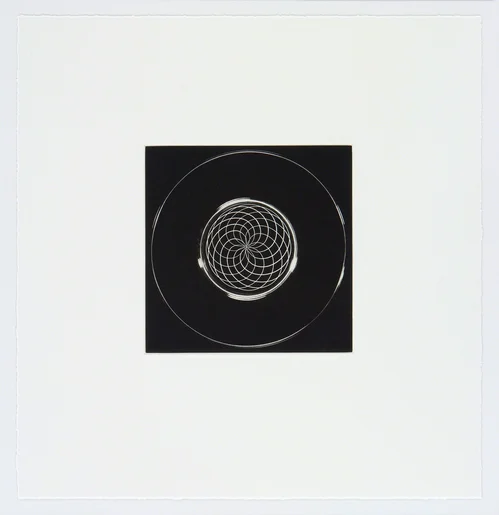
Studies in the Search for Infinity, 2011
Josiah McElheny
Graphicstudio USF
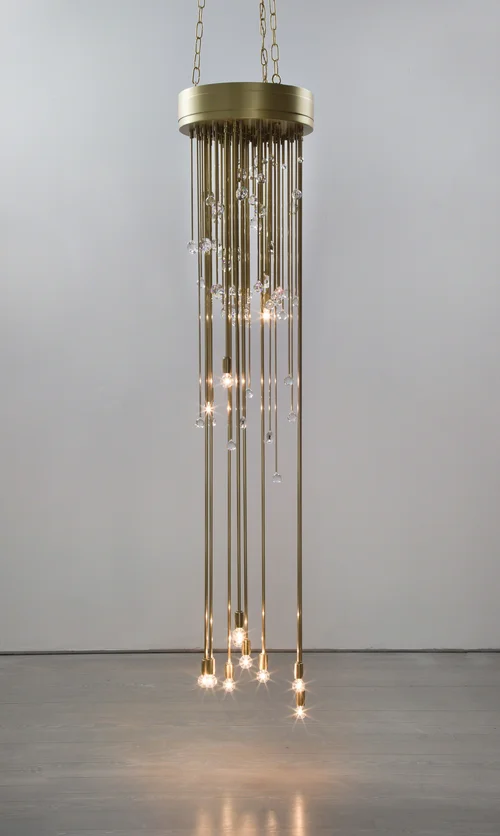
The Center is Everywhere, 2012
Josiah McElheny
White Cube
Josiah McElheny’s glass and metal sculptures also employ mirrored surfaces to disrupt spatial reality. The New York–based artist often uses mirrors to construct optical fields that appear to extend without limit, trapping viewers and sculptural forms in endless reflection.
McElheny shares with Kapoor an interest in how specific materials can unsettle our perception of space and evoke a sense of infinity. McElheny’s practice tends to explore the nature of reflection through serial arrangement and repetition, as opposed to Kapoor’s emphasis on monumental scale and density. In both cases, however, the artworks destabilize the viewer’s perception through movement and shifting vantage points.
McElheny studied at the Rhode Island School of Design and apprenticed with master glassblowers for nearly a decade. He has exhibited widely, with his most recent solo show at the Los Angeles County Museum of Art (2024).
Armen Agop
B. 1969, Cairo, Egypt. Lives and works in Pietrasanta, Italy.
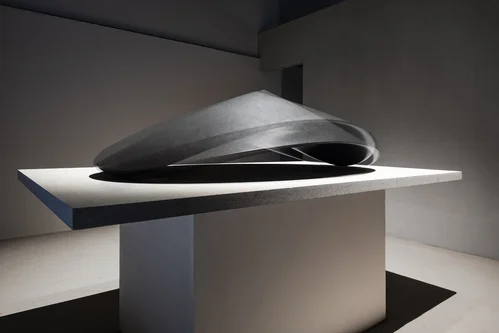
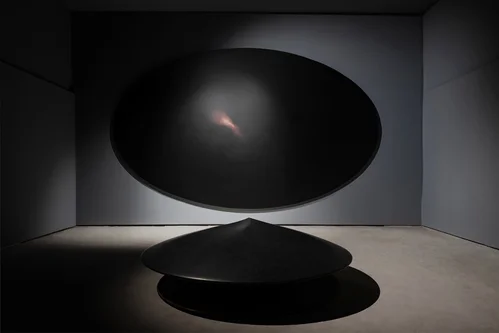
Armen Agop, who is currently representing Egypt at the 2026 Venice Biennale, sculpts black granite into abstract forms which exude a remarkable stillness. Like Kapoor, he has a deep interest in the void as an infinite depth and space of contemplation, rather than emptiness.
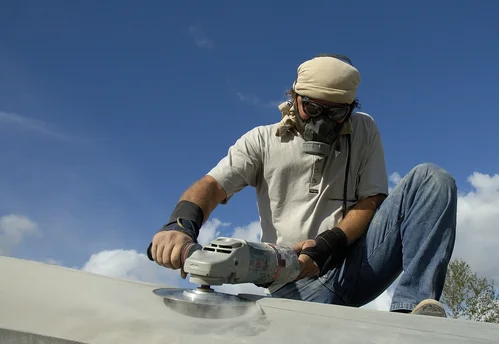
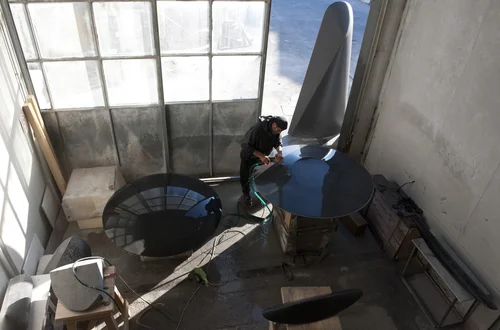
Born in Cairo to an Armenian family, Agop is now based in Pietrasanta, Italy, and draws inspiration from intersections in these cultural traditions. Pietrasanta is a historic town known for its marble sculpture workshops, while the artist’s use of black granite is a reference to ancient Egypt, which cherished the material for its durability. The result of a slow, labor-intensive carving process, Agop’s sculptures are intended to be experienced as meditative traces of time and are informed by Pharaonic spirituality’s emphasis on cosmic harmony and permanence.
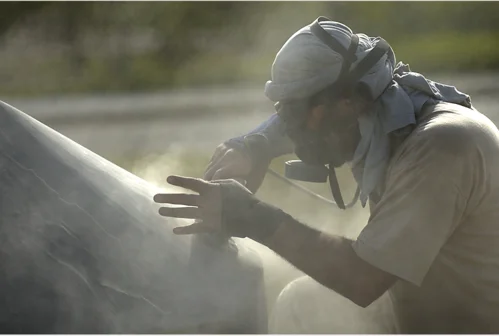
Agop’s works are held in several institutional collections, including the Saudi Arabia Museum of Contemporary Art; Mathaf, Doha; Barjeel Art Foundation, Sharjah, U.A.E.; and the Egyptian Modern Art Museum, Cairo.
Unyimeabasi Udoh
B. 1996, Chapel Hill, North Carolina. Lives and works in London.
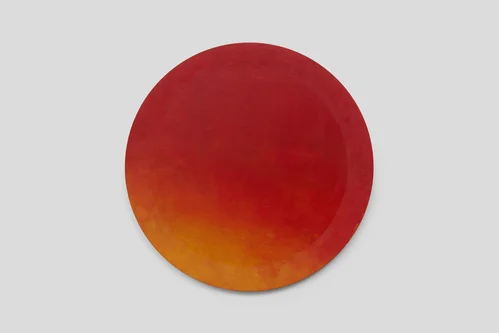
The London-based, Nigerian American artist Unyimeabasi Udoh shares Kapoor’s interest in absence and voids. Their work explores the tensions between visual form and meaning, drawing attention to the shapes and symbols that underpin everyday experience.
For “No Vehicles,” a new body of work that is currently on view at Alma Pearl, London, Udoh transformed road traffic signs into monochromatic abstractions. These pieces take the shape of the empty circle with a border, which serves as the official symbol to indicate that vehicles are prohibited on a specific street in the U.K. Made with cold wax medium, pigment, and iridescent glass beads, however, the “No Vehicles” works have no didactic purpose and instead evoke the sensory qualities of Kapoor’s “voids.” Like Kapoor, Udoh is concerned with how viewers perceive and create meaning from absence.
Since completing their MFA from the School of the Art Institute of Chicago in 2019, Udoh has had solo exhibitions at several contemporary art spaces in London, including Piccalilli, Kip, and Night Café.
Torkwase Dyson
B. 1973, Chicago. Lives and works in Beacon, New York.
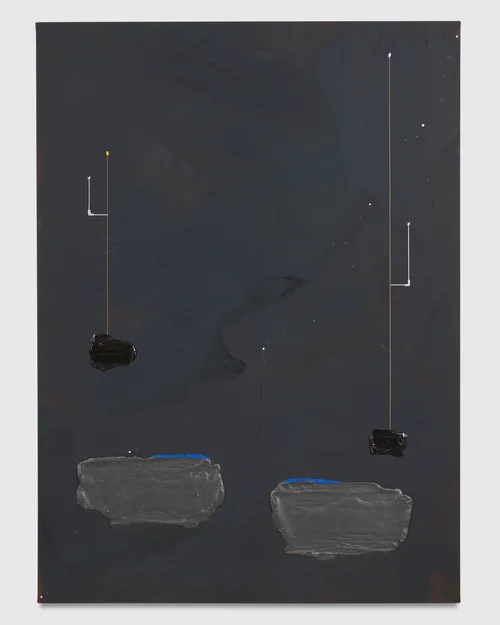
Blues 2 (Bird and Lava), 2026
Torkwase Dyson
Pace Gallery
Torkwase Dyson’s towering sculptures explore geometry, environment, and architecture. Like Kapoor, she is concerned with how space is perceived by the body, yet her work also insists that spatial experience is never neutral—especially for Black and Brown people.
Dyson’s work is composed of curvilinear and rectangular sculptures derived from architectural spaces that enslaved people in the U.S. adapted to escape slavery. Gesturing to waterways, attic spaces, and wooden crates, Dyson transforms strategies of resistance and liberation into powerful abstract forms.
The New York–based artist is currently included in the 2026 Carnegie International and the 2026 Venice Biennale international exhibition. Dyson’s multipart solo exhibition at the Kunsthaus Bregenz, Austria, will open in October 2026.
Jeppe Hein
B. 1974, Copenhagen. Lives and works in Berlin.
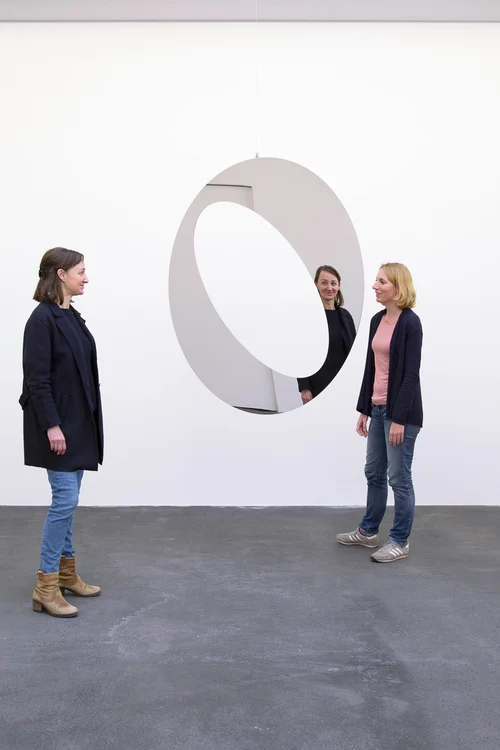
Rotating Mirror IV, 2018
Jeppe Hein
MARUANI MERCIER GALLERY
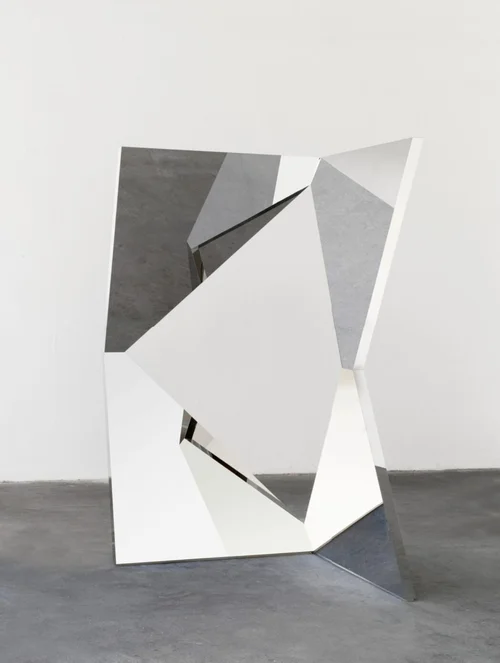
Twisted Geometric Mirror I, 2016
Jeppe Hein
Galería RGR
The Danish artist Jeppe Hein creates large-scale interactive sculptures and environments which, like Kapoor’s site-responsive works, use reflection and movement to explore the illusory possibilities of materials.
Hein is perhaps best known for his reflective installations, which frequently take the form of mirrored labyrinths, kinetic structures, and monumental polished surfaces that fold the surrounding environment back onto itself. Visitors drawn to Kapoor’s Cloud Gate may find a resonance in Hein’s Balance of Time (2023), a rotating stainless-steel sphere suspended above a Copenhagen rooftop, for example. Its mirrored surface continuously refracts the cityscape and warps the viewer’s perspective.
Hein’s sculptures and immersive environments can be found in museums and public spaces across the globe. He is currently based in Berlin.
Stella Zhong
B. 1993, Shenzhen, China. Lives and works in New York City.
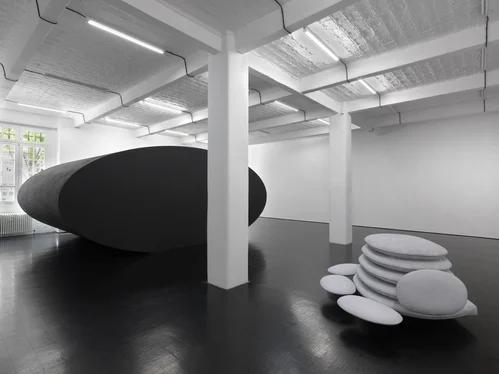
Like Kapoor’s monumental sculptures, Stella Zhong’s recent body of work is concerned with how scale shapes perception. Zhong experiments with large differences in size, from tiny sculptures to large, gallery-filling forms.
Accumulate into a New Star (2026), the centerpiece of her recent exhibition at Trautwein Herleth, Berlin, is an enormous cylindrical sculpture measuring nearly 20 feet long and over 13 feet wide. Coated in matte black paint, the work reduces form to its most elemental state: a surface that absorbs light and heightens sensory awareness. Dwarfing the viewer, the sculpture warps our perception of the space around it, evoking the disorienting pull of a black hole and recalling Kapoor’s own investigations into spatial illusion.
Before her exhibition at Trautwein Herleth, Zhong was included in group exhibitions at Para Site, Hong Kong; The Power Station, Dallas; Leeum Museum of Art, Seoul; and SculptureCenter, New York.
