


Biennials tend to be heightened moments of reflection on the state of the art world today, recurring blockbuster exhibitions that can also catapult an artist’s career. This year, several coincide, including the Venice Biennale and MoMA PS1’s “Greater New York,” as well as the Whitney Biennial, the Whitney Museum of American Art’s group show that takes the pulse of American art today, which opens on March 8.
For some editions of the Whitney Biennial, the exhibition curators—which change each time—approach the show with themes in mind. However, this year’s team, consisting of Marcela Guerrero and Drew Sawyer, opted to let the concerns of the artists guide them. Indeed, the curators took a particularly expansive approach to the task, traveling across the nation and to U.S. territories to visit artists on their list. Over the course of roughly a year, the curators estimate, they did more than 300 studio visits both in person and virtually, finally settling on the 56 artists, duos, and collectives in the show.
What emerges in the 2026 Whitney Biennial is a diverse, intergenerational group of artists who offer a broad view of art today. Although not all of the art is quite contemporary (many pieces are from decades ago), the artists are united not by common themes but by common conditions. These include the crumbling infrastructures (physical and metaphysical) of America, the kinship between humans and nature, and the shared urgency of self-determination. From an ode to man’s best friend to a glittery celebration of queer and trans bodies, here are eight standout artists from this year’s Whitney Biennial.
Young Joon Kwak
B. 1984, Queens, New York. Lives and works in Los Angeles.
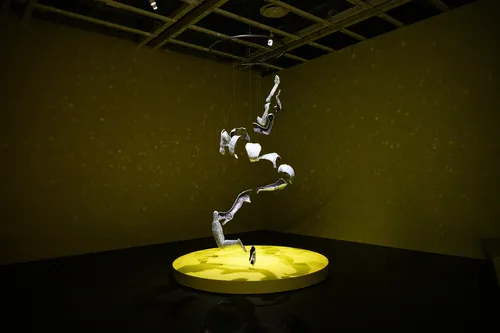
Like a physical embodiment of dopamine bursting through a body, Young Joon Kwak’s sculptural installation Divine Dance of Soft Revolt (Anna, Travis, Me) (2024) celebrates queer joy and resistance. The work consists of casts from the bodies of queer and trans people in Los Angeles, which the artist covered in glitter and mirrored glass. Each resembles the surface of a disco ball, the fragments suspended in the air in a swirling spiral. The reflected light shimmers along the yellow walls, giving the impression of entering a nightclub, a sense heightened by the electronic music Kwak created with collaborator Marvin Astorga. Kwak, whose work was featured in a 2025 solo exhibition “RESISTERHOOD” at New York’s Leslie-Lohman Museum of Art, sees their sculptural work as a kind of performance, imagining the viewer as a participant when they interact with the work.
The installation reflects one of the distinct “moods” the curators intended to create: called moments in which physical spaces can determine how people act or feel. As the only piece in a small room with yellow walls surrounding it, Kwak’s scintillating work marks a shift in energy, one that briefly transports the viewer to a place of queer exuberance.
Raven Halfmoon
B. 1991, Oklahoma City. Lives and works in Norman, Oklahoma.
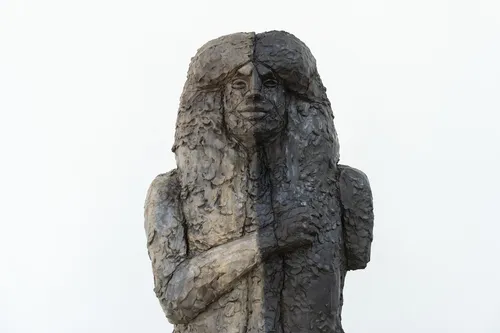
Two large, ceramic sculptures by Indigenous artist Raven Halfmoon are included in this year’s Biennial. One, a black and white figure called Too Ancient to Care (2025–26) stands at nine feet tall in the plaza in front of the museum. But the larger-than-life, hand-built sculpture does more than greet visitors to the show; it claims space for Halfmoon’s Caddo Nation culture, in particular Caddo women, drawing inspiration from the artist’s lived experiences and stories shared across generations. Indeed, ancestral traditions are central to her work; Halfmoon learned how to make coil ceramics from a community elder, but she adds a contemporary twist, marking the surfaces as if adding graffiti as a nod to Caddo tattooing traditions.
Inside the museum, Halfmoon’s work appears again in Sun Twins (2023). Consisting of two figures whose bodies appear fused together—a dual form Halfmoon uses often—the twins illustrate the value of community for the artist. The work also asserts the importance of family and ancestors over an individual outlook. For the last three years, a standout solo show of Halfmoon’s work has been traveling across the country in “Flags of Our Mothers” with the next stop opening at Ballroom Marfa in May.
Emilie Louise Gossiaux
B. 1989, New Orleans. Lives and works in New York.
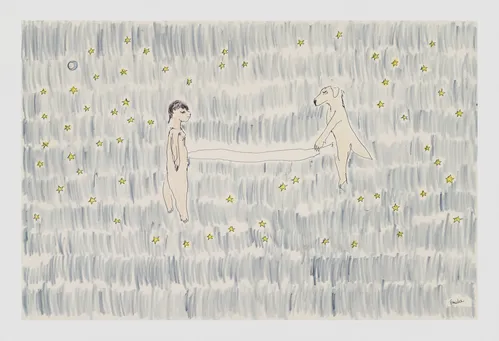
Nothing epitomizes the kinship between species more than the interdependent relationship between a person and their service animal. While love between man and pet is common, service animals become a vital part of how people with disabilities perceive the world, supporting them in ways that those who have not had this bond can never imagine. After losing their sight in an accident in 2010, interdisciplinary artist Emilie Louise Gossiaux began depicting their beloved service dog, a yellow Labrador named London. Gossiaux draws and sculpts portraits of themself and London, at times blurring the lines between the two bodies.
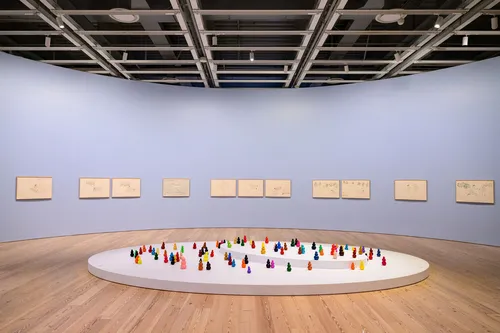
When London’s health began to decline in 2024, Gossiaux started hand-crafting one hundred sculptures of a Kong toy, the dog’s favorite. Filling a vast plinth in the Biennial, the artist imagines that these colorful, bulbous toys will bring eternal happiness to London, who passed away in September 2025. Drawings of the two fill the walls around the plinth, an homage to their relationship, which was so close Gossiaux considers London an equal collaborator in their artwork, according to the Whitney’s description. Gossiaux’s work has been exhibited widely, including in a 2023 solo show at the Queens Museum, and earned them the prestigious Joan Mitchell Fellowship in 2024.
Akira Ikezoe
B. 1979, Kochi, Japan. Lives and works in New York.
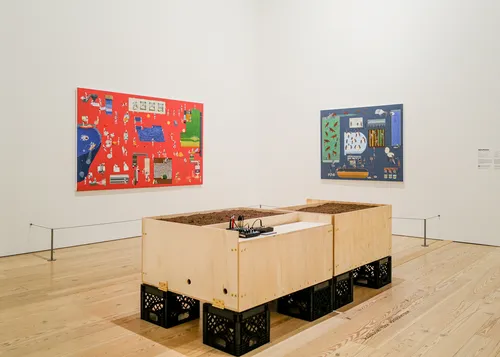
At first glance, Akira Ikezoe’s paintings appear to tell stories. However, in doing so, they suspend logic, depicting circular systems through a fantastical lens. Ikezoe often pairs images associated with energy infrastructure, like power plants and solar panels, with animals at work to imply a connection.
In Frog Stories Around Nuclear Power Plant (2025), for example, exhausted frogs are anthropomorphized, standing on their hind legs as they move through a series of tasks to facilitate the production of pearls. They are seen carrying clams as if part of an assembly line, bringing a mollusk from the water to a conveyor belt to a machine that rips out its valuable prize. Though chronology is implied through each series of tasks shown, the painting contains a circular narrative—the frogs repeating their motions senselessly. Indeed, at one point they are reduced to skeletons that continue their mission of opening the clam, getting electrocuted by a power line along the way. Inexplicably, a frog dressed as Santa Claus appears, a cheeky nod to consumerism.
In quirky and absurd imagery, Ikezoe points to the unseen connections between nature and man and likens the frogs to humans, as if we are also embroiled in a self-damaging, Sisyphean existence. Countless species and resources are needed for our energy and enjoyment, from the grids that power our lives to the gifts exchanged at Christmas. In addition to the Biennial, Ikezoe’s work will be featured in MoMA PS1’s “Greater New York” exhibition opening in April.
Kelly Akashi
B. 1983, Los Angeles. Lives and works in Altadena, California.
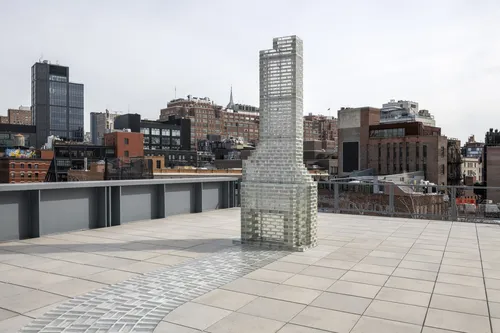
A resident of Altadena, Kelly Akashi is one of thousands of people who were displaced by the devastating 2025 wildfires in Los Angeles. Her home and studio were destroyed, except for a singular brick fireplace and chimney that remained standing even as the rubble surrounding it was cleared. In a meditative reflection on loss, survival, and rebuilding, Akashi used this chimney as inspiration for Monument (Altadena) (2026), a site-specific ghost-like glass installation that stands on the museum’s fifth-floor terrace.
To create the work, Akashi worked with a mason to replicate her chimney and fireplace, along with a pathway that mirrors her home’s own walkway. Nearby, a cut-steel sculpture hangs on a wall, the design inspired by doilies the artist’s grandmother used to own, a memorial to the objects and inheritance small and large that were lost in the fire. Shortly after the fire, Akashi had a solo show at Lisson Gallery in Los Angeles that consisted of pieces that were salvaged, safe off-site, or reworked quickly before the exhibition. Working steadily to rebuild her home and studio, Akashi’s participation in the Biennial is a marker of resilience and a reminder of the forces that unite us—from the power of community to the realities of natural disasters.
Aziz Hazara
B. 1992, Wardak, Afghanistan. Lives and works in Berlin.
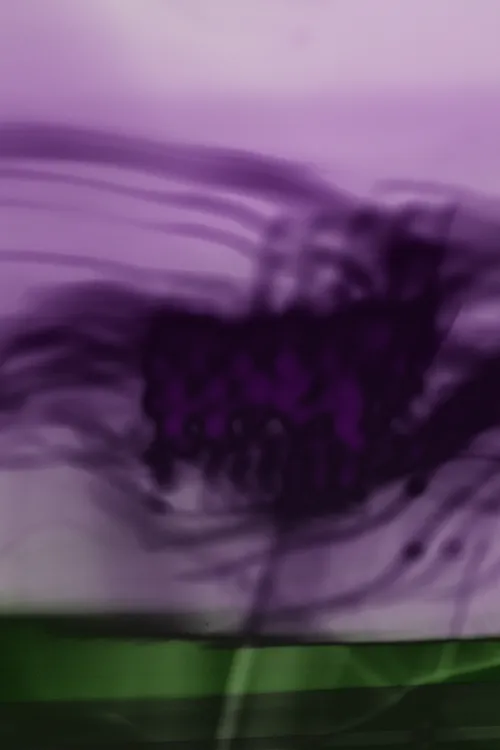
In another example of the curators creating a “mood” for the show, Aziz Hazara’s otherworldly green and purple, ethereal archival pigment prints are set against a wall covered in dark NATO thermal blankets. The dark setting is a poignant backdrop for Hazara’s powerful work. Hazara was born in Wardak, a highly contested area in the U.S. war in Afghanistan that held American military bases and saw intense fighting. In his work, Hazara considers power relations and the physical, unintended repercussions of geopolitical actions. When forces withdrew from Afghanistan, they left behind many discarded objects, like night-vision goggles, which often retained the information captured by soldiers. This data and the items themselves were each sold in Afghanistan, creating a market for surveillance equipment as well as information. Using this biometric data and retinal scans, Hazara creates images that, as their title Moon Sightings (2024) suggests, resemble otherworldly spaces.
At times, Hazara’s compositions appear haunted, evoking the energy of war-torn places after troops leave. In the context of the Biennial, Hazara’s work expands the notion of American art to include occupied territories and underscores the influence the U.S. has globally, in particular as a military force, as well as what is left behind in the wake of war. Hazara’s work has been exhibited widely, including in the 2025 Sharjah Biennial and the 2026 Diriyah Biennale.
Nour Mobarak
B. 1985, Cairo. Lives and works in Athens, Greece; and Bainbridge Island, Washington.
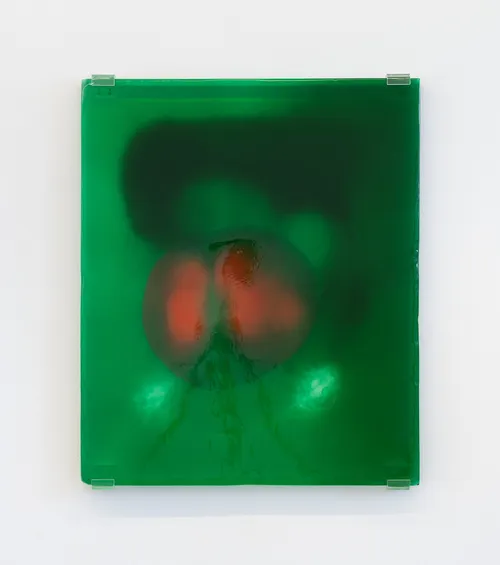
Nour Mobarak’s wall pieces use by far the most unconventional materials in the Biennial: breast milk, dehydrated blood, semen, and mycelium, for example. These casts of the artist’s own body resemble colorful, abstract compositions, the contours of her buttocks, breasts, and pregnant belly protruding playfully from the surfaces. Their shiny surfaces reflect the room and visitors in a distorted way, a dizzying perspective that reminds us how little control we have over biological processes.
An audio piece accompanying her resin works—entitled Broad’s Cast (Montage) (2024–26)—also pushes conventions. The work was produced by inserting a microphone into her vaginal canal before, during, and following her pregnancy. Recording the outside world from within, the strange sounds appear supernatural despite their very human nature. Yet, while revealing the awkwardness and messiness inherent in the human experience, Mobarak’s works remain enticing, even beautiful. New Yorkers may be familiar with Mobarak’s work following her first solo show in the city at MoMA in 2024–25.
Jasmin Sian
B. 1969, the Philippines. Lives and works in New York.
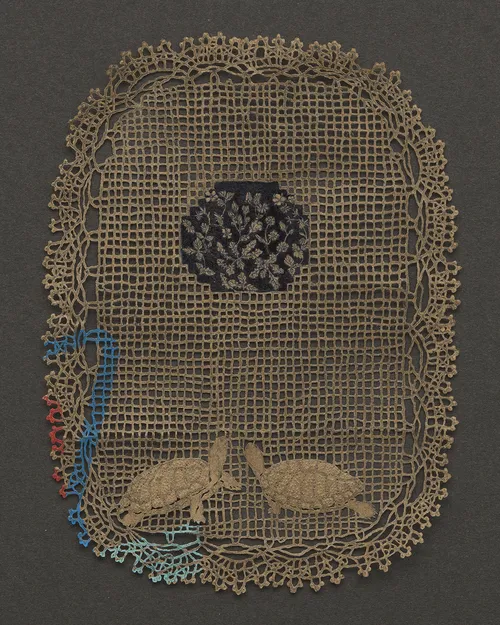
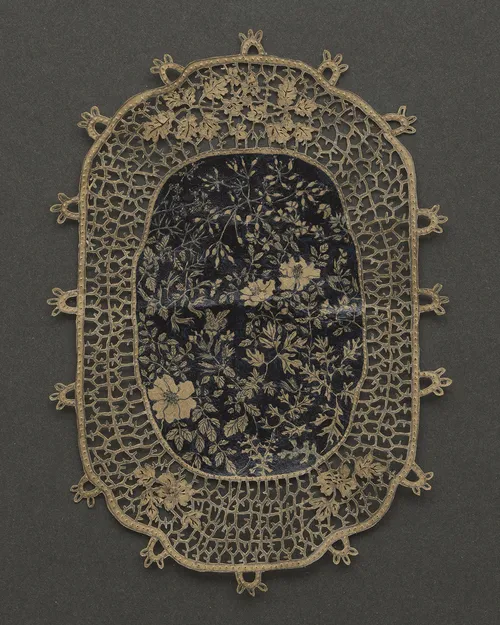
Small and delicate, Jasmin Sian’s lace-like paper artworks resemble doilies darkened over time, yet the wall text reveals that they are made of found materials. Specifically, she uses trash like fast-food bags and the wrapper from a biscuit, painting over them with minute, dense details. These plants and animals, painted in small scale, demand a closer look. (In the Biennial, the curators paired Sian’s work with monumental, mixed-media paintings by Teresa Baker that capture the way each plays with scale.)
Surrounding these intricate scenes are the lace-like borders that Sian has painstakingly cut with an X-Acto knife. Turning trash into meticulously crafted objects, Sian’s works serve as intimate odes to the natural world. The artist has been creating similar works for decades, earning a Joan Mitchell grant in 1998. In recent years, her work has gained commercial traction with successful art fair presentations, including a solo booth with Anthony Meier Gallery at the Art Dealers Association of America’s 2023 Art Show.
