


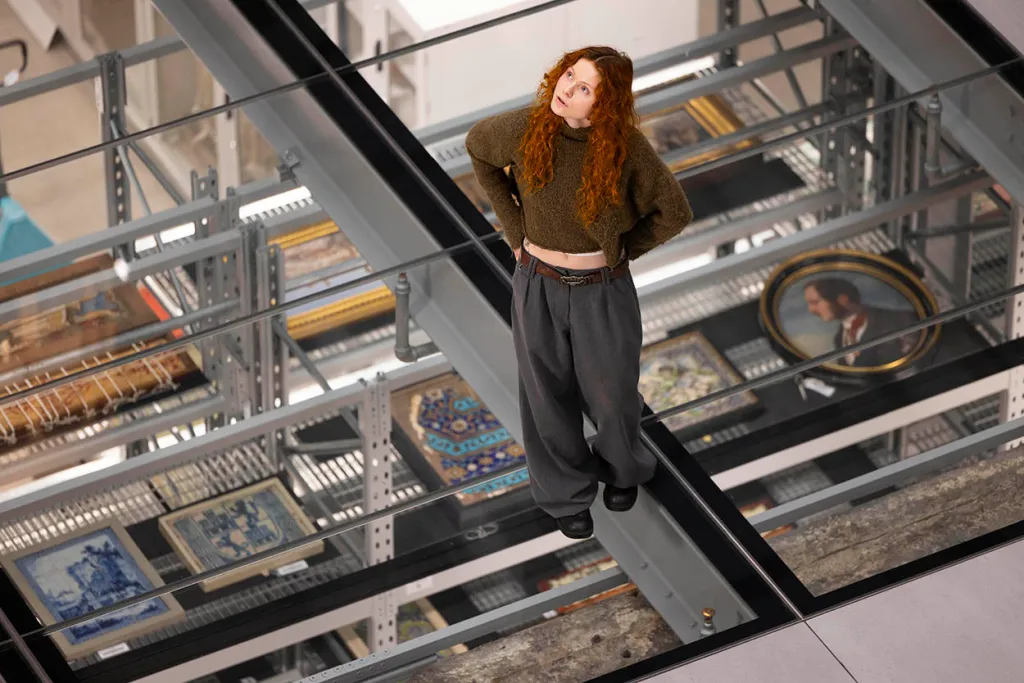
It is a symptom of museums’ perpetually acquisitive nature that a majority of global museum collections—up to 95 percent, according to some estimates—remains in storage. A number of high-profile institutions are addressing this surplus by providing public views into their storage facilities: While “visible storage” has been around since the 80s, projects like The Depot of Museum Boijmans Van Beuningen in Rotterdam (opened in 2021) and V&A East Storehouse in London (opened last year) promise a more spectacular and interactive experience, one that begins to blur the lines between storage and display. Often housed in costly, starchitect-designed facilities, these new institutional formations are the subject of a new anthology, Keeping Culture: The Architecture of Storage. Published by Valiz, it features contributions from architects, critics, and historians, many of whom are skeptical of the possibility that storage can be displayed and still be considered storage, or if its fundamental nature is as something kept in reserve.
Edited by architecture scholars Susan Holden and Ashley Paine, Keeping Culture offers a critical analysis of storage through an array of contemporary case studies ranging from Japan to Flanders. In focusing on architecture, the book emphasizes how buildings can structure relationships between the public, museum employees, and collections. V&A East, for example, brings visitors directly into the center of the building, where aestheticized crates and pallets expose both objects and the ways they are contained, transported, and cared for.
A lengthy introductory chapter by the editors lays out some of the assumptions around storage, including that storage facilities present a neutral encounter with objects, freed from the authoritative voice of the museum. Absent what Walter Benjamin termed the “mild boredom of order,” the ostensible “disorder” of storage might provide a more authentic experience—a type of unmediated encounter underscored by frequently used terms like “visibility,” “transparency,” and the “democratization” of collections (as in the book’s interview with Tim Reeve, the deputy director of the V&A).

Mesh roll-out storage racking at V&A East Storehouse.
Photo Hufton +Crow/V&A
But putting storage on display in the name of democratizing culture assumes objects’ accessibility is only about space and physical access, and that curatorial interpretation is a screen rather than a bridge to the thing itself. The things museums collect are often obstinate and unyielding; research and context can be a way of coaxing them to speak.
When storage itself is put on display, of course, the museum is still speaking, declaring both the wealth of its holdings and its generosity in sharing them. Several of the anthology’s authors question these open storage concepts, wondering if they offer merely the museum in another guise. British writer and former Design Museum director Deyan Sudjic acerbically calls The Depot “highly performative” in a way that “risks feeling manipulative.” The stakes of this performance are high as museums face increasing criticism about whether they should have quite so many things, especially things acquired in the wake of colonial violence.
Most problematic is the storage of human remains, as the Indigenous Australian architect Carroll Go-Sam addresses in her essay. Go-Sam outlines Australia’s attempt to create a home for Indigenous cultural materials and a National Resting Place for unprovenanced and low-provenanced ancestral remains, foregrounding the complexity of relying on architecture to reconcile past harms.
View of the Weston Collections Hall at V&A East Storehouse.
Photo Kemka Ajoku/V&A
Collecting is often a function of loss, an attempt to save something that might otherwise disappear, as the volume’s final essay poignantly articulates. The Spanish architect Marina Otero Verzier highlights efforts to preserve the entire island nation of Tuvalu as a series of digital bits. As rising sea levels endanger its existence, Tuvalu, an archipelago between Hawaii and Australia, has endeavored to become “the first digital nation” by “recreating its land, archiving its culture, and digitizing its government.” Housed in remote data centers whose energy-intensive maintenance perpetuates the changing environmental conditions that threaten Tuvalu’s existence, the attempt to redeposit territory digitally drives home the paradoxes, and costs, of storage. When cultural critic Susan Stewart called Noah’s ark the archetypal collection, she was writing about preservation and the future potential of collections. But given the example of Tuvalu, I’m left thinking about the flood, and all that is washed away in exchange for what we keep.
