


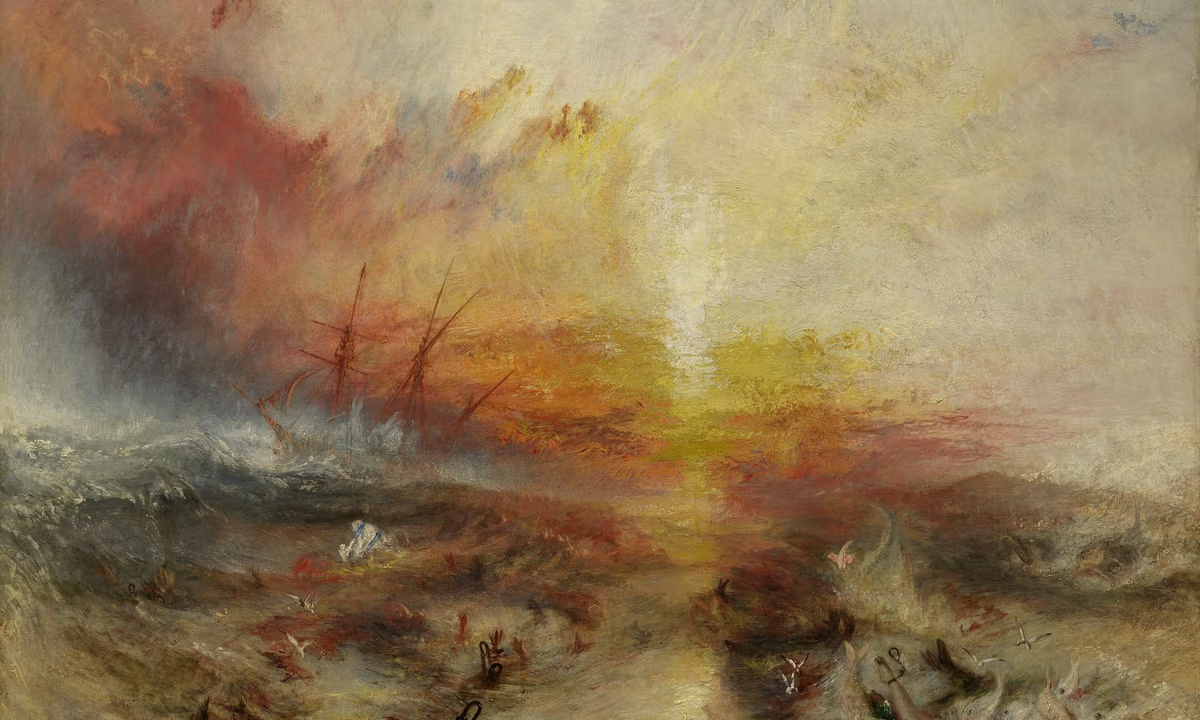
During the last four decades Sam Smiles has made an invaluable contribution to the literature on one of Britain’s great landscape painters, J.M.W. Turner (1775-1851). Yet his most significant text—in terms of the impact on our perception of the artist—is likely to be the article he published in 2007, revealing for the first time Turner’s involvement in a speculative scheme in Jamaica. Research into British families with a stake in the inhuman commerce of slavery indicated that in 1805, just when the abolition cause was gaining ground, Turner had invested in a “dry sugar work pen”, a type of property that centred primarily on raising livestock. The money he added to this collective endeavour helped pay off the mortgage on the plot and bought enslaved Africans to rear the cattle.
Smiles’s article charted the rickety venture’s ensuing failure to generate the anticipated profits. He then considered whether it was possible to reconcile this new information with our understanding of Turner’s celebrated painting Slavers Throwing Overboard the Dead and Dying – Typhoon Coming On (1840, Museum of Fine Arts, Boston). After its time in the collection of John Ruskin, it subsequently assumed the status of a sermon in paint, championed as a defiant stance against the objectionable practices of the slave trade in its unique depiction of jettison during the Middle Passage. Perhaps it was the potency of this reading of the picture that prevented Smiles’s article generating public outrage. It was, nonetheless, the seed for a haunting sequence in Mike Leigh’s biopic Mr. Turner (2014), and Winsome Pinnock’s powerful play Rockets and Blue Lights (premiered in 2018 at the Royal Exchange, Manchester, and revivedin 2021 at the National Theatre, London), in which she—and the character of Turner—wrestle with the idea that The Slave Ship (as the painting is now widely known) constitutes an attempt at displacing or repurposing guilt.
Smiles’s new book is a much fuller exploration of these key elements of Turner’s life and art, unpacking the rich hinterland in which he lived and worked through meticulous archival research and vivid first-hand contemporary accounts. A chapter on the Jamaican investment adds greater detail and, to counter the inevitably one-sided presentation of this discussion, Smiles manages to resuscitate from the blunt and sketchy surviving records one of the enslaved Africans, called “Grey”, working on the estate. But the subsequent chapter follows the money back from Turner himself to his wealthy patrons and collectors, some of whom were passionate opponents of abolition, such as the notorious John “Mad Jack” Fuller, MP for Sussex.
The pervasive links to slavery, of course, go back to the start of Turner’s career. His first excursion as a teenager was to the deeply embroiled city of Bristol, and his first essays in painting country houses were focused on mansions built with money generated from exploitation on Caribbean plantations. And in the shift from the landed gentry, who supported Turner’s early career, to the northern English industrialists, the funds paying for his pictures were further tainted through connections with North American cotton production. Smiles, here, is unable to detect anything in Turner’s work that especially attracted these types of clients. Moreover, many of the painter’s most successful peers at the Royal Academy were also sought by the same collectors, whether for aesthetic or commercial reasons.
Moving steadily towards an extended discussion of The Slave Ship itself, two further chapters survey contemporary representations of slavery and the likely influences on Turner’s awareness of the campaign for abolition and emancipation, for which Smiles builds on a now extensive body of research that encompasses, most notably, Sarah Thomas’s compelling Witnessing Slavery: Art and Travel in the Age of Abolition (Paul Mellon Centre, 2019).
The painting’s inspiration
Since 1959, The Slave Ship, almost without exception, has been interpreted as a representation of the infamous case of the Zong (or Zorg) massacre of 1781, during which as many as 132 of 442 enslaved Africans were thrown overboard by the British crew when the water rations were running short towards the end of its transatlantic voyage. A new account of the ensuing court case by Siddharth Kara, The Zorg (Doubleday, 2025), repeats this idea and as recently as 2021 Smiles himself supported the Zong theory in the Turner’s Modern World exhibition catalogue (Tate Britain and the Museum of Fine Arts, Boston).
In the present book, however, Smiles overturns the accepted idea that Turner was looking back to an incident almost 60 years earlier, instead persuasively arguing that the appalling practice by slave traders of jettisoning humans into the sea was an outrage of pressing concern in the years before the painting was exhibited, and therefore constitutes an act of contemporary artistic reportage—albeit one inevitably sublimated to Turner’s distinctive aesthetic characteristics. Smiles sets out and tests this proposal with an impressive close reading of the details in the picture, amplified by potential influences and resonances. However, it should be noted that this is not a completely new theory; in fact, the fundamental point had been made, using many of the same sources, by the late John McCoubrey in 1998, and it is curious that Smiles only cites this earlier article when he is refining its content.
Nevertheless, the scale of Turner and the Slave Trade permits Smiles to speculate on and open out the artist’s possible motives for painting The Slave Ship, ultimately challenging readers to evaluate for themselves how to assess Turner’s conflicted position both in his times, and our own.
Sam Smiles, Turner and the Slave Trade, Paul Mellon Centre, 224pp, 90 col. illust., £30 (hb), published 25 November 2025
• Ian Warrell is a leading expert on the life and art of J.M.W. Turner
