


Last March, when the Trump administration issued an executive order to “restore truth and sanity to American history,” the Smithsonian American Art Museum (SAAM) quickly became a target. Then, in August, the administration announced a comprehensive audit of all the Smithsonian’s exhibitions, didactics, and collections. Based on the executive order’s condemnation of any discussion of racism, sexism, and oppression as revisionist history, the audit promised to “celebrate American exceptionalism, remove divisive or partisan narratives, and restore confidence in our shared cultural institutions.” The announcement sent shockwaves through the museum world, seeming to signal the dismantling of free speech, especially within government-funded arts institutions.
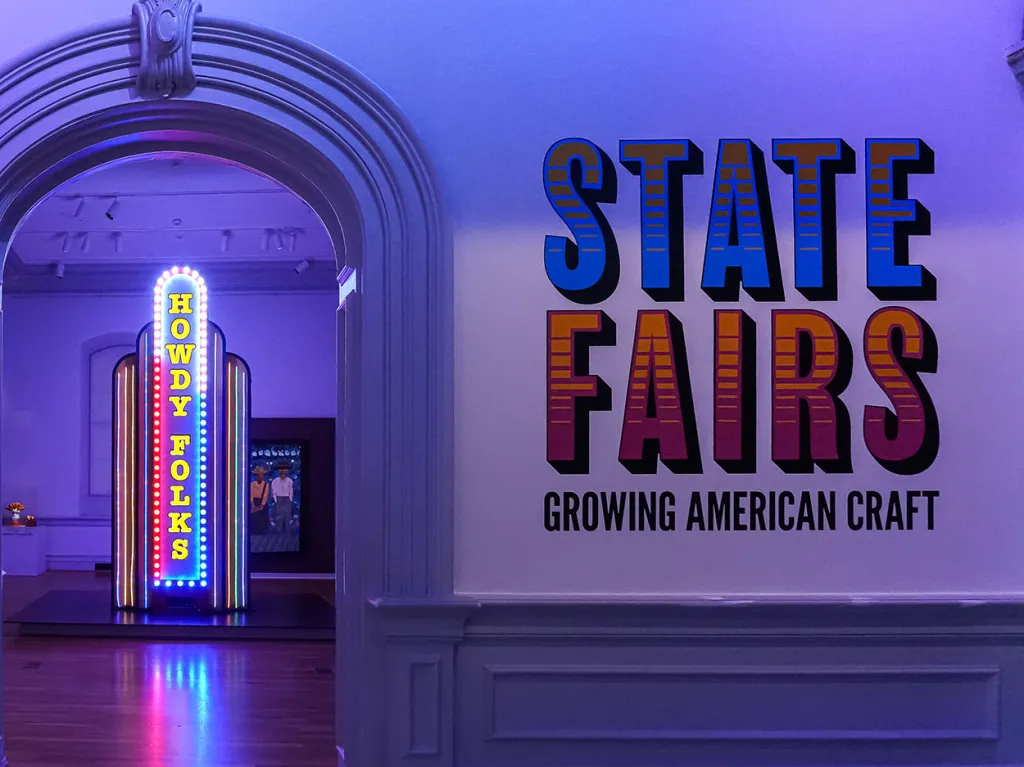
“State Fairs: Growing American Craft” is the first exhibition to open at SAAM’s Renwick Gallery since the audit announcement. The exhibition brings together over 250 works from across the United States, spanning the 19th century to the present, to argue for regional state and tribal fairs as essential sites for the development of American craft. Situated directly across the street from the White House, “State Fairs” beckons D.C. tourists and art enthusiasts alike.
View of the 20205 exhibition “State Fairs: Growing American Craft” at the Renwick Gallery of the Smithsonian American Art Museum in Washington, D.C.
Visitors are greeted at the Renwick’s entrance by a 12-foot pair of hand-painted Lucchese boots—US size 96, to be exact—worn by “Big Tex,” the world’s tallest cowboy. In the opening gallery, a Deco-style parade float reading “Howdy Folks” flashes in red, white, and blue. Throughout the show, spectacle abounds: The halls of the Renwick are decked in tricolor banners. A life-size butter sculpture of a cow is displayed in a custom-built refrigerated vitrine.
Which is to say that from the get-go, the exhibition immerses visitors in state fairs’ indulgent pleasures. Smorgasbord, a 2024 necklace by Morgan Hill, accumulates tiny resin candies, cigarettes, fruit, and chicken bones into a bouquet of hedonistic consumables. Ceramics by Kelly Bohnenkamp and Betty Spindler masterfully transform corndogs and hotdogs into gleaming monuments to fairs’ culinary delights. A wool tapestry by Linda Nez from the Northern Navajo Nation Fair presents fairgoers in Diné clothing riding roller coasters and queuing up for cotton candy.
It’s not all fun and games, though: The label for a Kentucky-prize-winning hooked rug by Kaye D. Miller describes her father’s PTSD, the result of witnessing the bombing of Pearl Harbor, as the impetus for the rug’s creation. The work’s pastoral imagery emerges as a healing mechanism as well as a personal response to one horror of American history. Peggie Hartwell’s quilted tribute to her grandparents, South Carolina sharecroppers, evokes histories of racialized exploitation—but it’s also a triumphant example of quilting’s role in sustaining Black communities over generations.
“State Fairs” is no simplistic celebration of a monolithic American culture. Couched in pageantry and kitsch, the exhibition presents two serious, powerful arguments. The first is that regional craft has always been central to the development of American art. The second is that American cultural pride cannot be neatly separated from—and in fact literally grows out of—histories of oppression and exclusion. It’s a brave rebuke to August’s executive order, harnessing the aesthetics of American nationalism as a means to critique it.

Seed art by Liz Schreiber: State Fairs: Growing American Craft, 2024–25.
Courtesy Liz Schreiber
Several galleries explore state fairs as training grounds for American craft practitioners, revealing that now-famous studio artists like Peter Voulkos, Consuelo Jimenez-Underwood, and Katherine Po-yu Choy all exhibited early work at state fairs. State fairs have even launched entirely new media: One of the show’s galleries is devoted to crop art, or seed mosaics—a technique born in the 1960s at the Minnesota State Fair.
Fairs also became sites for experimental approaches to ancestral craft traditions: A basket by Lee Sipe made of pine needles—a South Carolina regional tradition—borrows its form from South Korean pottery. A stunning tapestry of a potato plant, made by Robbie LaFleur for the Minnesota State Fair, adapts Norse mythological iconography and Norwegian textile techniques. Hispanic colcha stitching, Cochiti pottery, and Gullah-Geechee sweetgrass braiding are just some of the Indigenous and immigrant craft practices shown at state fairs and adapted to localized materials as markers of regional pride.
On the exhibition’s first floor, wall labels generally eschew explicit talk of “politics,” allowing the works to speak for themselves. And speak they do: One quilt was made by women from the Battered Offenders Self-Help group at the Kentucky Correctional Institute, who convened at the fair to share stories of domestic abuse; and a crop art plaque Annie Wells made to celebrate her marriage reads, “Celebrate Trans Love and Joy.” To properly revel in the beauty of regional craft, these galleries quietly argue, is to acknowledge the interconnectedness of immigrant, Indigenous, feminist, and queer artistic traditions.
Linda Paulsen: Dolly Parton, 2007.
Courtesy Linda Paulsen and John Colton
State fairs have also been exclusionary. In 1878, one wall label informs, Black farmers began organizing their own fair to protest the South Carolina State Fair’s discrepant prize earnings for white and Black entrants. The show’s politics are honed most directly on the gallery’s second floor, which asks in a wall text: Who is the American Farmer? Syd Carpenter’s installation portraying Black farmers in the American Southeast joins Margarita Cabrera’s life-size tractor model enveloped by the foliage and fauna characteristic of Mexican tree of life sculptures. The pair quietly underscore how American agriculture was built upon—and continues to rely on—Indigenous land seizure, slavery, and the exploitation of migrant communities.
Amidst the visual sumptuousness of “State Fair,” an air of melancholy persists. In the main ballroom, an installation of monumental piñata-inspired cornhusks, constructed from glittering streamers, shimmers and glows in a large yet eerily underpopulated room. The work, by Justin Favela, is an ode to corn’s place as a staple of Indigenous North American cuisines, and of the American agricultural economy. But the installation reads as sinister more than celebratory—if it’s a party, where are all the people? The question feels chilling: Amid the current federal takeover of Washington, D.C., just outside the gallery, the city’s Latine residents are being kidnapped off the streets.
