


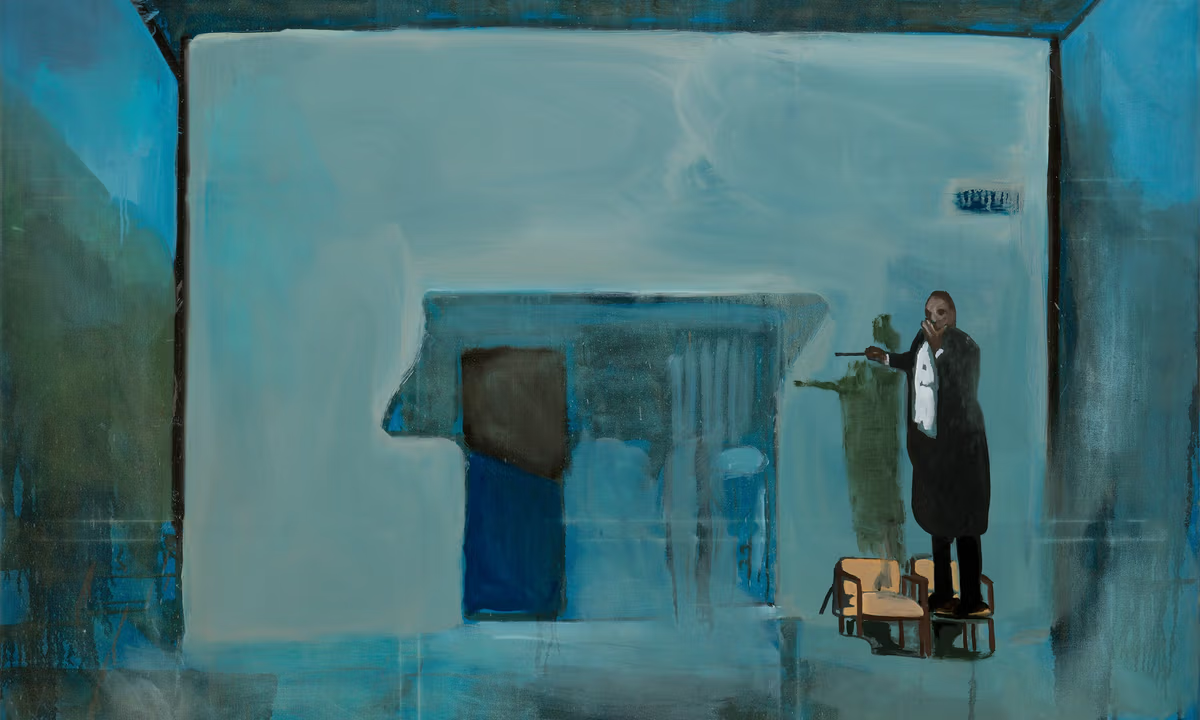
When the touring Noah Davis (1983-2015) survey first opened at Das Minsk, in Potsdam, in September 2024, critics hailed the late American painter as “an artist of our time” for his ability to balance social relevance with artistic independence. The exhibition comprised 60 works, a fraction of the 400 he made in total. They showed Davis to be a gifted colourist, a nimble storyteller, and an artist wielding erudite art history and keen political nous with equal dexterity. Mostly, they were paintings viewers and curators alike wanted to see more of.
As the exhibition heads to the final of its four stops, at the Philadelphia Art Museum, what is most surprising is that it is still racking up firsts. In Germany it was billed as the artist’s first European retrospective and at the Barbican, in February, as his UK debut. At the Hammer Museum in Los Angeles in June, it was his first on the West Coast, where he was living at the time of his death, and now it is his first on the East Coast, where he had studied. As the curator Eleanor Nairne points out, at the time of his death from cancer, aged 32, Davis had not had a museum retrospective at all and only two commercial gallery shows. These had garnered incredible popularity by word of mouth. The tour, to her mind, has replicated that on an international scale.
The survey of Noah Davis’s work has already visited Das Minsk in Potsdam, the Barbican in London and Los Angeles’s Hammer Museum Ed Templeton
That art market momentum is building around Davis’s work is clear. Last November, his 2008 painting The Casting Call sold for $2m at Sotheby’s in New York, doubling the presale low estimate and beating his auction record by 33%.
But the work has its own, internal momentum too. Davis is “very good at ‘show, don’t tell’,” Nairne says. “These are not didactic paintings. They don’t have singular meanings or stories or morals that they’re trying to impart on us. They’re very open, porous, multivalent works, and that makes for a really rich encounter for a visitor.”
Founded his own museum
Delve into Davis’s story and his magnetism also becomes quickly apparent. He was born in a largely white community in Seattle in 1983, his father the high-flying lawyer who represented the tennis players Venus and Serena Williams. Davis excelled as a youngster, dropping out of formal art education at the Cooper Union School of Art in 2004, to instead forge his own path, and, by 2012, had founded his own museum.
Davis and his wife Karon set up the Underground Museum, in Arlington Heights, Los Angeles, as a lending library, an ambitious exhibition space, a concert venue and a cinema. Karon would later describe their goal as offering the community “refuge, education, sharing, relaxation and peace”. It was, Nairne says, “a mad endeavour”. She adds: “How many people have the energy and determination to do that, especially when you think he didn’t own the building he was doing this in.”
Davis was civically minded. The exhibition catalogue highlights what was the overarching goal of his practice. In alighting on slice-of-life scenes, he sought, as he put it, to “take these anonymous moments” of Black life—the simple, the every day, the non-performative, the elusive—“and make them permanent”. He emphatically wanted just being, to be enough.
• Noah Davis, Philadelphia Art Museum, 24 January-26 April
